verification
Documentation and Batch Traceability: Minimum Record Sets for Peptide Material
What to record for received batches and for every solution prepared from them. Field-by-field record sets, label content, excursion logging and a receiving-to-first-use procedure.
For received material, record: supplier reference, batch or lot, the sequence as ordered and as stated on the certificate, molecular weight, net peptide content, purity with its method conditions, counterion, date received, storage location and condition. For every solution prepared from it: parent batch, solvent and proportion, nominal concentration, whether corrected for net peptide content and by what figure, volume, container type, date and operator, aliquot count and location. One principle produces both lists — a result is only as interpretable as the record of what produced it, and the commonest cause of an uninterpretable dataset is not a failed experiment but an incomplete material record.
Why the record limits the result
An experiment produces two things: data, and an account of the material that produced it. The second is treated as clerical and is usually the one that fails — quietly, because an incomplete record stops nothing. The vial opens, the solid dissolves, the instrument returns numbers.
The consequence arrives later, when a result is unexpected and the first question is what the material was. If the record cannot answer that, the result cannot be interpreted, defended or repeated. Failed chemistry is visible and gets repeated; a missing batch reference is invisible until needed, and cannot be reconstructed then.
The point bears hardest on synthetic peptides, where identity, content and purity are supplier-stated rather than measured on receipt. Discrepancies between labelled and actual composition are documented in material examined by controlling agencies 1. Only a record of what was stated, and when, makes such a discrepancy detectable afterwards.
Minimum record set: received material
Created once, on receipt. Every solution and result downstream refers back to it.
| Field | Source | Why it matters |
|---|---|---|
| Supplier reference | Order confirmation, delivery note | Route back to the originating transaction once packaging is gone |
| Batch or lot | Vial label, certificate | The unit of identity. Results attach to one batch |
| Sequence as ordered | Your order record | Half of a comparison nobody performs; recorded before the certificate is read |
| Sequence as stated | Certificate | The other half. Compare residue by residue, including terminal modifications |
| Molecular weight | Certificate | Every molar calculation rests on it. Free peptide or salt |
| Net peptide content | Certificate | Peptide fraction of the weighed solid. Without it, mass overstates |
| Purity, with method conditions | Certificate | Detached from column, gradient, wavelength and run time, it compares with nothing |
| Counterion | Certificate | Part of the weighed mass; not constant between batches |
| Date received | Delivery record | Start of holding time; anchor for later interval questions |
| Storage location and condition | Your own log | Position-level location. Condition as applied, not as stated |
Counterion earns its own line. Trifluoroacetate is the one most often carried through from reversed-phase purification, it forms part of the mass on the balance, and exchanging it is a deliberate procedure with its own conditions 2. A record omitting it cannot distinguish an exchanged batch from an untreated one.
Minimum record set: prepared solutions
A prepared solution is a new material with its own identity, and needs its own record pointing back to its parent batch. The commonest failure is a concentration stated with no indication of how it was reached.
| Field | Recorded as | Why it matters |
|---|---|---|
| Parent batch | Identifier from the received-material record | Without it the solution is an orphan; no certificate value applies |
| Solvent and proportion | Solvent, and proportion by volume for mixtures | Sets solubility, chemical environment, and what it may be diluted into |
| Nominal concentration | The figure the solution is treated as having | Calculated, not measured. Everything downstream uses it |
| Correction for net peptide content | Applied or not, and the figure used | A fixed proportional offset, recoverable only if recorded |
| Volume prepared | Total volume made | Reconciles against aliquot count, exposing arithmetic errors early |
| Container type | Material and format of the vessel | Adsorption is vessel-dependent and removes dilute peptide from solution |
| Date and operator | Date prepared and by whom | Fixes age; identifies who can answer a question about it |
| Aliquot count and location | Number, volume of each, position-level location | Makes the stock auditable without opening a freezer |
Container type is there for a substantive reason. Peptides adsorb to vessel surfaces to an extent depending on the container material and the peptide, and the loss is largest in dilute solution 4. A low recovery is interpretable if the vessel is recorded and uninterpretable if not: the same result fits adsorption, a calculation error and degradation equally.
Recording assumptions as assumptions
This is the most useful habit in material record-keeping and the one most often skipped. Where a value needed for a calculation was not supplied and a figure was assumed in order to proceed, record the assumption as an assumption — flagged, with the figure used and why.
The reason is the difference between a wrong number and an untraceable one. A stated concentration silently resting on an unverified net peptide content figure is not merely uncertain; it is unreconstructable. Nobody reading later can tell whether it was corrected or by what. It cannot be fixed, only discarded, and everything computed from it goes too.
The same number recorded as "assumed net peptide content 80 per cent, not stated on certificate" is provisional but repairable: if the true figure arrives, every concentration from that stock is corrected by one proportional factor and every result recomputed. Apply the habit to every unsupplied value — an assumed molecular weight where the salt form was unspecified, an assumed counterion, an assumed purity. Mark assumed values distinctly from stated ones, and never let one travel downstream without its flag.
Labelling that survives its environment
A label must survive conditions chosen for the material, not for the label. Adhesives lose grip at freezer temperature and labels detach inside boxes. Many inks dissolve on solvent contact. Condensation forming as a tube thaws runs water-soluble ink into a smear. Each produces a tube that exists but cannot be identified — the same, in effect, as material never recorded.
| Element | Content | Purpose |
|---|---|---|
| Unique identifier | Short code resolving to the full record | The only load-bearing element; the rest is expendable |
| Short identity | Abbreviated name or internal code, never the sequence | Picks the right tube without consulting the record |
| Concentration and solvent | Nominal figure and solvent, abbreviated | Prevents the commonest error: the wrong assumed concentration |
| Date prepared | One unambiguous format, applied consistently | Makes age visible at the point of use |
| Operator | Initials | Identifies who to ask when something is unexpected |
| Storage condition | Intended holding condition | Lets a misplaced tube be returned correctly |
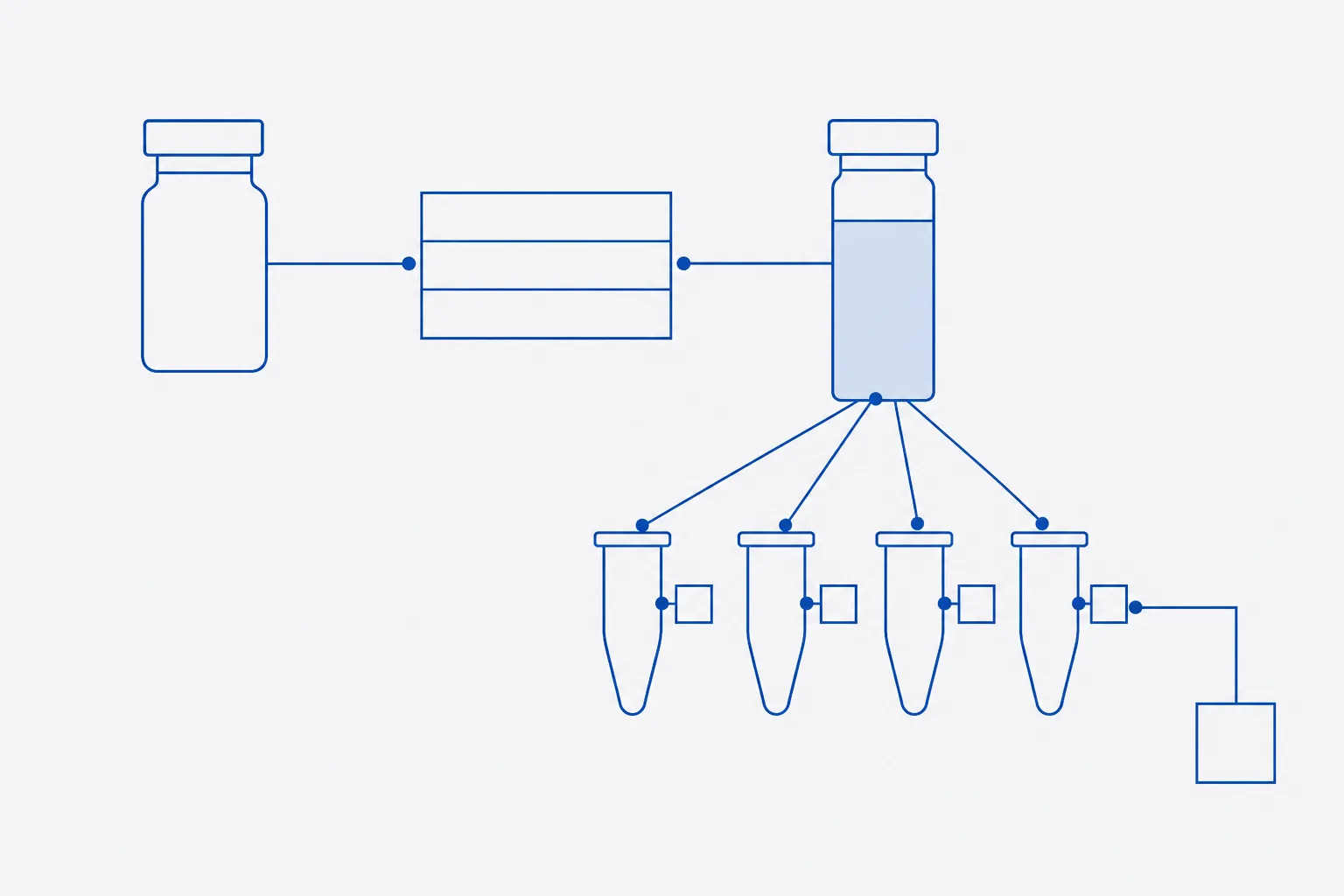
The design rule follows: carry a unique identifier resolving to the full record, rather than attempting to carry the record itself. Crowded labels fail worse than sparse ones, and a code cannot fall out of step with the record the way a transcribed value can. Practically: use label stock and marking rated for the holding temperature; label before freezing rather than onto cold surfaces; label the tube body as well as the cap, since caps get swapped; and check labels on retrieval, because damage accumulates unseen in storage.
Chain of custody, moves and excursions
Chain of custody means the record can state where material has been across the whole interval between receipt and disposal. Two events break it routinely: moves between storage units, and equipment failure.
For a move, record source location, destination, date, operator, and the interval spent outside controlled storage. Moves happen in bulk and under time pressure, and are where location records go stale. A wrong location is worse than none: it turns a search into a search in the wrong place.
For a temperature excursion — unit failure, power interruption, a door left open, an alarm of unknown duration — record when it was discovered and when the unit was last known to be within band; the unit, and every batch and aliquot held in it; the peak temperature, if a logger reports one; the duration outside band, stated as an estimate; the physical state the material was found in, including whether frozen solutions had thawed and whether condensation was present on solid material; and the action taken.
Record before judging. The temptation is to decide on the spot whether material is usable and log only that conclusion, but thermal history is cumulative and its effect depends on formulation, physical state and the presence of water 3. A recorded excursion lets the judgement be revisited when later results look odd; an unrecorded one leaves an anomaly with no candidate cause. Attach the note to every batch and aliquot in the unit: a note filed against a freezer is invisible to anyone reading a single tube's record.
Certificate retention and the disposal record
Retain the certificate as a file held against the batch record, not as an attachment in correspondence, and record its analysis date beside it — the certificate describes the material at the point of analysis, and every statement ages from there. Retain it as long as any data derived from that batch is retained, normally far longer than the material lasts. Where a batch is re-analysed, keep both documents and record which applies from when.
The disposal record closes the chain, and its absence is a worse gap than it looks: a batch record with no ending cannot tell a reader whether the material still exists, was used up, or was discarded and why. Record the batch, quantity, date, operator, route of disposal, and — the field carrying the information — the reason. "Exhausted", "held beyond intended interval" and "discarded following a temperature excursion" are three different histories, and the last two bear on data generated beforehand.
Receiving to first use: procedure
- Record the date received and the condition of the outer packaging before opening it.
- Open the packaging, retain all documentation supplied, and record the batch or lot reference from the vial label.
- Compare the vial label against the delivery documentation and the certificate. Record any mismatch as a mismatch.
- Compare the certificate sequence against the sequence as ordered, residue by residue, including terminal modifications. Record both and record the comparison.
- Transcribe the certificate values: molecular weight and the form it refers to, net peptide content, purity with method conditions, counterion, analysis date.
- For every value the certificate omits, record the omission, then record any figure assumed in its place, flagged with its reason.
- Assign the batch its unique identifier and label each vial received with it.
- Place the material into storage and record the location to position level — unit, shelf, box, slot.
- At first use, open a new record referencing the parent batch: solvent and proportion, nominal concentration, whether corrected for net peptide content and by what figure, volume, container type, date, operator.
- Aliquot, label each aliquot with an identifier resolving to that record, and log aliquot count, volume and locations.
- Record each withdrawal, and close the record with a disposal entry when the last aliquot is gone.
The procedure costs minutes and pays out at the only moment that matters — when a result is questioned. Everything in it exists so a reader who was not present can determine what material produced a given number, what was known, what was assumed, and what became of it.
References
- Analysis of illegal peptide biopharmaceuticals frequently encountered by controlling agencies
- Optimization of the hydrochloric acid concentration used for trifluoroacetate removal from synthetic peptides
- Stability of protein pharmaceuticals: an update
- The importance of using the optimal plasticware and glassware in studies involving peptides