transport standards
Dry Ice as a Dangerous Good: UN1845, Venting and the Declaration
Why a refrigerant is regulated at all, how its status changes between air, road and post, the marks and air waybill entries that go with it, when a Shipper's Declaration is and is not needed, and how to plan the quantity from a measured loss rate.
Dry ice is carbon dioxide, solid, UN1845. By air it is a Class 9 dangerous good packed under Packing Instruction 954: the package must vent, must be marked “UN1845”, “Dry ice” or “Carbon dioxide, solid” and the net mass in kilograms, must carry a Class 9 hazard label, and the air waybill must repeat those particulars; up to 200 kg is permitted per package, and a Shipper's Declaration is not required when dry ice is the only dangerous good or cools a UN3373 package 12. By road under ADR it is not subject to the regulations except the coolant provisions of 5.5.3, which address asphyxiation 4. In the UK inland post it is prohibited as a coolant 6.
This page covers the regulation and the paperwork. Whether a given consignment should travel on dry ice at all is a separate decision about the material and its stability, and it is not addressed here.
Why a refrigerant is regulated
Dry ice sublimes at −78.5 °C at atmospheric pressure, passing from solid to gas without a liquid phase. One kilogram yields roughly 0.55 m³ of gas at room temperature — several hundred times its solid volume. Three hazards follow, and each maps to a specific control in the regulations.
| Hazard | Mechanism | Regulatory control |
|---|---|---|
| Pressure | Gas generated inside a closed container raises internal pressure until something fails | Packaging must permit release of carbon dioxide; dry ice kept out of sealed inner packaging |
| Asphyxiation | Carbon dioxide is denser than air and accumulates in enclosed, unventilated spaces | Net mass declared to the carrier; ADR coolant marks and vehicle warning marks |
| Cold contact | Surface at −78.5 °C causes cold burns and embrittles plastics | Packaging integrity at refrigerant temperature; handling precautions |
Carbon dioxide is also toxic in its own right before oxygen displacement matters. HSE sets workplace exposure limits of 5000 ppm over an eight-hour reference period and 15000 ppm over fifteen minutes, and records fatalities where carbon dioxide entered confined spaces and displaced oxygen 7. A cold room, a sealed lift car or a van cab holding a large consignment is exactly that kind of space.
Status by mode
| Route | Status | Principal obligations |
|---|---|---|
| Air cargo | Class 9, UN1845, Packing Instruction 954 | Vented package; UN1845 and name marked; net mass in kg; Class 9 label; air waybill entry; 200 kg per package |
| Road and rail | Not subject to ADR/RID except 5.5.3 when used as coolant | Package marked with the coolant's name and “AS COOLANT”; vehicle warning mark and ventilation where asphyxiation risk exists |
| Sea | Coolant provisions of the IMDG Code | Equivalent package and cargo transport unit marking |
| UK inland post | Prohibited as coolant | Not accepted for UN3373 or perishables |
| Passenger baggage | Limited allowance | Up to 2.5 kg per person to pack perishables; package vents; checked bags marked |
The passenger allowance is narrow and irrelevant to laboratory consignments in practice: it covers perishables packed with up to 2.5 kg of dry ice per person, in packaging that releases gas, with checked baggage marked with the words and the net mass 3. Infectious substances may never travel in baggage at all 2. The postal prohibition covers dry ice and liquid nitrogen whether used for UN3373 or for any other perishable item 6.
Venting and placement
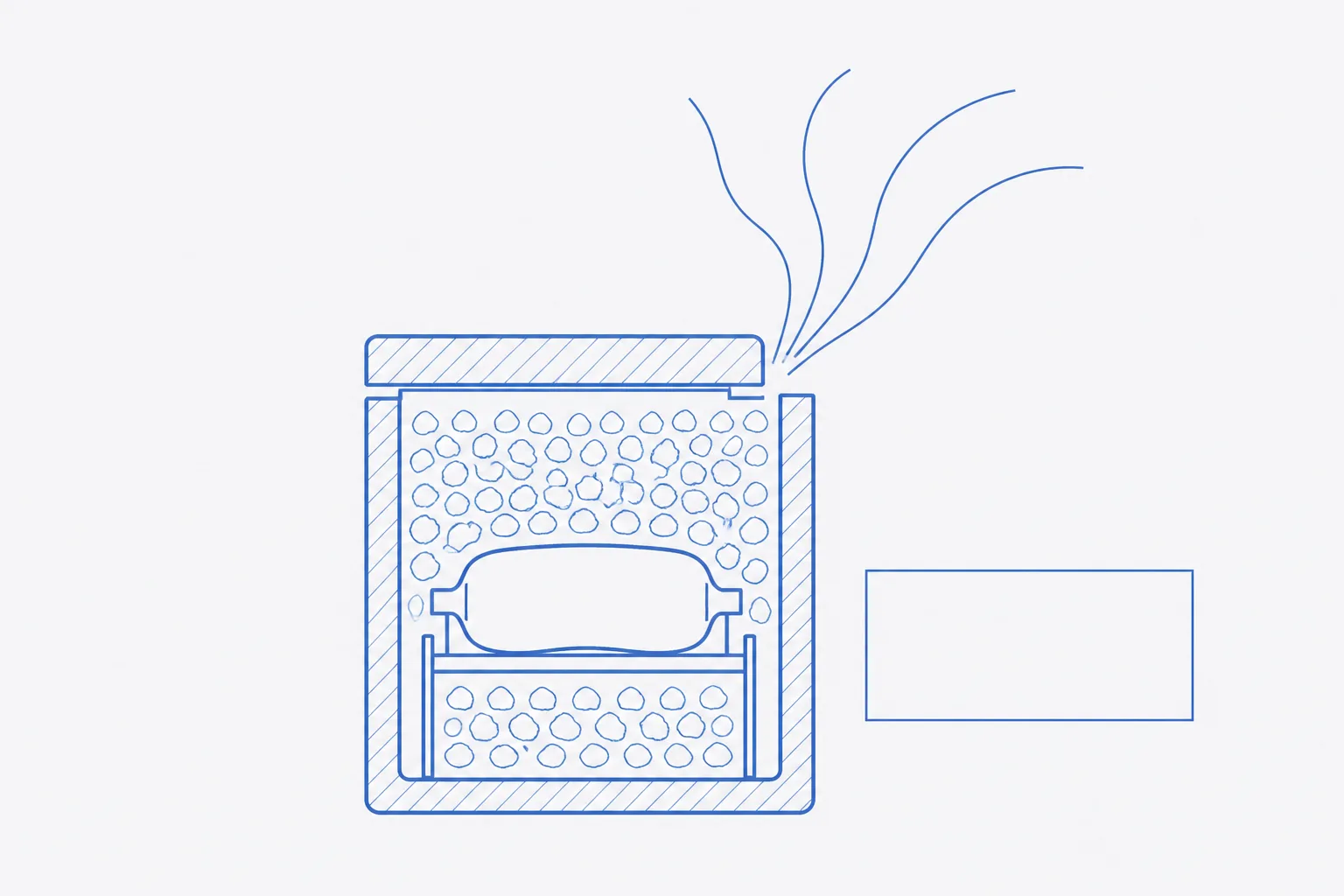
Under the Category B packing instruction, dry ice goes outside the secondary packaging, in the outer packaging or an overpack, with interior supports that hold the secondary in its original position once the dry ice has sublimed. The packaging must permit release of carbon dioxide to prevent a build-up of pressure that could rupture it, and the primary receptacle and secondary packaging must keep their integrity at the refrigerant's temperature and at the temperatures and pressures that would follow if refrigeration were lost 2.
- Use an insulated shipper designed for dry ice. Its lid should seat, not seal.
- Never place dry ice inside a screw-cap container, a sealed bag or the sealed secondary packaging.
- Do not tape every seam of an inner foam box, and do not wrap the whole insulated box in film.
- Fit supports or a rack so the secondary packaging cannot drop into the void left by sublimation.
- Use primary and secondary materials rated for −78 °C. Many plastics embrittle and crack.
- Load dry ice around and above the payload where the shipper design allows; cold gas sinks.
- Weigh the dry ice at packing and record the net mass. That figure goes on the package and the air waybill.
- Close the outer carton normally. A carton closed with tape still vents through its seams; a gasketed container does not.
The drop test for Category B packaging anticipates the void. UK guidance requires packaging intended for dry ice to be tested with an additional sample stored until all the dry ice has dissipated and then dropped, because a package that holds its contents only while the refrigerant fills the space fails in the last hours of transit 5.
Marks, label and the air waybill
The IATA acceptance checklist is the most useful statement of what the operator will check, because a single “no” means the package is refused 1. Its items translate directly into a packing record.
| Where | Entry |
|---|---|
| Package | “UN1845” |
| Package | “Carbon dioxide, solid” or “Dry ice” |
| Package | Full name and address of shipper and consignee |
| Package | Net mass of dry ice in the package, in kilograms |
| Package | Class 9 hazard label; irrelevant marks and labels removed |
| Overpack | Marks and labels visible or reproduced; “Overpack” if not visible; total net mass of dry ice |
| Air waybill | “UN1845”; “Carbon dioxide, solid” or “Dry ice”; number of packages; net mass in kilograms |
| Quantity | 200 kg or less per package |
| Packaging | Conforms to PI 954 and vents |
A Category B package cooled with dry ice carries both sets of marks: the UN3373 diamond with its proper shipping name, and the UN1845 marks with the Class 9 label. The air waybill carries both entries. Neither requires a Shipper's Declaration 12. A declaration becomes necessary when the package contains dangerous goods that require one in their own right — a Category A infectious substance, for example — and the dry ice is then entered on it. State and operator variations can add conditions to any of this and are checked before booking.
Road carriage: the coolant provisions
Under ADR, dry ice used as coolant is outside the regulations except for section 5.5.3. Packages containing a coolant are marked with its name followed by the words “AS COOLANT”. Where there is a real risk of asphyxiation in the vehicle or container, a warning mark at least 150 mm wide and 250 mm high goes at each access point and stays until the space has been ventilated and the goods unloaded, and specific documentation applies 4. The ADR text is the governing one for UK road carriage, and the practical control is simple: a large consignment rides in a ventilated load space separate from the cab, never in the passenger compartment of a car.
Planning the quantity
The loss rate of dry ice is a property of the shipper, the fill and the ambient profile, not of dry ice itself, and it is measured during qualification of the shipping container rather than guessed. The arithmetic is then straightforward: quantity equals measured loss rate multiplied by planned transit time plus contingency, plus the residual mass required on arrival.
- Take the loss rate from the shipper's qualification data at the relevant seasonal profile. Example: 2.4 kg per 24 hours under a summer profile.
- Set planned transit from the booked service, door to door. Example: 48 hours.
- Add contingency for a missed connection or a weekend hold. Example: 24 hours.
- Set the residual required on arrival so the payload is still surrounded when the box is opened. Example: 1 kg.
- Compute: 2.4 kg × 3 days + 1 kg = 8.2 kg. Round up to the next pack size the shipper accepts.
- Check the result against the shipper's capacity. If it does not fit, the shipper or the service is wrong, not the arithmetic.
| Variable | Effect | Source of the figure |
|---|---|---|
| Wall thickness and insulation | Dominant term; thinner walls lose faster | Shipper qualification |
| Pellet versus slab | Pellets have more surface and sublime faster | Measured at packing |
| Headspace | Empty volume increases loss | Pack-out drawing |
| Ambient profile | Summer profiles consume more | Seasonal qualification runs |
| Lid openings in transit | Each opening accelerates loss | Should be zero; record any |
Receipt and residual dry ice
- Open dry-ice consignments in a ventilated area, not in a walk-in cold room or a small closed store.
- Use insulated gloves and eye protection. Never handle pellets bare-handed.
- Record the state of the dry ice on arrival — present, partly sublimed, exhausted — as part of receipt.
- Let residual dry ice sublime in a ventilated place. Do not seal it in a container or put it down a drain.
- Remove or obliterate dry-ice marks and the Class 9 label before a box is reused for anything else.
Training and records
UK guidance is explicit that a Category B shipment brings no specific training requirement of its own, but that where the package contains other dangerous goods such as dry ice or liquid nitrogen the shipper must be trained in the transport of those goods, and that airlines may apply policies stricter than the regulations 5. Keep the training record with the packing procedure, and keep a packing record for each consignment: shipper model, dry ice net mass, time of closure and the person who packed it.
The short version
Dry ice is regulated because it makes gas, and every rule about it follows from that: vent the package, keep it out of anything sealed, declare how much there is so the carrier can manage the space it travels in, and label it so the person who opens the box knows what is inside. The paperwork is short. The failures are almost all physical — a sealed container, an unsupported secondary, a quantity that ran out a day early — and each of them is preventable at the bench.
References
- 2026 Acceptance checklist for dry ice (carbon dioxide, solid), for use when a Shipper's Declaration for Dangerous Goods is not required
- Dangerous Goods Regulations, 67th edition: Packing Instruction 650
- Dangerous Goods Regulations, 65th edition: Table 2.3.A, provisions for dangerous goods carried by passengers or crew
- ADR 2025: European Agreement concerning the International Carriage of Dangerous Goods by Road
- Guidance note 17/2012 (Revision 7): Transport of infectious substances UN2814, UN2900 and UN3373
- Prohibited and restricted items – business customer guidelines
- General hazards of carbon dioxide