transport standards
Packaging Instruction 650 and UN3373: The Triple-Packaging Standard Explained
What PI 650 requires of each packaging layer, the pressure, drop and marking rules, the quantity limits by route, and the classification step that decides whether it applies at all — which, for dry synthetic peptide, it usually does not.
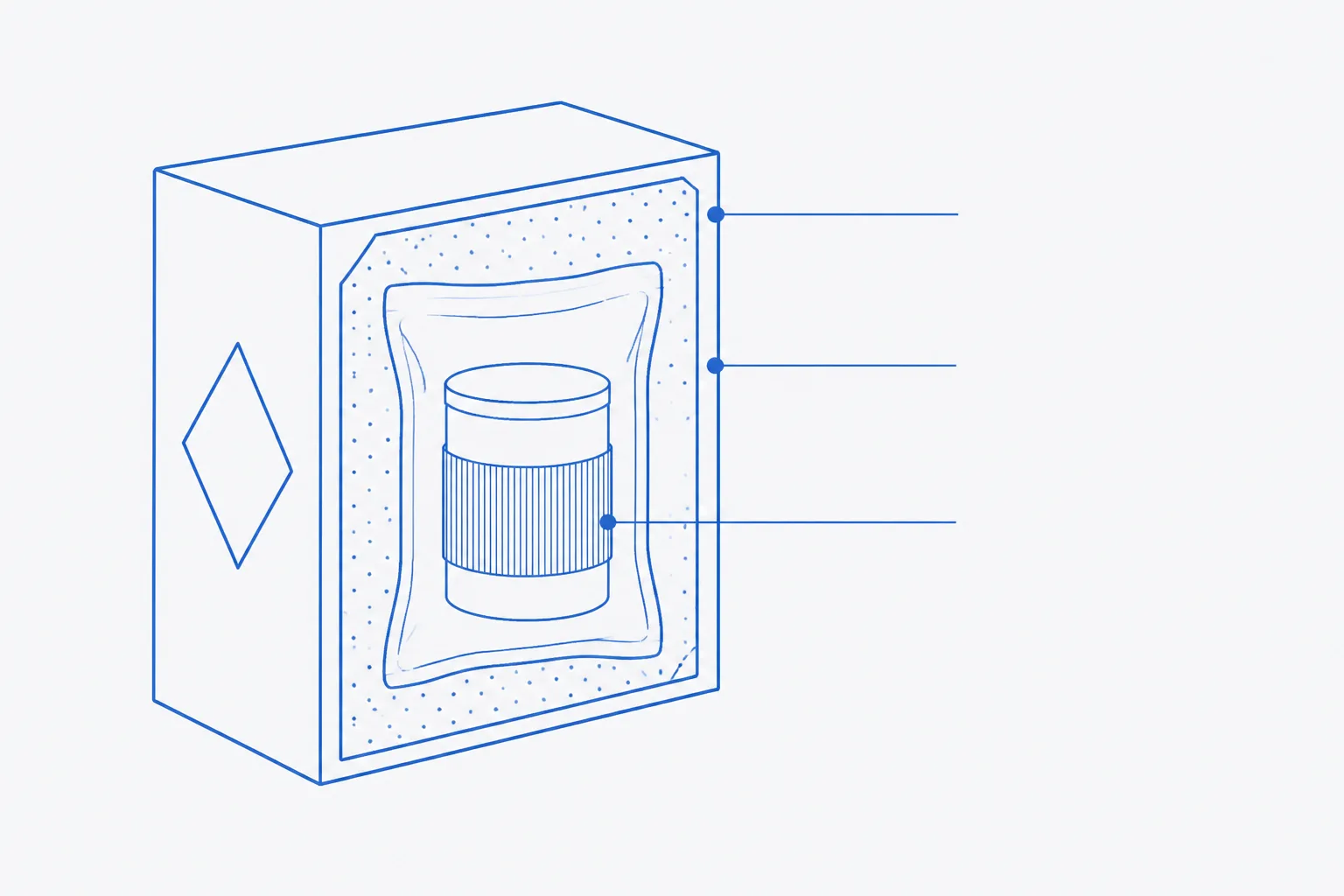
Packaging Instruction 650 (written P650 in the road, rail and sea codes) is the packing standard for UN3373, Biological Substance, Category B: material known or reasonably expected to contain pathogens that does not meet the Category A criteria. It prescribes three layers — a leakproof or siftproof primary receptacle, a leakproof or siftproof secondary packaging and a rigid outer packaging — plus a 95 kPa pressure requirement for liquids, a 1.2 m drop capability, a diamond mark and quantity limits per receptacle and per package 12. It is a transport standard for infectious risk. It is not a general standard for laboratory samples.
That distinction settles most cases in a peptide laboratory. A chemically synthesised peptide, dry or dissolved in water or buffer, contains no micro-organisms. It is not an infectious substance, it is not Division 6.2, and PI 650 does not govern it. PI 650 becomes relevant when the consignment is biological — serum, plasma, tissue, culture medium or other human or animal material, with or without a peptide added. This page states the standard. It is not a posting guide, and the separate classification of solvents and other chemical hazards is outside its scope.
Where PI 650 sits in the regulatory stack
The text originates in the UN Model Regulations, which have no legal force of their own. Each transport mode adopts it through its own instrument, and each UK mode has a competent authority: the Department for Transport for road and rail, the Civil Aviation Authority for air, the Maritime and Coastguard Agency for sea 3. The IATA Dangerous Goods Regulations are the airline industry's operating manual built on the ICAO Technical Instructions, and they add state and operator variations that can be stricter than the base text 1.
| Mode | Instrument | Packing instruction | UK legal basis |
|---|---|---|---|
| Air | ICAO Technical Instructions; IATA DGR | PI 650 | Air Navigation (Dangerous Goods) Regulations 2002 |
| Road | ADR | P650 | Carriage of Dangerous Goods and Use of Transportable Pressure Equipment Regulations 2009 |
| Rail | RID | P650 | As for road |
| Sea | IMDG Code | P650 | Merchant Shipping (Dangerous Goods and Marine Pollutants) Regulations 1997 |
| Inland post | Carrier conditions | PI 650 packaging plus postal limits | The carrier's terms, layered on the modal rules |
The modal texts are close but not identical. The road text permits either the secondary or the outer packaging to be the rigid layer, and UK guidance treats a collection vehicle's fitted box as the outer packaging for surgery and clinic rounds; the air text requires a rigid outer packaging in every case 135. Pack to the air text and the package satisfies every mode.
Classification comes first
Assigning a substance to a category is the consignor's duty and requires professional judgement by a suitably qualified person 3. The categories are defined by the hazard on exposure, not by the organism's name alone.
| Class | Definition | Identification | Packing |
|---|---|---|---|
| Category A | Pathogen in a form that, on exposure, can cause permanent disability or life-threatening or fatal disease | UN2814 (humans) or UN2900 (animals only) | PI 620 / P620 |
| Category B | Infectious substance not meeting the Category A criteria | UN3373, Biological Substance, Category B | PI 650 / P650 |
| Exempt specimen | Human or animal specimen with minimal likelihood that pathogens are present | Marked “Exempt human specimen” or “Exempt animal specimen” | Triple packaging that prevents leakage |
| Not subject | Known not to contain infectious substances; pathogens neutralised or inactivated; only non-pathogenic micro-organisms | None | Not subject, unless another class applies |
UK competent authorities read the exemption narrowly: it applies to material known not to contain pathogens, for example after testing or after inactivation, and it is strongly recommended that human or animal material be regarded as UN3373 unless Category A is known or suspected 3. Where there is doubt about Category A, the material travels as Category A.
- Lyophilised synthetic peptide: not an infectious substance. Not UN3373.
- Synthetic peptide in water, saline or buffer: not UN3373.
- Peptide in an organic solvent: not UN3373. The solvent may be a dangerous good of another class and is classified on its own terms.
- Plasma, serum or tissue from a study, spiked or not: the matrix decides. UN3373 by default under UK advice unless known pathogen-free.
- Culture supernatant: classified as biological material, according to the cell line and any adventitious agents.
- Fixed or inactivated tissue: not subject as an infectious substance; the fixative may be a dangerous good.
The three layers
Primary receptacles are packed into secondary packaging so that under normal transport they cannot break, be punctured or leak into it, and the secondary packaging is secured in the outer with cushioning that any leakage must not compromise 1. Multiple fragile primaries in one secondary are wrapped individually or separated. UK guidance adds practical detail: closures sealed with tape, a sealed bag acceptable as the secondary, cotton wool or vermiculite as cushioning 3.
| Component | Liquids | Solids | Common failure |
|---|---|---|---|
| Primary receptacle | Leakproof; 1 L maximum | Siftproof; within the package limit | Screw closure not sealed |
| Absorbent | Between primary and secondary; enough for the entire contents | Required where residual liquid is possible | Sized for one tube, used for six |
| Secondary packaging | Leakproof | Siftproof | Bag left unsealed |
| Outer packaging | Rigid; one surface at least 100 mm × 100 mm; 4 L maximum | Rigid; one surface at least 100 mm × 100 mm; 4 kg maximum | Padded envelope used as the outer |
| Itemised list | Between secondary and outer | Between secondary and outer | Taped to the outside, or omitted |
Pressure and drop performance
For liquids, either the primary receptacle or the secondary packaging must withstand an internal pressure differential of 95 kPa without leakage. The differential may be produced by internal hydraulic or pneumatic pressure or by external vacuum; vacuum is not normally acceptable for flexible receptacles, or for receptacles closed at an absolute pressure below 95 kPa 1. The requirement exists because a cargo hold at altitude sits well below sea-level pressure, and a closure that holds on the bench can weep in flight.
The completed package must survive a 1.2 m drop in any orientation with no leakage from the primary receptacle, which must remain protected by absorbent in the secondary; capability may be shown by testing, assessment or experience 1. UK guidance sets out the test sequence, allows water as the surrogate fill, permits the consignor to run the test with a record kept, and states that an accredited facility is not required 3.
- Box-shaped samples: five drops in sequence — flat on the base, flat on the top, flat on the longest side, flat on the shortest side, onto a corner. Drum-shaped: diagonally onto the top chime, diagonally onto the base chime, flat on the side.
- Fibreboard outer packaging: water spray equivalent to about 5 cm of rain per hour for at least one hour, then the drop sequence.
- Plastic inner or outer packaging: condition at −18 °C or below for at least 24 hours (four hours where the sample contains dry ice), then drop within 15 minutes of removal.
- Packaging intended for dry ice: one additional sample stored until the dry ice has dissipated, then dropped.
Quantity limits by route
| Route | Per primary receptacle | Per package | Who may consign |
|---|---|---|---|
| Air, IATA PI 650 | 1 L liquid | 4 L liquid or 4 kg solid | Any shipper; state and operator variations may restrict |
| Road or rail, P650 | 1 L liquid | 4 L liquid or 4 kg solid | Any consignor |
| Royal Mail, Category B | Not separately stated | 50 ml or 50 g total sample per parcel; within the UK only | Medical, dental, veterinary or nursing professionals, or a recognised laboratory or institution |
| Royal Mail, exempt specimen | Not separately stated | 250 ml or 250 g; supplier sample kits only | As above |
The inland postal service accepts Category B only on those terms, only in PI 650 packaging, and only with the sender's name and return address visible on the outer; it does not carry Category B internationally 4. The 2026 air text lists state variations, including one entered by the United Kingdom, and more than thirty operator variations against PI 650 1. Read both before a consignment is booked, not after it is refused.
Marking, labelling and documents
| Item | Requirement |
|---|---|
| UN3373 mark | Square set at 45°, each side at least 50 mm, line at least 2 mm, characters at least 6 mm, contrasting background, entire mark on one side |
| Proper shipping name | “Biological Substance, Category B”, characters at least 6 mm, adjacent to the diamond |
| Shipper and consignee | Name and address on each package; barcode or QR code permitted |
| Person responsible | Name and telephone number, on the air waybill or the package |
| Itemised contents list | Between the secondary and outer packaging |
| Overpack | “Overpack” at least 12 mm high and package marks reproduced, unless all marks are visible |
| Air waybill | “UN 3373”, “BIOLOGICAL SUBSTANCE, CATEGORY B” and the number of packages |
| Shipper's Declaration | Not required |
A UN3373 package packed and marked to PI 650 is otherwise exempt from the air regulations, except for classification, incident reporting and the operator's inspection for damage or leakage 1. No colour is specified for the mark; UK guidance recommends at least 100 mm for packages collected by road from clinics, for visibility 3. Passengers and crew may not carry infectious substances in baggage or on their person 1.
Refrigerants
Ice or dry ice goes outside the secondary packaging, in the outer packaging or an overpack, with interior supports that hold the secondaries in position once the refrigerant has gone. Ice requires a leakproof outer or overpack; dry ice requires packaging that vents carbon dioxide; and the primary and secondary must keep their integrity at the refrigerant's temperature and at the temperatures and pressures that follow if refrigeration is lost 1. Many plastics become brittle at dry-ice temperature 3. Dry ice is a dangerous good in its own right with separate marks, and the inland postal service prohibits dry ice and liquid nitrogen as coolant 4. WHO guidance covers liquid nitrogen dry shippers 2.
Packing sequence
- Record the classification and its basis before any packing begins.
- Confirm the packaging system's manufacturer statement covers 95 kPa and the 1.2 m drop, and file it.
- Close each primary receptacle and seal the closure with tape or film.
- Wrap or separate fragile primaries. Place absorbent sufficient for the total liquid volume.
- Seal the secondary packaging.
- Place the itemised contents list outside the secondary and inside the outer.
- Add refrigerant outside the secondary with supports; vent the outer if dry ice is used.
- Close the outer. Apply the diamond, the proper shipping name, both addresses and the responsible person's telephone number.
- Apply dry ice marks and label where applicable, and complete the air waybill entries.
- Record the package in the custody record with date, time and packer.
Training and responsibility
UK guidance states that no specific training is required to ship Category B, but that shippers must be trained where the package contains other dangerous goods such as dry ice or liquid nitrogen, and that individual airlines may apply stricter policies than the regulations 3. WHO guidance sets out the separate responsibilities of shipper, carrier and receiver, and treats training and competence as part of each 2. Packaging manufacturers must supply clear filling and closing instructions, and those instructions belong in the procedure file 1.
When PI 650 is the wrong question
For most consignments leaving a peptide laboratory — dry synthetic material, reference standards, aqueous solutions — PI 650 is not the governing standard and the UN3373 mark should not appear. The questions that do govern them are chemical classification of any solvent, the temperature the material needs, and the custody record that travels with it. PI 650 enters when biological matrix enters. Classification is the step that decides which of those two regimes applies, and it is the one step that cannot be corrected by better packaging.
References
- Dangerous Goods Regulations, 67th edition: Packing Instruction 650
- Guidance on regulations for the transport of infectious substances 2025–2026: applicable as from 1 October 2025
- Guidance note 17/2012 (Revision 7): Transport of infectious substances UN2814, UN2900 and UN3373
- Prohibited and restricted items – business customer guidelines
- ADR 2025: European Agreement concerning the International Carriage of Dangerous Goods by Road