quantification
Karl Fischer Titration and Residual Moisture
Water is the largest non-peptide term nobody measures. How the titration works, what volumetric and coulometric modes are each good for, where the sub-three-per-cent convention came from, and what a moisture figure on a certificate does and does not describe.
Every gross-weight figure printed on a container of lyophilised solid includes water. The balance cannot separate it from the rest, purity assays do not see it, and it is the one component of the mass that changes after the container is opened. Karl Fischer titration is the specific assay for it: a chemical reaction that consumes water stoichiometrically and reports nothing else. For freeze-dried biological material it has been the reference approach since the comparative work of the early 1980s, which found gravimetric and thermogravimetric alternatives to give systematically different answers on the same containers 1.
Why water is the hidden variable
Residual moisture has two distinct origins that are habitually merged. The first is process water: liquid not removed during primary and secondary drying and still held in the amorphous cake. The second is sorbed water taken up afterwards, from the headspace, through the closure over months of storage, or from room air in the seconds after opening. Only the first is a property of the drying cycle. The second is a property of how the container has been handled since, which is why a moisture figure is dated and a batch is not simply dry or wet.
The consequences run in two directions. On the mass side, water is a term in the accounting that separates total solid from peptide: a solid at three per cent moisture yields three per cent less peptide per unit of weighed mass than an anhydrous one, before counterion and salt are even considered. On the stability side, water is a mobiliser. It plasticises the amorphous solid, lowers the glass transition temperature and permits the molecular motion that chemical degradation requires. Increased moisture in lyophilised protein formulations is associated with faster aggregation and faster chemical change on storage 4. The same variable therefore corrupts a concentration and shortens a shelf life at once.
Volumetric and coulometric titration
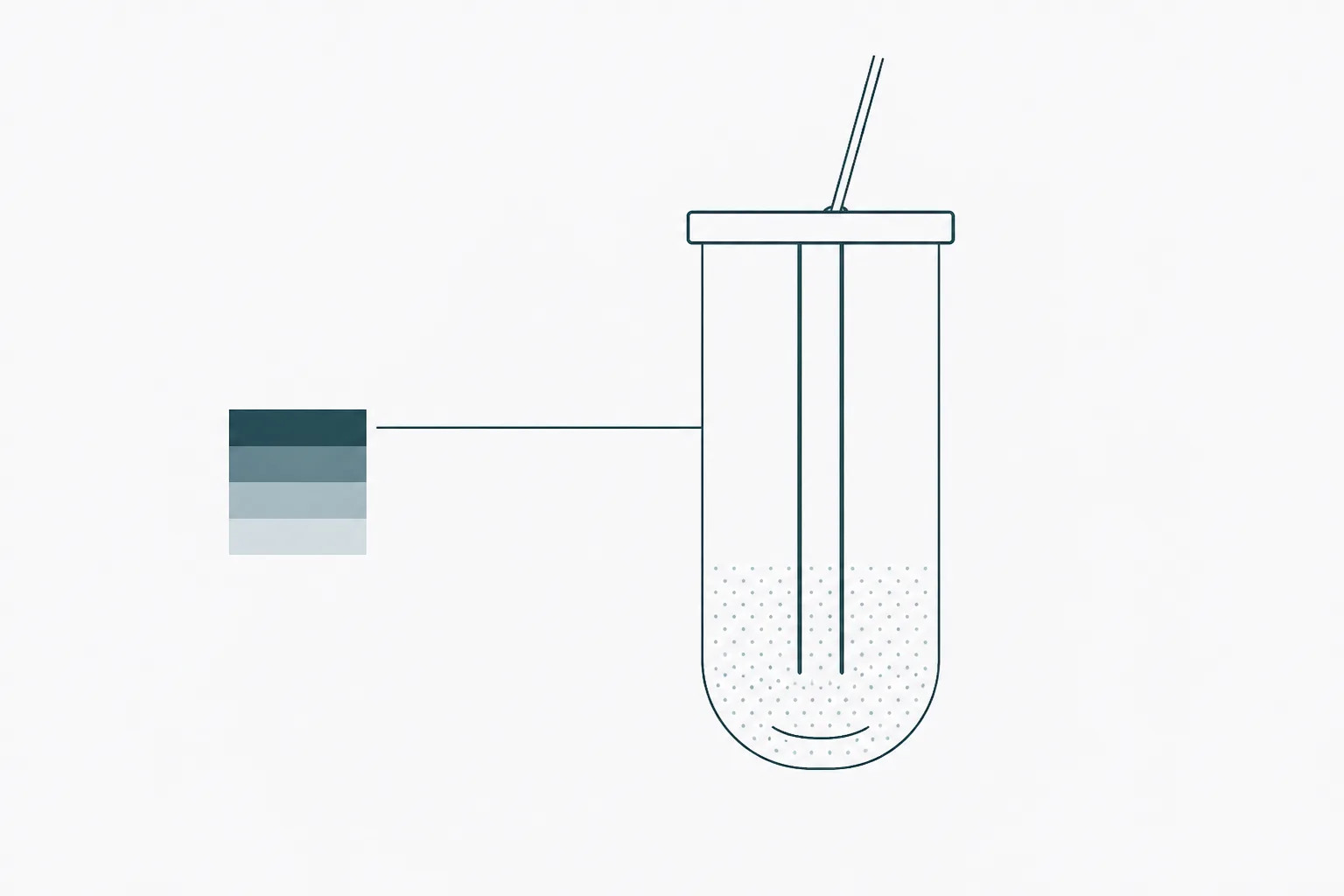
Both modes rest on the same chemistry. Iodine oxidises sulfur dioxide in the presence of water and an alcohol, in a reaction that consumes one mole of iodine per mole of water. A base holds the working medium in its optimum pH window, roughly pH 5 to 7; modern reagents use imidazole in place of the pyridine of the original formulations. The endpoint is detected electrometrically as the first appearance of unreacted iodine. The modes differ only in how the iodine is supplied.
| Volumetric | Coulometric | |
|---|---|---|
| Iodine supply | Delivered from a burette as a standardised reagent | Generated electrochemically in the cell during the titration |
| Quantity measured | Titrant volume against a determined titre | Charge passed, converted by Faraday's law |
| Working range | Roughly 100 ppm to 100% water | Roughly 1 ppm to 5% water |
| Typical sample mass | Tens to hundreds of milligrams | A few to tens of milligrams |
| Calibration burden | Titre re-standardised regularly against a water standard | No titre; the conversion is a physical constant |
| Usual application here | Bulk material, larger fills | Individual small-fill containers |
Coulometric determination is the ordinary choice for a small lyophilised fill, for one reason above all others: sample consumption. The assay is destructive, so the material used is gone, and a mode that answers on a few milligrams costs less of the batch than one that needs a hundred. The conversion is fixed rather than calibrated — 10.71 coulombs of charge corresponds to one milligram of water — which removes titre standardisation as a source of drift between runs.
Sample introduction is the decision that matters more than the mode. Direct addition puts the solid into the working medium, which requires it to dissolve or at least release its water there, and exposes it to whatever side reactions the medium permits. Oven evaporation instead heats the sample in a sealed vial, typically between 100 and 160 °C, and sweeps the liberated water into the cell on a dry carrier gas. The sample itself never enters the titration vessel. For solids that dissolve poorly, that react with the reagent, or that carry interfering functionality, the oven route is the safer default and gives the cleaner blank.
Three interferences account for most bad numbers. Aldehydes and ketones react with the methanolic medium to form acetals and ketals, releasing water and reporting high; ketone-specific reagents exist for this case. Strong acids and strong bases push the medium outside its pH window, slowing the reaction to a creeping endpoint or accelerating side chemistry. Reducing species — free thiols among them — consume iodine directly and also report high. Cell drift compounds all three: a coulometric cell has a background water ingress of a few micrograms per minute, and a titration that runs long multiplies that drift into the result, so drift must be measured and subtracted rather than assumed negligible 3.
Targets, and where the sub-three-per-cent convention came from
The band quoted for lyophilised biological solids is usually one to three per cent water by mass. The upper figure has the status of a convention rather than a regulation, and it is worth knowing what it rests on. Residual moisture testing became routine for dried biological products because early stability failures traced back to it, and the comparative method studies of that period established both that the measurement was worth making and that different methods disagreed on the same material 1. The band that emerged reflected where stability data stopped improving, not a chemical threshold.
The important refinement came next. Drier is not monotonically better. Work on lyophilised protein pharmaceuticals identified an optimum rather than a limit: removing water beyond a certain point destabilised the solid, apparently by stripping the hydration that maintains conformation in the dried state, so both excess moisture and over-drying shortened shelf life 2. That result is why a specification of the form not more than three per cent, with no lower bound, is an incomplete statement for a formulated product, and why the useful figure is the measured one rather than the limit it sits under.
| Measured water content | Ordinary interpretation | What to check next |
|---|---|---|
| Below about 0.5% | Aggressively dried | Whether the formulation is one that over-drying destabilises |
| About 1% to 3% | The conventional working band | Nothing; record it and carry it into the mass accounting |
| About 3% to 5% | High for a freeze-dried solid | Cycle, closure and storage history; expect a shorter useful life |
| Above about 5% | Incompletely dried or moisture ingress | Container integrity, and whether the figure predates a handling event |
Sample handling in humid air
An amorphous freeze-dried cake is a high-surface-area hygroscopic solid, and its water content is not fixed once the container is open. Uptake is fast enough to matter on the timescale of an ordinary weighing. Two mechanisms drive it. Condensation is the first: a container taken straight from cold storage sits below the dew point of room air, and water condenses onto and into the cake before the cap is even off. Sorption is the second and continues for as long as the solid is exposed to air above its equilibrium relative humidity.
- Equilibrate the sealed container to ambient temperature before breaking the seal. Allow a full hour rather than a nominal few minutes, and do not shorten it by warming the container.
- Open and handle in the driest enclosure available — a purged glovebox, a dry box, or at minimum a balance enclosure with fresh desiccant.
- Record the ambient relative humidity and temperature at the time the container is opened. Without them a later disagreement cannot be diagnosed.
- Transfer the sample quickly and in one movement. Repeated openings compound the exposure; each one is a fresh sorption event.
- Backfill the headspace with dry nitrogen or argon before resealing anything intended for further use.
- Weigh with the enclosure closed and take the reading once stable, not once plausible. A mass that climbs steadily is sorption in progress, not balance drift.
- Run the titration on the same day the container was opened, and record the interval between opening and analysis alongside the result.
The practical consequence is that a moisture assay measures the sample as presented, not the batch as manufactured. A figure generated on material that spent ten minutes open on a humid bench is a real measurement of a sample that no longer represents anything. Where the question is the state of the batch, the analysis must be run on a container opened for that purpose under controlled conditions.
Loss on drying, and reading the figure on a certificate
Loss on drying is the cheaper alternative and answers a different question. The sample is weighed, heated or held under vacuum to constant mass, and weighed again; the mass lost is reported as water. The last clause is where the confusion enters, because the mass lost is everything volatile under those conditions. For material isolated by reverse-phase chromatography that routinely includes residual acetonitrile, acetic acid and trifluoroacetic acid, all of which leave under the same conditions as water and none of which are water. Thermal decomposition adds further mass loss that is not volatilisation at all.
The error runs both ways. Loss on drying over-reports where volatile solvent is present and under-reports where water is tightly bound in the amorphous solid and does not leave at the temperature used. The two errors can partly cancel, which is worse than either alone, because the agreement between a loss-on-drying figure and a titration figure then proves nothing. Comparative studies on freeze-dried material found exactly this pattern of method-dependent disagreement, with the differences large enough to move a batch across a specification limit 1.
| Method | Measures | Blind to | Cost and sample use |
|---|---|---|---|
| Karl Fischer, coulometric | Water, specifically and stoichiometrically | Non-aqueous volatiles | Moderate; a few milligrams, destroyed |
| Karl Fischer, volumetric | Water, specifically | Non-aqueous volatiles | Moderate; tens to hundreds of milligrams, destroyed |
| Loss on drying | Total mass lost under stated conditions | The distinction between water and any other volatile | Low; sample destroyed |
| Thermogravimetric analysis | Mass loss as a continuous function of temperature | The identity of what is leaving, without a coupled detector | Moderate; small sample, destroyed |
Read a moisture entry on a certificate for four things. First, the method: a figure labelled only moisture, with no method named, cannot be assumed to be a water assay at all. Second, whether titration was direct or by oven evaporation, since the interference profile differs. Third, the test date relative to the fill date, because a figure generated at release describes the batch then. Fourth, whether the value is a single determination or a mean of replicates — a single coulometric result on a few milligrams of a heterogeneous cake carries real sampling uncertainty.
Water is the most tractable of the terms that separate gross weight from peptide mass, because unlike counterion load it can be measured directly on a few milligrams in under an hour. It is also the only one that moves while the material is being handled. A moisture figure carried forward from a certificate without its date, its method and the handling history since is an assumption wearing the clothes of a measurement.
References
- Determination of residual moisture in freeze-dried viral vaccines: Karl Fischer, gravimetric and thermogravimetric methodologies
- Determining the optimum residual moisture in lyophilized protein pharmaceuticals
- Moisture content in proteins: its effects and measurement
- Effect of moisture on the stability of a lyophilized humanized monoclonal antibody formulation