degradation
Peptide Degradation Pathways: Chemistry, Susceptible Residues and Analytical Signatures
The chemical routes by which a peptide preparation loses integrity, the residues each route attacks, and the evidence that identifies it. This is the reference the rest of the stability cluster points back to.
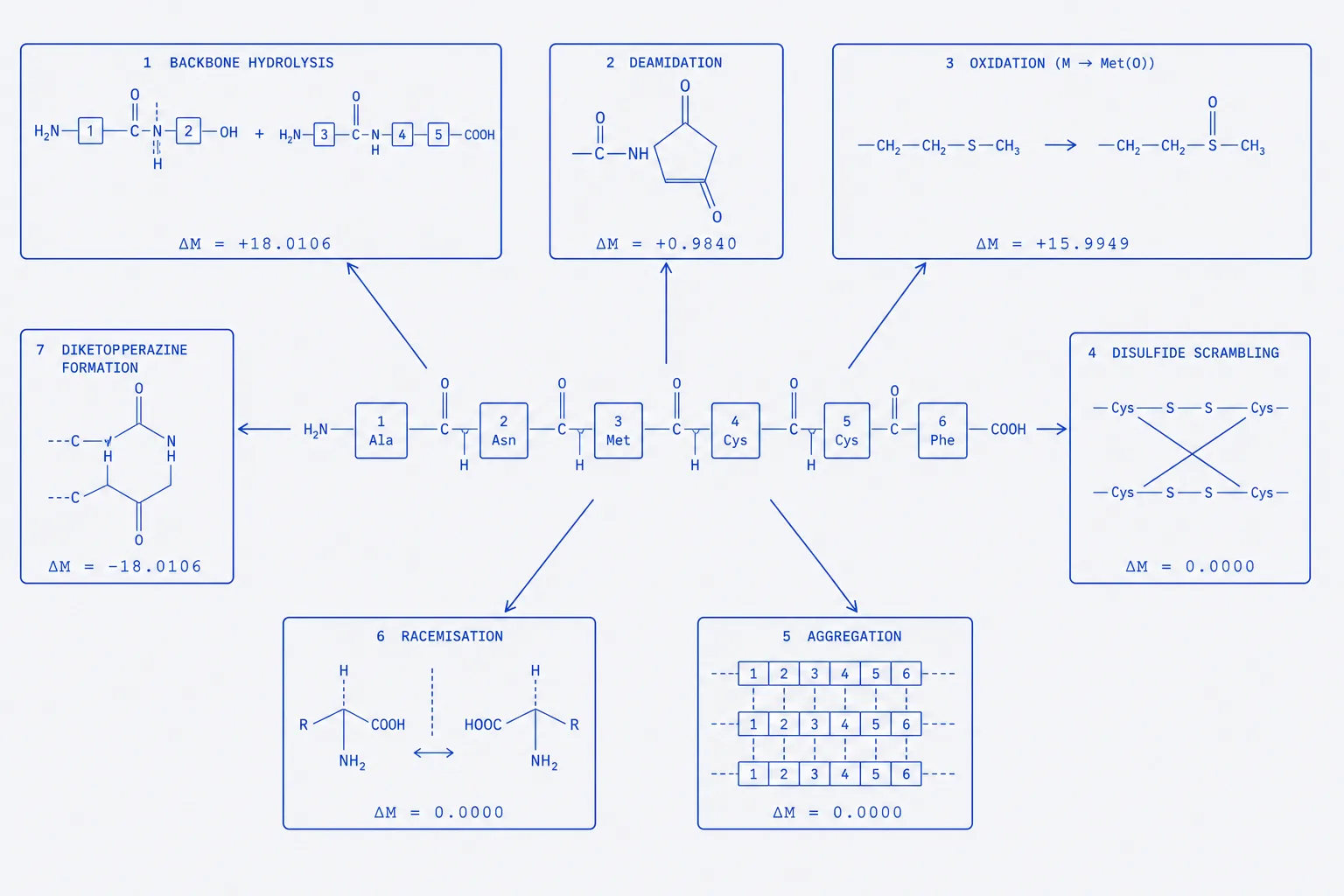
Peptides degrade by a small, well-characterised set of chemical routes: hydrolysis of the backbone amide, deamidation of asparagine and glutamine, oxidation of sulfur-containing and aromatic residues, disulfide scrambling, diketopiperazine formation at the N-terminus, and racemisation — with aggregation alongside them as a physical rather than chemical route. Each attacks specific residues, is accelerated by identifiable conditions, and leaves a distinguishing signature 1. This entry gives the chemistry, residues at risk, conditions and detection method for each, and closes with an assignment procedure.
Backbone Hydrolysis
Hydrolysis cleaves a backbone amide by adding the elements of water across it. One chain becomes two fragments whose masses sum to the parent plus 18 Da. Acid and base both catalyse it, so the pH-rate profile has a minimum near neutrality and rises at both extremes 2.
An unadorned backbone is robust; rates are dominated by motifs where a side chain supplies intramolecular catalysis. Aspartyl residues are the principal offender: under acid the protonated side-chain carboxyl attacks the adjacent backbone carbonyl and cleaves the Asp-X bond from within. Asp-Pro and Asp-Gly are disproportionately susceptible and account for most site-specific cleavage in stored material 12. Proline's tertiary amide protonates readily; glycine imposes no steric obstruction on the cyclic transition state. Two N-terminal reactions belong here by signature: N-terminal glutamine cyclises to pyroglutamate losing ammonia, −17 Da, and N-terminal glutamate cyclises losing water, −18 Da.
Accelerating conditions are pH extremes — below pH 4 for aspartyl cleavage in particular — heat and long residence in solution. The signature is unambiguous: new reversed-phase peaks whose deconvoluted masses sum to the parent plus 18 Da, with peptide mapping locating the cleaved bond.
| Motif | Mechanism | Greatest lability | Signature |
|---|---|---|---|
| Asp-Pro | Protonated aspartyl carboxyl attacks a readily protonated tertiary amide | Acidic, pH 2 to 4; heat | Fragments summing to parent plus 18 Da |
| Asp-Gly | Same catalysis, no steric hindrance from the next residue | Acidic; also near neutrality via succinimide | Cleavage fragments or isoaspartyl product |
| Asp-X, other | Side-chain carboxyl catalysis, slower | Acidic; heat | Cleavage C-terminal to aspartate |
| N-terminal Gln | Cyclisation to pyroglutamate, ammonia lost | Mildly acidic; heat | Minus 17 Da; N-terminus blocked |
| N-terminal Glu | Cyclisation to pyroglutamate, water lost | Mildly acidic; heat | Minus 18 Da; N-terminus blocked |
Deamidation of Asparagine and Glutamine
Deamidation converts an asparagine or glutamine side-chain amide to a carboxylate. At neutral and alkaline pH it does not proceed by direct hydrolysis: the backbone nitrogen of the following residue is deprotonated, attacks the side-chain carbonyl, closes a five-membered cyclic imide — the succinimide — and expels ammonia 3.
The succinimide is hydrolysed at either carbonyl. Attack at the α-carbonyl regenerates a normal aspartyl residue; attack at the β-carbonyl gives isoaspartate, in which the side-chain carboxyl becomes part of the backbone and an extra methylene enters the chain. The β route is favoured, so aged material carries more isoaspartyl than aspartyl product 3. Isoaspartate lengthens the backbone, removes a side chain from the surface, and commonly abolishes activity.
Rate is set by the residue immediately C-terminal to the asparagine. Asn-Gly is fastest, glycine imposing no steric barrier on ring closure; Asn-Ser, Asn-Ala and Asn-His follow; β-branched residues slow it substantially. Asn-Pro is blocked outright — proline's tertiary amide nitrogen carries no proton to remove. Glutamine deamidates through a six-membered glutarimide that forms far less readily, making Gln much the slower of the two 3.
pH dependence is steep. Succinimide formation is base-catalysed and accelerates above neutrality; below roughly pH 4 the cyclic route shuts down and slow direct hydrolysis gives aspartate without isoaspartate, so the practical minimum sits in the mildly acidic region 1. Heat, high buffer concentration — phosphate acts as a general base catalyst — and high ionic strength all accelerate it 2.
The mass change is why deamidation is missed. Asn to Asp or isoAsp is +0.984 Da, nominally +1 Da, which on a low-resolution instrument sits inside the parent isotope envelope and merely raises the apparent M+1 peak. It must be looked for deliberately. The succinimide itself is easier to see at −17 Da. Aspartate and isoaspartate are isobaric with each other: electron-transfer dissociation separates them by diagnostic c and z ions where mass alone cannot.
Oxidation
Oxidation is the route most often encountered, because its reagents are ambient. Methionine goes first: the thioether sulfur oxidises to the sulfoxide at +16 Da and, under forcing conditions, to the sulfone at +32 Da, needing no catalyst beyond dissolved oxygen and time 4. Cysteine is second. A free thiol pairs to a disulfide with loss of two hydrogens, −2 Da; beyond that the sulfur climbs to sulfenic acid at +16 Da, sulfinic at +32 Da and sulfonic at +48 Da, the last irreversible.
Tryptophan and histidine are secondary targets, and usually indicate a more aggressive oxidant or light exposure. Tryptophan gives hydroxytryptophan at +16 Da, N-formylkynurenine at +32 Da and kynurenine at +4 Da; loss of the intact indole quenches its fluorescence, which makes fluorescence a cheap screen. Histidine gives 2-oxohistidine at +16 Da. Tyrosine forms dityrosine crosslinks — a covalent dimer with no change in monomer mass 4.
The sources are mundane. Iron and copper leached from glassware, stainless steel and ordinary-grade buffer salts drive site-specific metal-catalysed oxidation, where the oxidant is generated on the residue rather than delivered to it. Polysorbate and polyethylene glycol autoxidise on storage to hydroperoxides, and residual peroxide persists in some plastic containers after sterilisation. Ambient light drives photo-oxidation, with tryptophan and tyrosine as sensitisers 4.
Disulfide Scrambling
Scrambling is thiolate-disulfide exchange: a thiolate attacks one sulfur of an existing disulfide and displaces a new thiolate, which attacks the next. In a sequence with more than one disulfide the population drifts toward a thermodynamic mixture of connectivity isomers, usually inactive. The reactive species is the thiolate, so exchange accelerates sharply above pH 7 as the sulfhydryl deprotonates.
Free thiol supplies the initiator, and very little is needed: one unpaired cysteine, a partly reduced fraction, or carryover of dithiothreitol, tris(2-carboxyethyl)phosphine or 2-mercaptoethanol will shuffle a whole population catalytically, because the thiolate is regenerated at every step 2. Thiol-based antioxidants do the same. Scrambled isomers are isobaric with the parent, so intact mass reports nothing wrong. Detection needs chromatographic resolution of the isomers, or non-reduced peptide mapping to establish which cysteines are actually paired; Ellman's reagent screens for the initiator.
Diketopiperazine Formation
The free N-terminal α-amino group attacks the carbonyl of the second peptide bond, cyclises to a six-membered diketopiperazine and removes the first two residues as a cyclic dipeptide. The remainder is released with a new N-terminus at residue three, lighter by the two residue masses lost.
The geometry must be reachable, and proline at position 2 supplies it: the cis Xaa-Pro amide holds the terminal amine within reach of the target carbonyl, which is why proline-second sequences are the classic case. Glycine at either of the first two positions also favours it. The nucleophile is the free base, so neutral to mildly alkaline pH and heat accelerate the reaction, and an N-terminus blocked by acetylation or pyroglutamate cannot undergo it. The signature is a chain two residues shorter with the correct new N-terminus, plus a small cyclic species at low m/z.
Racemisation
Racemisation inverts the α-carbon: a base abstracts the α-proton, the carbanion is planar, and reprotonation from the opposite face installs the D-residue. Alkaline pH and heat accelerate it. Aspartyl residues racemise far faster than the rest of the sequence, because the succinimide makes the α-proton much more acidic — which is why isomerisation and racemisation appear together in aged material 3. Detection is the difficulty: a D-residue is isobaric with its L-counterpart, so neither intact mass nor a standard peptide map registers it. Chiral analysis is required — total hydrolysis, chiral derivatisation, reversed-phase separation — and since hydrolysis itself racemises, a matched blank is mandatory.
Aggregation
Aggregation is physical rather than chemical, and is covered by the physical-stability entry in this cluster. It is listed because it is the commonest explanation for lost material with no chemical change. Partly unfolded or surface-adsorbed chains expose hydrophobic faces and associate. Concentration, agitation, air-liquid and ice-water interfaces, freeze-thaw cycling, container contact and pH near the isoelectric point all drive it 2. Aggregates may later become covalent through disulfide or dityrosine crosslinking. The signature is monomer loss by size-exclusion chromatography, a rise in hydrodynamic radius, opalescence or subvisible particles — and no new mass.
Pathway Summary
Mass changes are per event on a single affected residue, nominal unless stated.
| Pathway | Residues at risk | Accelerating conditions | Mass change | Signature |
|---|---|---|---|---|
| Backbone hydrolysis | Asp-Pro, Asp-Gly, Asp-X | pH below 4 or above 8; heat; time in solution | Fragments sum to parent plus 18 Da | New peaks; map locates the cleaved bond |
| Pyroglutamate formation | N-terminal Gln or Glu | Mildly acidic; heat | Minus 17 Da from Gln; minus 18 Da from Glu | Blocked N-terminus; shifted retention |
| Deamidation | Asn, fastest at Asn-Gly; Gln far slower | pH above 6; heat; phosphate; ionic strength | Plus 1 Da; succinimide minus 17 Da | Raised M+1 inside the isotope envelope |
| Aspartyl isomerisation | Asp, same succinimide | pH above 6; heat | None; isoAsp isobaric with Asp | Electron-transfer dissociation; retention shift |
| Methionine oxidation | Met, exposed first | Oxygen; peroxide excipients; light; metals | Plus 16 Da sulfoxide; plus 32 Da sulfone | Plus 16 Da on the Met map peptide |
| Cysteine oxidation | Free Cys | Oxygen; trace metals; alkaline pH | Minus 2 Da on pairing; plus 16, 32, 48 Da | Free-thiol loss; dimer peaks |
| Trp and His oxidation | Trp, His; Tyr crosslinking | Peroxide; light; metal-catalysed radicals | Trp plus 16, 32 or 4 Da; His plus 16 Da | Fluorescence loss; mass ladder on the map |
| Disulfide scrambling | Two or more disulfides | pH above 7; free thiol or reductant carryover | None; isomers isobaric | Non-reduced map; isomer separation |
| Diketopiperazine formation | N-terminal dipeptide, especially Xaa-Pro | Neutral to alkaline pH; heat; free N-terminus | Chain lighter by the first two residues | Truncated chain plus cyclic dipeptide |
| Racemisation | Asp fastest; then Ser, Cys | Alkaline pH; heat | None; D and L isobaric | Chiral chromatography against a blank |
| Aggregation, physical | Sequence-independent | Concentration; agitation; interfaces; freeze-thaw; pH near pI | None | Monomer loss by size-exclusion; light scattering |
Conditions and Their Trade-Offs
No single set of conditions minimises everything, and pH is the clearest case. Deamidation, disulfide scrambling, racemisation and diketopiperazine formation are base-catalysed and slow as pH falls. Acid-catalysed cleavage at aspartyl residues does the reverse, and is fastest where deamidation is slowest. A preparation moved to pH 4 to protect an Asn-Gly motif has moved into the window where an Asp-Pro bond in the same sequence is least stable 12. Where both are present, the choice is a compromise decided on measured data.
Temperature moves every chemical route in the same direction, since all carry positive activation energies — but freezing introduces ice-water interfaces and freeze-concentration, which promote aggregation, and buffers that crystallise on freezing shift pH as they do so; sodium phosphate is the standard warning. Lyophilisation suppresses hydrolysis and slows deamidation at the cost of the freezing and drying stresses, and residual moisture restarts the same chemistry in the solid state.
Oxidation responds to simple controls: chelate the metals, exclude headspace oxygen, keep the material dark, specify low-peroxide excipient lots. But thiol-based antioxidants suppress oxidation while promoting disulfide scrambling, and a chelator at the wrong ratio to the metal it binds can turn pro-oxidant 4. Each control must be checked against the routes it does not address.
| Control | Suppresses | Leaves or worsens |
|---|---|---|
| Frozen storage | Every covalent route | Freeze-thaw aggregation; buffer pH shift on freezing |
| Lyophilisation, low residual moisture | Hydrolysis, deamidation, scrambling | Freezing and drying stress; oxidation continues |
| pH 4 to 5 | Deamidation, scrambling, racemisation, diketopiperazine | Acid-catalysed Asp-X cleavage |
| pH 7 to 8 | Acid-catalysed Asp-X cleavage | Deamidation, scrambling, racemisation, diketopiperazine |
| Chelator, EDTA or DTPA | Metal-catalysed oxidation | Wrong metal-to-chelator ratio can turn pro-oxidant |
| Inert headspace, amber glass, darkness | Oxidation and photo-oxidation | Nothing |
| Sacrificial free methionine | Oxidation of Met and aromatics | Nothing |
| Thiol-based antioxidant | Oxidation of Met and aromatics | Disulfide scrambling |
| Low-peroxide excipient lots | Peroxide-driven Met and Trp oxidation | Nothing |
| Acetylated N-terminus | Diketopiperazine and pyroglutamate formation | Unavailable after synthesis |
Narrowing Down a Failure
Work in this order when a stored preparation has lost activity or gained peaks. The cheapest discriminating measurement comes first; the isobaric routes come last.
- Re-inject the aged sample and a fresh reference on the same column and mobile phase, same day. Exclude column ageing and detector drift first.
- Record the storage history: buffer and pH, container, headspace, temperature excursions, freeze-thaw count, time in solution, light exposure, excipient lot.
- Run size-exclusion chromatography or light scattering. Monomer loss with no new low-mass species is aggregation; settle the physical conditions first.
- Acquire an intact deconvoluted mass spectrum against the reference. Read the differences: plus 16, plus 32, plus 1, minus 17, minus 18, minus 2, truncations.
- Map the observed shifts onto the pathway summary table. A single dominant shift usually identifies the route on its own.
- If activity or the chromatogram changed while the intact mass did not, the route is isobaric: scrambling, isomerisation or racemisation.
- Digest and run a reduced peptide map. Localisation turns an ambiguous plus 16 Da into a named methionine.
- Run a non-reduced map wherever the sequence carries two or more cysteines, and assign observed connectivity against the expected pairing.
- For a plus 1 Da shift, separate aspartate from isoaspartate by electron-transfer dissociation, confirmed by the isomer retention shift.
- For residual isobaric loss with a clean map, run chiral analysis after total hydrolysis against a matched racemisation blank.
- Confirm by forced degradation: stress fresh aliquots one route at a time — dilute peroxide, elevated pH, mild acid, heat — and see which reproduces the peak.
The endpoint is a named route and the condition that drove it, not a general finding of instability. Correct the single condition implicated and re-test a fresh aliquot.
References
- Stability of protein pharmaceuticals: an update
- Instability, stabilization, and formulation of liquid protein pharmaceuticals
- Deamidation, isomerization, and racemization at asparaginyl and aspartyl residues in peptides. Succinimide-linked reactions that contribute to protein degradation
- Chemical instability of protein pharmaceuticals: Mechanisms of oxidation and strategies for stabilization