degradation
Deamidation of Asparagine and Glutamine: Mechanism, Sequence Risk and Detection
The succinimide route in detail: how the reaction runs, which motifs are fast, what pH and buffer do to it, and why a +1 Da change costs activity. Includes a sequence-risk assessment procedure.
Deamidation is the loss of the side-chain amide from an asparagine or glutamine residue, converting it to a carboxylate; the sequences at risk are those carrying an asparagine followed by a small residue, Asn-Gly faster by a wide margin than anything else and Asn-Ser, Asn-Asp and Asn-His next. Above pH 4 it does not simply add water to the amide. It runs through a cyclic intermediate that yields two backbone isomers, only one of them the residue expected, and registers as a mass change of one unit 1.
The asparagine reaction
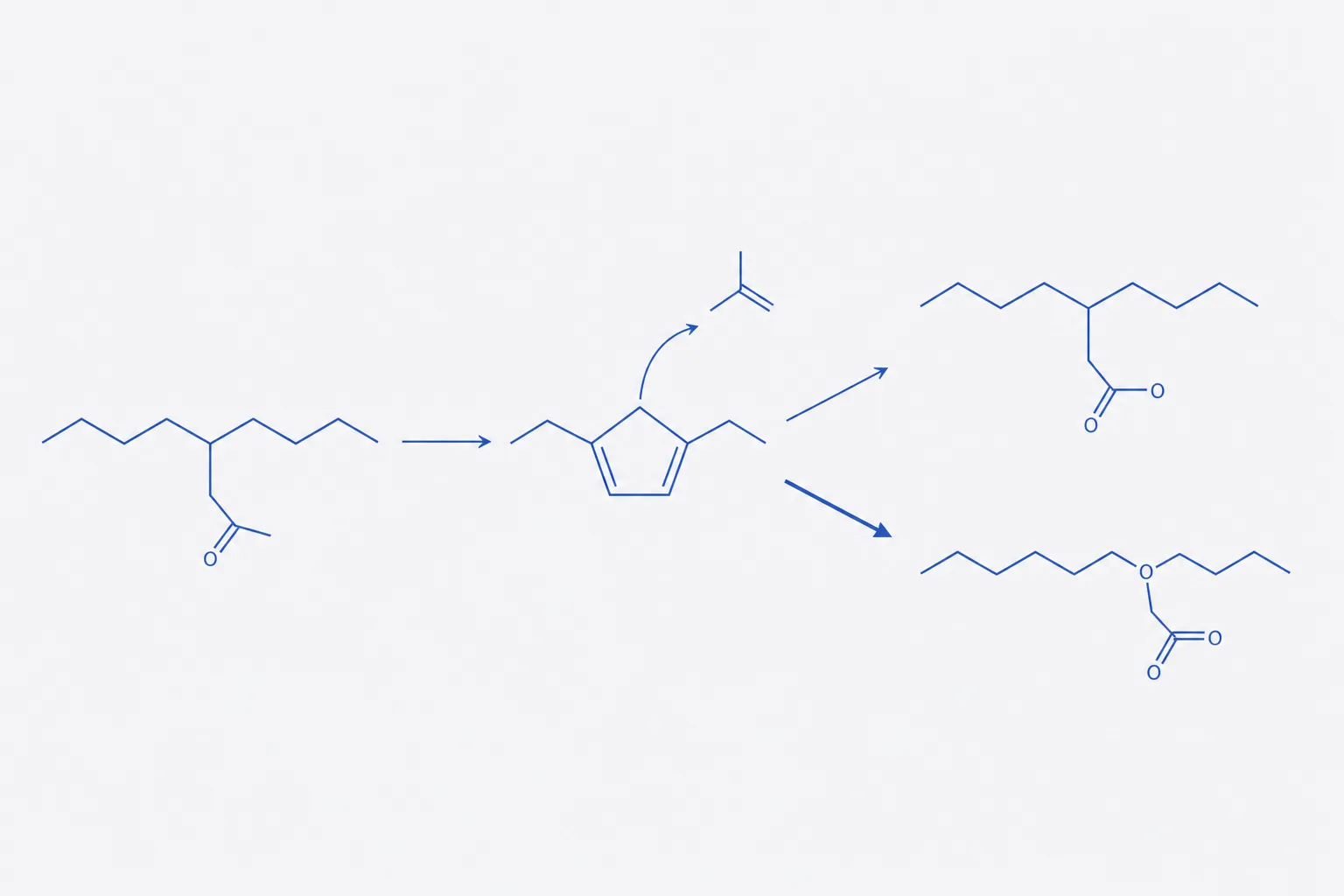
The reaction begins on the backbone, not the side chain. The amide nitrogen of the residue immediately C-terminal to the asparagine is deprotonated; the nitrogen anion attacks the side-chain amide carbonyl; a tetrahedral intermediate collapses with loss of ammonia; and a five-membered cyclic imide — the aspartyl succinimide — is left fused into the chain 1. That first deprotonation is the slow step, which is why the reaction is base-catalysed and why the following residue matters.
The ring is strained and short-lived in water, which opens it at either carbonyl. Attack at the α-carbonyl restores a conventional backbone and a normal aspartyl residue. Attack at the β-carbonyl routes the chain through what was the side chain, giving isoaspartate. The β route is favoured, by roughly three to one in the model peptides where the ratio was established 1. Either way the net change is one nitrogen replaced by one oxygen: +0.984 Da, nominally +1 Da.
The ring is also a branch point. Cyclisation makes the α-proton far more acidic than in an ordinary residue, so it is abstracted and replaced with inversion: four isobaric species emerge from one asparagine, L- and D-aspartyl, L- and D-isoaspartyl 1. An aspartyl residue already in the sequence reaches the same ring by losing water rather than ammonia, so a peptide with no asparagine can still generate isoaspartate, with no mass change at all. A C-terminal asparagine has no following backbone amide to supply the nucleophile, and cannot cyclise.
Glutamine: same chemistry, slower
Glutamine carries one additional methylene, so the equivalent cyclisation closes a six-membered glutarimide. The chemistry is otherwise analogous, giving glutamate and its β-linked isomer at the same +0.984 Da, but the six-membered transition state is reached far less readily and glutamine is a minor contributor under ordinary conditions 13. Rank glutamine sites below every asparagine site, promoting one only under alkaline pH, heat or long holding. N-terminal glutamine is a separate reaction: cyclisation to pyroglutamate at −17 Da, blocking the N-terminus.
Sequence context sets the rate
Primary sequence is the strongest available predictor, and within it the residue immediately C-terminal to the asparagine dominates everything else 13. The reason is geometric: ring closure requires the backbone to fold into a conformation bringing the deprotonated nitrogen over the side-chain carbonyl, and anything bulky on the carbon bearing that nitrogen obstructs it. Glycine has no side chain and imposes none, which is why Asn-Gly leads the set by a wide margin; bulky and β-branched residues slow it markedly. Sterics are not the whole account — serine and histidine can participate in proton transfer, and an adjacent carboxyl catalyses on its own. Proline is the opposite case: its nitrogen carries no proton to remove.
| Motif | Relative rate | Note |
|---|---|---|
| Asn-Gly | Highest, by a wide margin | Nothing obstructing ring closure |
| Asn-Ser | High | Small; hydroxyl assists proton transfer |
| Asn-Asp | High | Adjacent carboxyl catalyses intramolecularly |
| Asn-His | Elevated | Imidazole assists proton transfer |
| Asn-Ala | Moderate | Single methyl; the reference obstruction |
| Asn-Leu, Asn-Phe, Asn-Trp | Low | Bulky side chains obstruct the conformation |
| Asn-Thr, Asn-Val, Asn-Ile | Lowest reactive set | β-branched; greatest obstruction |
| Asn-Pro | Blocked | No backbone amide proton to remove |
| C-terminal Asn | Very low | No following amide; direct hydrolysis only |
| Gln-Xaa, any | Far below the Asn equivalent | Six-membered ring; a secondary site |
| Asp-Gly, Asp-Xaa | Isomerisation, not deamidation | Same ring; no mass change |
One qualification. In a folded protein local structure overrides sequence, since a motif held rigid or buried cannot reach the required conformation; a short synthetic peptide has little such protection, so the ranking applies more directly 3.
pH: two routes, two regimes
Because the rate-limiting step is removal of a backbone amide proton, succinimide formation is base-catalysed and accelerates sharply above neutrality 13. This is the largest lever available. A solution at mildly alkaline pH is not marginally worse for a labile motif; it is in a different regime.
Below roughly pH 4 the picture inverts. The backbone amide is not appreciably deprotonated, cyclisation shuts down, and slow direct hydrolysis of the side-chain amide is what remains. That route gives aspartate only — no isoaspartate and no racemisation, neither reachable without the ring — so the product profile reports which regime the material was held in. The ring is also more persistent under acid, so the succinimide can be observed at −17 Da rather than inferred.
The minimum is not free. The acidic region that suppresses cyclisation is the one in which the protonated aspartyl side chain attacks the adjacent backbone carbonyl and cleaves the chain, so a sequence carrying both an Asn-Gly motif and an Asp-Pro or Asp-Gly bond has no pH at which both are slow 23. The choice is a compromise.
Temperature, ionic strength and buffer species
Temperature accelerates every step, during sample handling as readily as during storage: an overnight digestion or a heated autosampler tray generates deamidation while the sample is being prepared, and the artefact is indistinguishable from what was there before unless a control is run alongside. Water activity works the other way, but removing the solvent slows the reaction without stopping it — it continues in a lyophilised solid at a rate set largely by residual moisture 2.
Ionic strength raises the rate, and buffer species matters independently of pH. Phosphate is the case to know: it acts as a general base catalyst on the rate-limiting deprotonation and accelerates deamidation appreciably against a non-catalytic buffer at the same pH, the effect rising with concentration 23. An observation made in phosphate therefore does not transfer to another buffer at the same pH, and buffer concentration must be recorded alongside identity — a figure routinely omitted.
Why a trivial mass change has a large effect
The isoaspartyl product is why deamidation matters out of proportion to its mass. Opening the ring at the β-carbonyl inserts an additional methylene into the backbone and leaves the α-carboxyl projecting outward as a new side chain: the backbone is one atom longer there, and the substituent has moved. That alters the torsion angles available to neighbouring residues and the geometry of any turn the region forms, so a binding surface built from them is no longer the same shape. A neutral amide has also become a carboxylate, losing a hydrogen-bond donor and gaining a negative charge.
Hence the divergence that makes this route hard to manage. A preparation can lose a substantial fraction of its binding while the intact deconvoluted mass has moved by one unit and the reversed-phase trace shows a modest shoulder 2. Isomerisation from an existing aspartate is worse: the same insertion with no mass change at all. Assays that measure quantity report the material as present, and they are right — it is present, and it is a different molecule.
Detection
Detection is the practical problem, in two parts. The first is seeing that deamidation has occurred at all. A shift of +0.984 Da falls inside the isotope envelope of the parent ion: on a low-resolution instrument it appears not as a new peak but as a raised apparent M+1, and in a partly deamidated population the signal is a distorted isotope pattern rather than a resolved species 4. It is missed by default. High-resolution measurement against a fresh reference — same instrument, same day — is the minimum.
The second part is harder, because aspartate and isoaspartate are isobaric and mass alone can never separate them. Reversed-phase separation resolves the isomers as distinct peaks, more reliably at the peptide level after digestion, and needs a shallow gradient and a column able to hold a small retention difference. Electron-transfer dissociation and related electron-driven methods give fragment ions diagnostic of the β-linkage — the definitive assignment 4. A specific enzymatic assay also exists: the repair methyltransferase that recognises isoaspartyl residues methylates them and nothing else, so its stoichiometry quantifies isoaspartate without locating it.
Charge-based methods are the cheap screen: deamidation adds a negative charge, so cation-exchange chromatography and isoelectric focusing resolve the products as acidic variants — blind to site and mechanism, but enough to decide whether the question needs pursuing. Whichever method follows, control the preparation. A tryptic digest run overnight at mildly alkaline pH and elevated temperature is close to ideal conditions for the reaction being measured.
Controls and their limits
Every available control slows the reaction. None removes it except a change to the sequence, and each carries a cost elsewhere 23.
| Control | Effect | Limitation |
|---|---|---|
| Lyophilised storage | Removes the reactant, restricts mobility | Continues at a rate set by residual moisture |
| Low temperature | Slows every step | Liability unchanged; excursions cumulative |
| Mildly acidic pH | Suppresses cyclisation and isoaspartate | Enters the aspartyl-cleavage window |
| Non-phosphate buffer | Removes a base catalyst independent of pH | Buffering capacity and assay compatibility constrain it |
| Low buffer and ionic strength | Reduces catalysis | Modest; usually fixed by the experiment |
| Fresh preparation from solid | Limits time in solution | Discipline only; no help for a long study |
| Sequence substitution at the site | Removes the liability at source | Design stage only; a different molecule |
| Cold, brief, low-pH sample prep | Prevents deamidation during analysis | Protects the measurement, not the material |
Assessing a sequence from its primary structure
The following ranks the liabilities in a sequence before any material is held or measured. It is a ranking, not a rate.
- Write the sequence in single-letter code and index every position, so sites can be named unambiguously.
- Mark every N and Q as a deamidation site, and every D as an isomerisation site reaching the same ring without a mass change.
- For each N, record the residue at the next position. The assessment turns on it.
- Classify each N against the motif table: G highest; S, D or H high; A moderate; bulky or β-branched low; P blocked.
- Flag a C-terminal N separately — no following amide, so no cyclisation and no isoaspartate.
- Rank every Q below every N, promoting one only where conditions are alkaline, hot or long.
- Record the following residue for each D. D-G isomerises readily, yielding isoaspartate no mass measurement will reveal.
- Write the intended conditions beside the list: pH, buffer identity and concentration, temperature, ionic strength, time in solution. Phosphate and any pH above neutrality raise every entry.
- Note whether each high-ranked site falls where it matters — a binding motif, a turn, a conserved segment. A fast motif in an inert region ranks below a moderate motif in a binding surface.
- Acquire reference data while the material is fresh: high-resolution intact mass and a reversed-phase trace.
- Record list, conditions and reference together; re-rank if buffer, pH or storage changes.
The exercise costs nothing and is done in advance, which is its value. A sequence carrying an Asn-Gly motif and destined for phosphate buffer at neutral pH is a known problem before it is dissolved, and knowing which peak to look for separates an explained result from an anomaly.
References
- Deamidation, isomerization, and racemization at asparaginyl and aspartyl residues in peptides. Succinimide-linked reactions that contribute to protein degradation
- Stability of protein pharmaceuticals: an update
- Instability, stabilization, and formulation of liquid protein pharmaceuticals
- Mass spectrometry-based proteomics