analytical method design
System Suitability and Reference Standards: Proving the Instrument Before Trusting the Result
Validation shows a method can work; system suitability shows it worked on the day. The parameters and their formulas, how to build a test for a peptide purity method, and how the reference standard behind it is characterised, qualified, stored and recorded.
A system suitability test is a short set of injections, run with every sequence, that shows the chromatographic system is performing well enough on that day for the results to be trusted. It checks separation, peak shape, precision and sensitivity against criteria written into the method before any sample result is looked at. If the test fails, the sample results from that sequence are not reported. Method validation, covered in the handbook's article on validation for a small laboratory, shows that a method can work; system suitability shows that it did work, this time.
Most of those checks are measured against a reference standard, and every assay result is calculated from one. A system suitability test is therefore only as sound as the standard behind it. This page covers both: how the test is built for a peptide purity method, and how the reference material it depends on is characterised, qualified, stored and recorded.
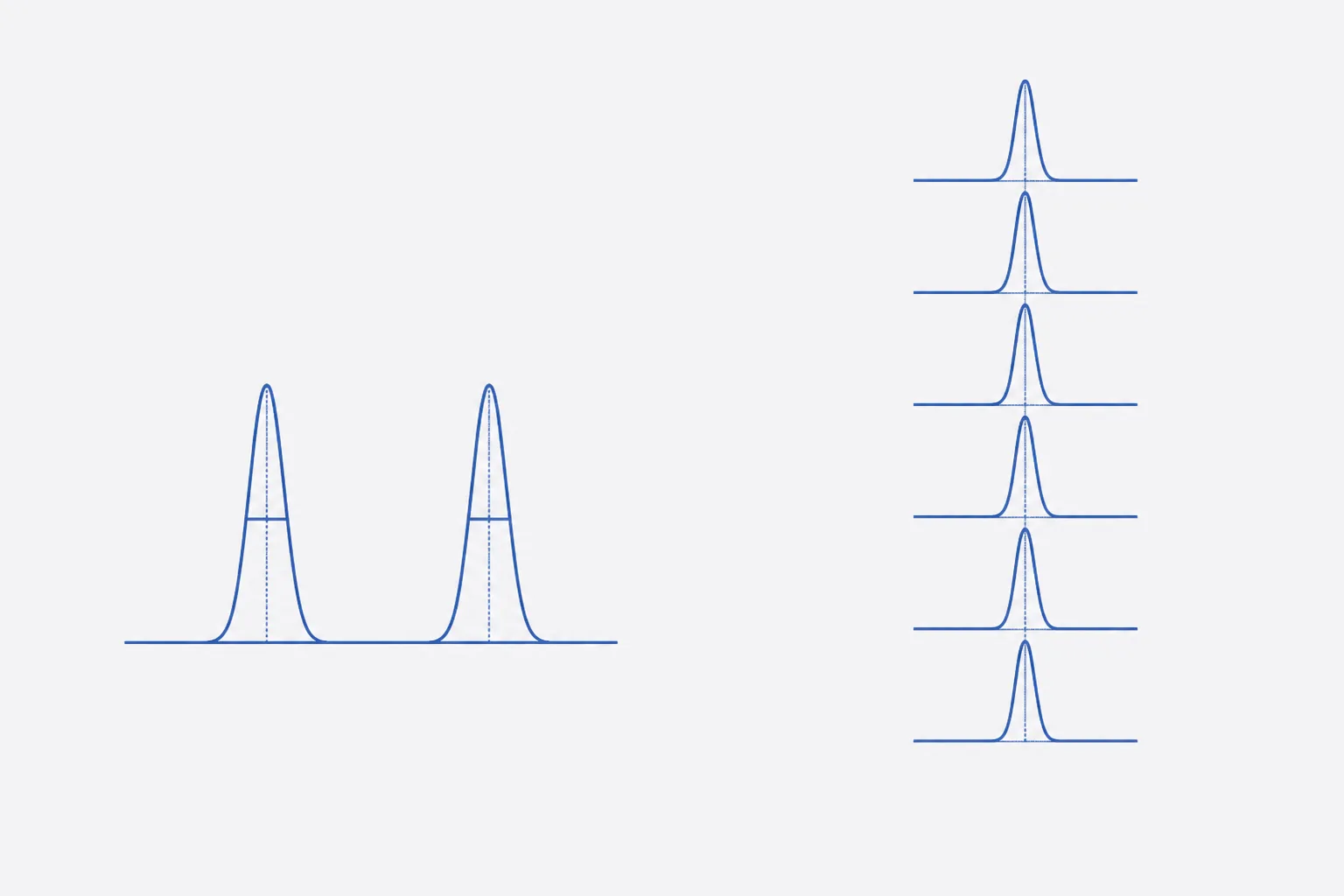
The parameters and their formulas
The parameters are defined in the chromatography chapters of the pharmacopoeias, which were revised and harmonised between the European, Japanese and United States texts; the harmonised United States chapter became official on 1 December 2022 1 2. The formulas below use retention time (tR), peak width at half height (wh), and peak heights measured from the baseline.
| Parameter | Formula | What a failure indicates |
|---|---|---|
| Resolution (Rs) | 1.18 × (tR2 − tR1) / (wh1 + wh2) | Loss of separation of the critical pair: column ageing, wrong mobile phase, gradient or temperature drift |
| Plate number (N) | 5.54 × (tR / wh)² | Loss of column efficiency; void at the column inlet; extra-column volume |
| Symmetry factor (As) | w0.05 / 2d, where w0.05 is the width at 5% height and d the leading half-width | Tailing from secondary interactions or column damage; fronting from overload or strong sample solvent |
| Repeatability | Relative standard deviation of replicate injections | Injector, pump or detector imprecision; unstable sample |
| Signal-to-noise (S/N) | 2H / h, H the peak height and h the noise range | Loss of sensitivity; lamp ageing; contaminated flow cell |
| Peak-to-valley ratio (p/v) | Hp / Hv, the minor peak height over the valley height | Used where a pair cannot reach baseline separation |
| Retention time | Compared with an expected window | Mobile-phase error, flow error, dwell-volume difference |
For a gradient peptide method, the plate number is less informative than it looks. Gradient elution compresses peaks, so the apparent plate count is high and changes with gradient slope as much as with column condition. Resolution between the pair of peaks hardest to separate — the critical pair — measures what the method exists to do and should carry the most weight.
Worked calculations
Take a generic 20-residue peptide whose critical pair is a deletion impurity eluting at 20.40 min (wh 0.20 min) ahead of the main peak at 21.00 min (wh 0.22 min). Resolution is 1.18 × 0.60 / 0.42, which is 1.69. The plate number of the main peak is 5.54 × (21.00 / 0.22)², about 50,500. Six replicate injections of the standard give areas of 1502, 1498, 1510, 1495, 1505 and 1500; the mean is 1501.7, the standard deviation 5.3, and the relative standard deviation 0.35%.
A resolution of 1.5 corresponds to close to baseline separation for two peaks of similar size, which is why it is a common minimum for a critical pair. Where the impurity is small beside a large main peak, 1.5 may not be enough for the small peak to integrate cleanly, and a higher limit or a peak-to-valley criterion is used instead.
Building the test for a peptide purity method
- Identify the critical pair from development data: usually the main peak and its closest-eluting impurity, often a deletion, an oxidised form or an aspartimide.
- Prepare a resolution solution that contains both: a sample stressed to generate the impurity, or the standard spiked with an impurity marker.
- Prepare a sensitivity solution at the reporting level, for example the standard diluted to 0.1% of the working concentration.
- Prepare the reference standard at the working concentration for replicate injections.
- Inject in this order: blank, resolution solution, sensitivity solution, replicate standards, then samples.
- Place a check standard after every block of samples and at the end, and set a limit on its drift from the opening standards.
- Write every criterion into the method, with the action to take on failure.
The sensitivity check follows the quantitation-limit convention in ICH Q2(R2), where a signal-to-noise ratio of about 10 is a common basis for the lowest level that can be quantified with acceptable precision 3. If the reporting-level solution does not reach that ratio, impurities at the reporting level cannot be reported reliably from that sequence.
| Check | Solution | Example criterion |
|---|---|---|
| Blank | Diluent | No peak above the reporting level at the retention time of the main peak or known impurities |
| Resolution | Resolution solution | Rs of the critical pair at least 1.5 |
| Symmetry | Standard | Symmetry factor of the main peak 0.8–1.8 |
| Repeatability | Six replicate standard injections | Relative standard deviation of area not more than 2.0% |
| Sensitivity | Reporting-level solution | S/N at least 10 |
| Retention | Standard | Main peak within ±2% of the established retention time |
| Drift | Check standards | Within 2.0% of the mean opening standard area |
The symmetry range in the table is the harmonised pharmacopoeial default for peaks used in quantitative tests 1. The pharmacopoeial repeatability requirement for assays is not a single fixed figure: the chapters calculate a maximum permitted relative standard deviation from the specification limits and the number of replicate injections 2. The other limits are typical in-house choices. Limits copied from elsewhere are either too tight for your system or so loose that they never fail; setting them from your own validation runs avoids both.
What a reference standard is
The World Health Organization's guidelines define a primary chemical reference substance as one widely acknowledged to have the appropriate qualities within a specified context, whose assigned content is accepted without comparison with another substance. A secondary reference substance is one whose characteristics are assigned by comparison with a primary 5. ICH Q7 uses the same division for active-substance manufacture: a primary standard is shown by an extensive set of analytical tests to be authentic material of high purity, and a secondary standard is established by comparison with the primary and used for routine analysis 4.
| Tier | Source | How its value is established | Use |
|---|---|---|---|
| Pharmacopoeial or certified | Official body or accredited producer | Assigned by the issuer | Primary, where one exists for the analyte |
| In-house primary | A well-purified, fully characterised batch | Mass balance from orthogonal determinations | Assigning working standards |
| Working (secondary) | A routine batch | Qualified against the primary | Daily assays and system suitability |
| Impurity marker | Synthesised or isolated impurity | Identity by mass and retention; content where needed | Resolution solutions and peak assignment |
Characterising an in-house primary standard
For most research peptides no pharmacopoeial standard exists, so the laboratory characterises its own. The WHO guidelines state the principle: the determinations of water, organic solvents, inorganic impurities and organic components should together amount to 100% 5. For a peptide that means identity by mass and fragmentation, chromatographic purity, water by Karl Fischer titration, counter-ion by ion chromatography, and peptide content by amino acid analysis as an independent check.
A worked mass balance: chromatographic purity 98.5%, water 6.0%, trifluoroacetate 12.0%, no detectable residual solvent or inorganic residue. The peptide content as is, meaning per unit of weighed solid, is (100 − 6.0 − 12.0) × 0.985, which is 80.8%. The same material expressed on an anhydrous, counter-ion-free basis is 98.5%. Both are correct and they differ by nearly 18 percentage points, which is why the basis must be written beside every assigned value. The European guideline on synthetic peptides expects assay limits by liquid chromatography to be expressed on the counter-ion-free, anhydrous basis unless otherwise justified 6.
Qualifying a working standard
- Confirm identity of the candidate batch by mass and by retention time against the primary.
- Determine water content on the day of qualification.
- Prepare at least three independent weighings each of the primary and the candidate at the working concentration.
- Run both under a passing system suitability test in the same sequence.
- Calculate the candidate's content from the primary's assigned value, correcting for the water content of both on the day.
- Accept the candidate if replicate preparations agree within a predefined limit, and assign the mean value with its basis.
- Record the assigned value, basis, qualification date, requalification date and storage condition.
Storage, moisture and requalification
Peptides are often very hygroscopic, and moisture uptake changes the weighed mass without changing the peptide. The European guideline expects precautions against moisture uptake by peptide reference standards during storage and analysis, confirmation of moisture content before use where appropriate, and a stated approach to requalification that prevents drift in peptide content; a dissolved reference substance is an accepted alternative 6. The WHO guidelines add that cold rooms and refrigerators can be humid, that storage at about 5 °C with protection from moisture suits most reference substances, and that containers should not be opened until they have reached room temperature 5.
- Divide the standard into single-use aliquots in tightly closed containers, so the main stock is never opened repeatedly.
- Store with desiccant, and let each container reach room temperature before opening.
- Weigh on a balance whose calibration is current, in conditions controlled for static and humidity.
- Determine water on the day of use, or use a dissolved standard of known concentration and stability.
- Requalify on a written schedule, and sooner if system suitability results drift.
What counts as a significant change depends on use. The WHO guidelines note that a few per cent of degradation may not impair a standard used for identification, while even small amounts of impurity may be unacceptable in a standard used for chromatographic assay, and that the tolerable degradation should be defined in advance 5.
Records
| Field | Content |
|---|---|
| Identifier | Internal code, source and batch |
| Tier | Primary, working or impurity marker |
| Assigned value and basis | For example 80.8% as is, or 98.5% anhydrous and counter-ion-free |
| Evidence | Reference to the characterisation or qualification data |
| Dates | Qualification, next requalification, expiry |
| Storage | Temperature, desiccant, aliquot scheme |
| Use log | Each aliquot opened, date, analyst and sequence |
Every sequence record should then carry the system suitability results against their criteria, the identifier of the standard used, and a clear pass or fail before any sample result. A result reported from a sequence whose suitability test failed, or from a standard past its requalification date, is not a result.
References
- <621> Chromatography (harmonised text)
- Ph. Eur. Commission adopts harmonised general chapter 2.2.46. Chromatographic separation techniques
- ICH Q2(R2) Validation of Analytical Procedures
- ICH Q7 Good Manufacturing Practice Guide for Active Pharmaceutical Ingredients
- General guidelines for the establishment, maintenance and distribution of chemical reference substances (WHO Technical Report Series No. 943, Annex 3)
- Guideline on the Development and Manufacture of Synthetic Peptides (EMA/CHMP/CVMP/QWP/367182/2025)