storage
Stability of Peptides in Solution: Controlling Variables and Handling Practice
Solution-phase stability is a different problem from the dried solid, governed by different variables. Covers the pH trade-off, adsorptive loss to containers, and a single-use aliquot procedure.
Shorter than in the dried solid by a wide margin, and quantifiable only for a formulation that has been tested. Dissolving lyophilised material restores the reagent freeze-drying was performed to remove: water is the reactant in backbone hydrolysis and in deamidation of asparagine and glutamine, and putting it back restores both routes. For the same sequence under comparable conditions, degradation in solution proceeds orders of magnitude faster than in the solid state 12. The usable interval is a property of the conditions the solution is held under, not of the peptide.
Why solution is a different problem
Two things change on reconstitution, together. Water returns as a reactant, in enormous excess over the peptide. And molecular mobility returns: in a dry cake below its glass transition, reaction is limited not only by the scarcity of water but by the inability of reactants to move far enough to meet. In solution neither limit applies 12.
The routes are the same routes — backbone hydrolysis, deamidation through the cyclic imide, oxidation of methionine, cysteine and tryptophan, disulfide exchange, aggregation. What changes is the rate, and with it which route matters first 2. Deamidation is the clearest case of a route belonging to the solution phase: the succinimide intermediate that drives it forms far more readily where the backbone is mobile and solvated 3.
Storage decisions taken for the solid therefore do not carry over. Minus 20 °C is a routine long-term condition for a sealed dry cake. For a solution it is a holding condition of limited duration, and every excursion to ambient stresses the whole of what remains in the vessel.
The controlling variables
Seven variables account for most of the difference between a solution that holds and one that does not. The direction of effect is general; the magnitude is sequence- and formulation-dependent and is not 12.
| Variable | Direction of effect | Practical control |
|---|---|---|
| Temperature | Every covalent route accelerates. Steep and continuous; no threshold below which chemistry stops | As cold as the physical form allows. Frozen for storage, chilled while working, minimum time at ambient |
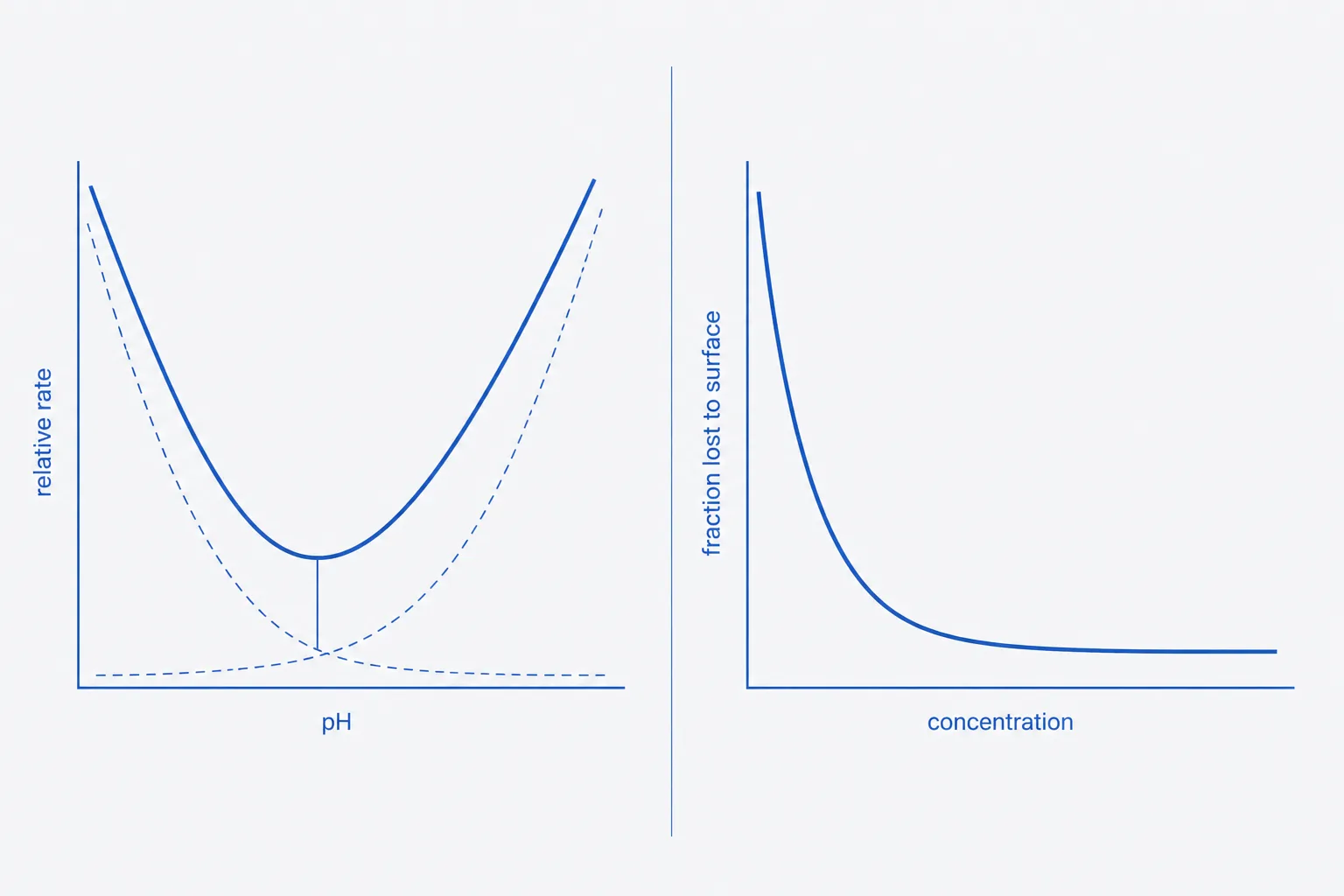
| pH | Dominant. Base-catalysed routes accelerate above neutral, aspartyl cleavage at low pH. U-shaped profile, sequence-dependent minimum | Buffer deliberately rather than accepting what the solvent gives. Measure the final solution |
| Ionic strength | Modest beside pH and temperature. Screens electrostatic repulsion, favouring association | Keep salt to what the work requires. The buffer species participates — phosphate is a general base catalyst |
| Concentration | Both directions. Aggregation rises with concentration; fractional loss to surfaces rises as it falls | Work mid-range. Prepare dilute working solutions fresh rather than storing them dilute |
| Dissolved oxygen | Raises oxidation of methionine, cysteine, tryptophan and tyrosine. Enters at every opening | Minimise headspace and openings. Amber or opaque containment, since light drives the same chemistry |
| Trace metals | Iron and copper catalyse site-specific oxidation. Sources are ordinary: glassware, steel, unpurified salts | High-purity salts, fresh solvent, a chelator where the downstream work tolerates one |
| Container surface | Removes material by adsorption without altering what remains. Worst at low concentration | Low-binding polypropylene, silanised glass, or a carrier protein where the assay tolerates it |
The variables are not independent, and a control chosen for one route can worsen another. Lowering pH to suppress deamidation moves the solution towards the region where aspartyl cleavage is fastest. Freezing suppresses every covalent route but introduces ice-water interfaces and freeze-concentration, both of which promote aggregation, and some buffers shift pH as they freeze 2.
pH as the dominant lever
For many sequences the region of greatest solution stability sits in a mildly acidic window rather than at neutrality 12. That is a reasonable starting point and a poor specification.
Above neutrality, deamidation accelerates sharply. It runs through a five-membered cyclic imide formed when the backbone nitrogen of the following residue is deprotonated and attacks the asparagine side-chain carbonyl; the rate-determining step is base-catalysed, so rate rises with pH 3. Sequence context governs it as strongly as pH does — Asn-Gly is fastest, β-branched neighbours much slower, and an asparagine followed by proline cannot form the intermediate at all 3.
Below roughly pH 4 the cyclic route largely shuts down and a second takes over. The protonated aspartyl side chain attacks the adjacent backbone carbonyl and cleaves the chain from within, so acid-catalysed hydrolysis at Asp-X sites — Asp-Pro and Asp-Gly in particular — becomes the fastest loss route 2.
The two minima do not coincide, and that is the honest consequence. The pH at which deamidation is slowest lies inside the region where aspartyl cleavage is fastest. Where a sequence carries both an asparagine in a labile context and a susceptible aspartyl bond, the choice is a compromise rather than an optimum, and which compromise is correct depends on the residues that sequence contains 1. Treat a mildly acidic buffer as a defensible default, record it, and where the outcome matters establish the optimum by measurement.
Two operational points follow. The pH that matters is that of the final solution, after the peptide and any counter-ion carried over from purification — measure it rather than inferring it from the recipe. And buffer pH is temperature-dependent, so a solution adjusted at ambient is not necessarily at that pH once chilled.
Concentration acts in both directions
Concentration is usually set by convenience, and it fails at both ends. Dilute solutions lose material to surfaces: adsorption removes an approximately fixed quantity per unit of exposed surface, so the fraction lost rises as concentration falls, and below some point it becomes the dominant term in the result 4.
Concentrated solutions aggregate. Association is higher-order in concentration, and the crowding that suppresses proportional surface loss raises the probability that two partly unfolded chains meet. Aggregation is faster again near the isoelectric point, where net charge no longer keeps molecules apart, and at interfaces 2.
There is a workable middle, but its position is sequence- and solvent-dependent and no general figure exists. Where a dilute working solution is unavoidable — a standard curve or a low-concentration control — prepare it fresh from a concentrated stock immediately before use, in low-binding vessels, rather than holding it dilute.
Adsorption to container surfaces
Adsorption warrants separate treatment because it is the most common invisible source of apparent potency loss. The material has not degraded. It is on the wall of the vessel, and the solution left behind is more dilute than the arithmetic says 4.
Loss is substantial at low concentration and worst at the two extremes of character: hydrophobic sequences partition onto plastic, and highly charged or basic sequences interact with ionised silanol groups on glass 4. Both operate on ordinary labware at ordinary working concentrations, and losses are cumulative — every tube, tip and plate well presents fresh surface.
The signature at the bench is a standard curve reading uniformly low, a serial dilution falling away faster than the dilution factor, or a result that changes when the labware changes and nothing else does. None of that resembles chemical degradation.
| Surface | Adsorptive behaviour | Practical handling |
|---|---|---|
| Untreated borosilicate glass | Ionised silanol groups bind charged and basic sequences; appreciable at low concentration | Acceptable for concentrated stocks. Silanise, or move to low-binding plastic, for dilute work |
| Silanised glass | Silanol groups capped, binding markedly reduced | The usual glass option for dilute solutions. Confirm the treatment survives repeated cleaning |
| Standard polypropylene | Hydrophobic surface binds hydrophobic sequences | Adequate for concentrated stocks; not for dilute work without checking recovery |
| Low-binding polypropylene | Treated to reduce hydrophobic partitioning; the general-purpose choice | Specify it. Do not assume a tube is low-binding because it is polypropylene |
| Polystyrene, including many plates | Strongly binding; the usual failure point in plate-based work | Low-binding plates, or block the surface where the assay tolerates it |
Three mitigations, in increasing order of intervention. Choose low-binding polypropylene or silanised glass by default rather than by exception. Add a carrier protein — a low concentration of bovine serum albumin is usual — which occupies binding sites in preference to the peptide, wherever the assay tolerates it 4. Where neither is possible, pre-rinse the vessel with the peptide solution and discard the rinse, taking the loss at a known point rather than in the result.
Preparation and single-use aliquots
The sequence below removes the most avoidable loss. It is ordered so that every decision fixing a variable is made once, before the material is divided.
- Decide the storage concentration and the aliquot volume before dissolving anything. Set the aliquot volume to the smallest quantity a single routine use consumes, so no aliquot is opened twice.
- Choose solvent and buffer deliberately and record both. Measure the pH of the final solution after the peptide has dissolved.
- Dissolve gently. Swirl or invert; avoid vortexing and vigorous shaking, which generate air-liquid interface and promote aggregation.
- Inspect against a light before dividing. Undissolved solid, haze or fibres are a reason to stop, not to proceed carefully.
- Dispense into low-binding single-use tubes, one tube type throughout. Do not mix labware within a preparation.
- Label every aliquot with identity, lot reference, concentration, solvent and buffer, date and preparer. A tube carrying only a name is unusable evidence six weeks later.
- Freeze promptly, in the dark, at the coldest condition available, in a manual-defrost unit.
- Thaw one aliquot, thaw it once, use it, discard the remainder. Do not refreeze and do not top one aliquot up from another.
Aliquoting is the highest-value habit in solution handling, and the reason is structural rather than incremental. A stock held in one vessel takes a warming cycle, an ice-water interface, an air-liquid interface and a fresh admission of oxygen every time any quantity is withdrawn, and each insult falls on the entire remaining volume rather than on the portion taken. Freeze-thaw damage is cumulative, unrecorded and largely physical 2. Dividing the material converts a repeated freeze-thaw problem into a single-use one, at a cost of one careful session.
Assessing a stored solution
Inspect every solution before use, and do not trust the inspection. It detects gross failure only. Precipitate, cloudiness, opalescence, visible fibres, a change of colour, or a dropped meniscus all indicate a problem, and material showing any of them should not be used. Their absence indicates nothing.
Deamidation, oxidation, aspartyl isomerisation, disulfide scrambling and racemisation produce no change visible to the eye at the levels that matter analytically 1. Adsorptive loss produces none by definition: the solution left behind looks exactly like the one prepared 4. A clear, colourless solution is consistent with full potency and equally consistent with substantial loss.
- Still at the stated concentration? Not answerable by inspection. Adsorptive loss is invisible and largest in the dilute solutions where it matters most.
- Degraded chemically? Not answerable by inspection. Chromatography against a fresh reference, same column and mobile phase, same day, is the minimum.
- Aggregated? Partly. Visible haze confirms it; a clear solution does not exclude soluble aggregate, which needs size-exclusion chromatography or light scattering.
- Fit to use? A question about the record — time held, temperature, pH, thaw count, container — not about appearance.
Where the answer matters and no measurement is available, prepare fresh from solid. A new solution from a properly stored cake is a known starting point; an old solution of unrecorded history is not.
Recording preparation and storage
The record is what makes an anomalous result traceable to a handling event rather than leaving it unexplained. Enter the following at the time of preparation.
- Identity of the material, lot reference, and the source vial the quantity came from.
- Quantity dissolved, the basis on which it was taken — as supplied, or corrected for stated peptide content — and the balance record.
- Solvent and buffer, including species and concentration, and the measured pH of the final solution.
- Final concentration in the units the downstream work uses, and the volume prepared.
- Aliquot volume, number of aliquots, and the labware type used for dispensing and storage.
- Date, time and preparer.
- Storage unit, temperature band and position, logged to shelf and box.
- A running line per aliquot removed: date, identifier, appearance on thaw, and the work it was consumed by.
- Any deviation, exactly as it occurred — delayed return to storage, unit alarm, power interruption, an aliquot refrozen against practice, a change of labware mid-preparation.
- The date the preparation is retired and the reason: consumed, held beyond the interval local practice allows, or discarded on inspection.
The last two entries are most often skipped and most useful in retrospect. A deviation recorded at the time is an explanation; the same deviation recalled six weeks later is a guess. Where an anomaly appears across two preparations with different histories, the record is what separates a problem with the material from a problem with the handling 1.
References
- Stability of protein pharmaceuticals: an update
- Instability, stabilization, and formulation of liquid protein pharmaceuticals
- Deamidation, isomerization, and racemization at asparaginyl and aspartyl residues in peptides. Succinimide-linked reactions that contribute to protein degradation
- The importance of using the optimal plasticware and glassware in studies involving peptides