preparation
Filtration and Particulate Control: What a Membrane Removes, Including Peptide
Filtration removes particulate and aggregate above the pore rating, and removes peptide by binding it to the membrane. Membrane materials compared, with a procedure for re-measuring what survives the pass.
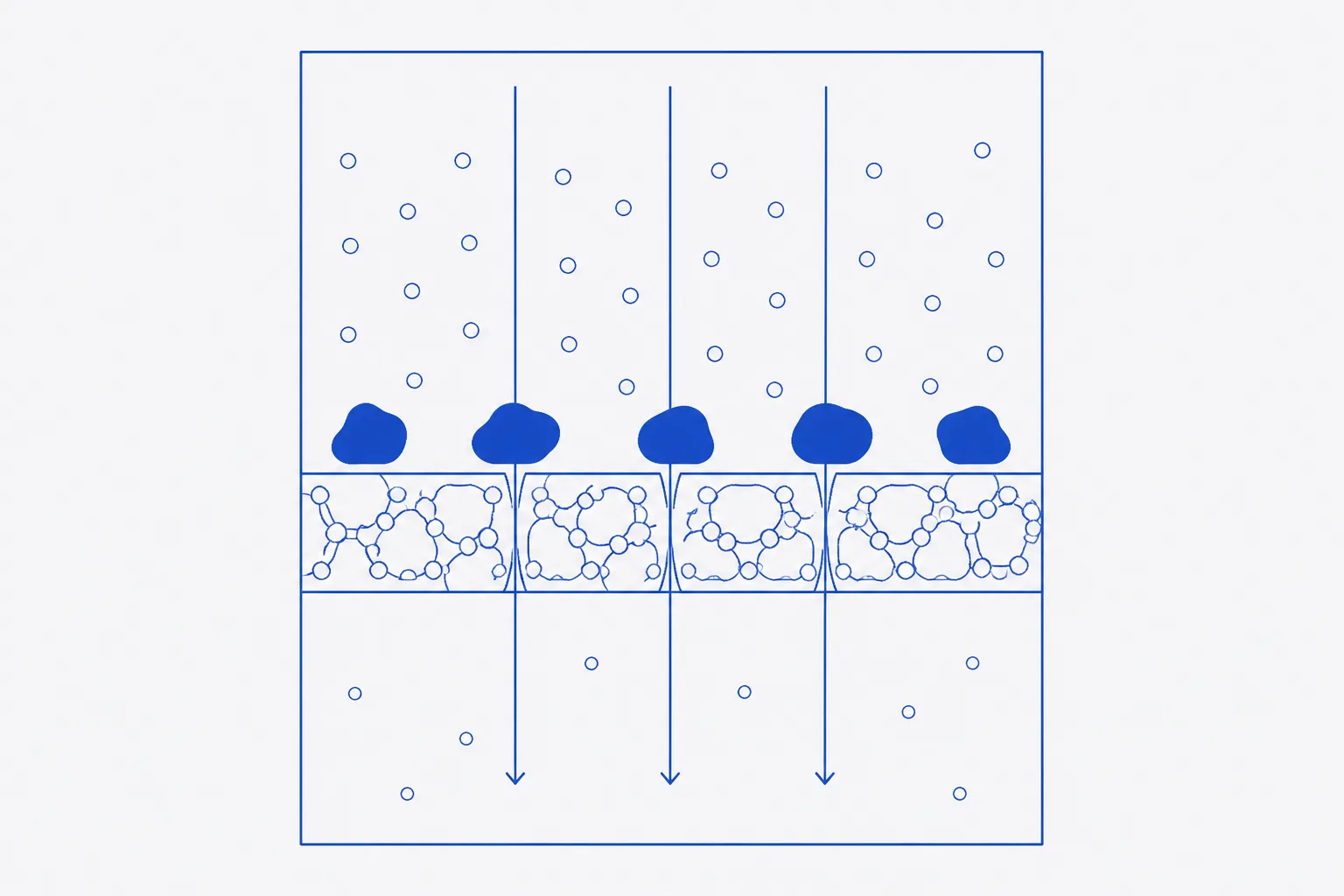
Yes — a filtration step removes peptide as well as particulate, because peptide adsorbs to the membrane as the solution passes through it. This is the same surface binding that strips peptide onto tube walls and pipette tips, operating on a material presenting a very large internal surface area within a very small volume 2. The loss is not a fixed percentage. It is proportionally largest where the total quantity of peptide is smallest — dilute solutions, small volumes. A preparation filtered and then assumed to hold its pre-filtration concentration may be substantially wrong.
What filtration removes, and what it does not
Filtration is a size-exclusion operation: a membrane of a stated pore rating retains material larger than that rating and passes everything smaller. That is the whole of the mechanism. It removes insoluble particulate — dust, fibre, undissolved solid, precipitate — and aggregate grown beyond the rating. Aggregation proceeds along a size continuum, from soluble dimers and small oligomers through submicron species to visible precipitate 1. A membrane intercepts that continuum at exactly one point; everything below the cut passes untouched.
It does not achieve chemical purification. Soluble oligomers below the rating pass unchanged, and they are the species of most analytical concern precisely because they are invisible and because they seed further aggregation 1. Degradation products — deamidated, oxidised or truncated forms — are the same order of size as intact peptide and pass entirely 3. Counterions, salts, buffer components and residual solvents pass. Endotoxin passes: lipopolysaccharide is small enough to cross an ordinary sterilising-grade membrane and is not removed by it 4.
Retention of bacterial cells is the one contamination-control function a membrane performs well. In laboratory work this is housekeeping: it suppresses microbial growth in a preparation held at ambient temperature or incubated over days, removing a source of experimental artefact. It is a control on the sample, and nothing more should be read into it.
| Species | Removed? | Note |
|---|---|---|
| Dust, fibre, undissolved solid | Yes | The intended target. Also removes evidence that dissolution failed |
| Visible precipitate, large aggregate | Yes | Removed as mass. The peptide in it is lost, not recovered |
| Submicron aggregate below the rating | No | Needs a finer rating or another technique |
| Soluble dimers and oligomers | No | Same order of size as the monomer |
| Deamidated, oxidised, truncated forms | No | Altered, not larger. Only a separative assay resolves these |
| Counterions, salts, buffer components | No | Dissolved and small. Not a desalting step |
| Endotoxin | No | Lipopolysaccharide crosses the membrane |
| Bacterial cells | Yes | The basis of filtration as contamination control |
Loss to the membrane
Peptides adsorb to solid interfaces through hydrophobic and electrostatic interaction, and a membrane is an unusually severe interface: a porous structure whose internal surface area far exceeds its face area, presented to the whole sample under pressure 2.
Two properties make this a hazard rather than an inconvenience. The first is that it does not scale with the sample. A membrane binds toward a saturation quantity — roughly a fixed mass for a given material and area — largely irrespective of how much is offered. Pass several millilitres of a concentrated solution and the bound mass is a minor fraction; pass a few hundred microlitres of a dilute one and the same bound mass may be a large fraction of everything present. The loss is worst exactly where material is scarcest 2.
The second is that it leaves no trace. The filtrate is clear, its volume close to what was applied, and nothing in its appearance reports that a share of the solute stayed behind. A clear filtrate carrying an assumed concentration is a preparation whose most important number has never been measured.
The magnitude cannot be predicted from first principles. It depends on the hydrophobicity and net charge of the sequence, the membrane material, the pH and ionic strength of the solution, any carrier protein or surfactant present, and the ratio of volume to membrane area 23. Treat it as unknown until measured.
Membrane materials compared
| Material | Adsorption tendency | Chemical compatibility | Typical use |
|---|---|---|---|
| PVDF | Low; lower in treated low-binding grades | Aqueous and many organic solvents | General aqueous peptide solutions. The usual default |
| PES (polyethersulfone) | Low; comparable to PVDF | Aqueous and mild alcohols. Poor with strong organics | Aqueous buffers wanting high flow at low pressure |
| Cellulose acetate | Low | Aqueous only. Hydrolyses at pH extremes | Buffers where recovery outweighs solvent range |
| Nylon | High. Binds peptide strongly | Broad solvent range, hence its presence in stock | Solvent and mobile-phase filtration. Not peptide solutions |
| PTFE | Low, but hydrophobic and not water-wetted | Widest of the group. For aggressive organics | Solvents and gas. Aqueous use needs a hydrophilic grade |
Nylon is the classic avoidable error: common in stock, inexpensive, broad in compatibility, and binding peptide more strongly than any alternative above. A nylon unit reached for because it was in the drawer removes a share of the material and reports nothing 2. Match the membrane to solvent and solute, and record which was used — "filtered" in a notebook, without material and rating beside it, is not a reproducible record.
Pore ratings and what each is for
A pore rating is a retention specification, not a measurement of hole diameter. Membranes carry a distribution of pore sizes and are rated by performance against a challenge standard, so the figure describes what is retained rather than a dimension present throughout.
- 5 µm and 1.2 µm — coarse clarification. Removes fibre, dust and heavy precipitate ahead of a finer membrane, stopping it blinding.
- 0.45 µm — general clarification. The usual rating before an instrument injection where microbial retention is not the object.
- 0.22 µm — the standard microbial-retention rating. Controls microbial growth in preparations held or incubated over time.
- 0.1 µm — retention of smaller organisms. Slower, higher back-pressure, more internal surface contacted, so more adsorptive loss.
- Ultrafiltration by nominal molecular weight cut-off — a different operation, used to concentrate or exchange buffer, not to clarify.
Finer is not better. Every reduction in rating raises back-pressure and increases the surface the solution contacts, and so increases adsorptive loss. State the object first, then select the coarsest rating that achieves it.
Pre-rinsing, low-binding grades and hold-up volume
Because a membrane binds toward a finite quantity, the loss can be shifted onto material that does not matter. A sacrificial volume passed first — buffer of the same composition, an aliquot of the sample itself, or a dilute carrier protein where the assay tolerates one — occupies binding sites before the sample proper is applied 23. That pass is discarded; what follows meets a partly saturated surface and loses less.
A buffer rinse has a second benefit: it flushes manufacturing residues — wetting agents, glycerol, other extractables — which otherwise enter the filtrate and can interfere with a downstream assay or with the stability of the preparation 3.
"Low protein binding" is a manufacturer designation for membranes surface-treated to reduce adsorption. It is a relative claim against untreated material of the same type, made against protein standards rather than any particular peptide. Worth specifying, but it reduces the loss rather than removing it, and it is no substitute for measuring what came through.
Hold-up volume — liquid retained in the membrane and device body after the pass — is a separate, purely mechanical loss. It is fixed by the device, scaling with diameter rather than with the sample, and for small units is typically tens of microlitres. Against several millilitres that is a rounding error; against a few hundred microlitres it is a substantial fraction, and at the smallest scale a device can retain more than it delivers. Choose the smallest diameter that will pass the volume, and account for hold-up separately: one loss is geometry, the other chemistry.
Procedure: filtration and re-quantification
- State why the solution is being filtered and what is expected to be removed. If the answer is "to remove a precipitate", read the next section first.
- Record the concentration of the unfiltered solution by measurement, not by calculation from a labelled mass.
- Select the membrane against the solvent and the solute, not against what is in stock, specifying a low-binding grade where one exists.
- Select the coarsest rating that meets the object, and the smallest device diameter that will pass the volume.
- Pre-rinse with the solution's own buffer, or pre-saturate with a sacrificial aliquot of the sample. Discard that volume without exception.
- Pass the sample at low, steady pressure. Do not force a blinding membrane — replace it. Forcing raises pressure across retained aggregate and drives material through.
- Record the volume recovered. The shortfall is hold-up, and it is a real loss, not a measurement error.
- Re-measure the filtrate concentration by the method used in step 2, so the two figures are comparable.
- Record both concentrations and the recovery between them, with membrane material, rating, device diameter and any pre-rinse.
- Use the post-filtration figure in every downstream calculation. The pre-filtration figure describes a solution that no longer exists.
When not to filter
Filtration is often applied as a reflex to a preparation that looks wrong. That is the case in which it does the most damage.
A cloudy or visibly precipitated solution has already failed. The particulate is peptide that has left solution — aggregated, denatured or salted out — and a membrane removes that mass permanently 1. What remains is clear, at an unknown and lower concentration, carrying no visible sign of what happened. Filtering a failed preparation does not restore it. It conceals the failure, converting an obvious problem into an invisible one that surfaces later as an unexplained result.
The correct response to visible precipitate is diagnostic: establish why it formed — pH near the isoelectric point, an incompatible solvent, excessive concentration, thermal or freeze–thaw stress, agitation at an air–liquid interface 13 — and prepare again under corrected conditions. Where material is scarce and re-preparation is impossible, filtration is defensible only if the filtrate concentration is measured and the batch flagged as compromised in the record.
Two further cases argue against filtering: very dilute solutions and very small volumes, where proportional adsorptive loss outweighs the benefit of clarification; and any preparation on which aggregation itself is being measured, since filtration removes part of the population being characterised.
Centrifugation as an alternative
Where the object is clarification rather than microbial retention, centrifugation is the alternative. Drawing the supernatant off a pellet removes dense particulate without a membrane, so without a large adsorptive surface and without device hold-up. Loss to the tube wall still applies, but that is the loss the container already imposes 2.
Its limitation is that separation is by sedimentation rate — density and size — not by a size cut-off. Small or low-density aggregate does not pellet at ordinarily available speeds and stays in the supernatant, so a clarified solution is not equivalent to a filtrate. The pellet is loosely held and easily disturbed on withdrawal, returning the removed material. And centrifugation does not retain bacteria, so where microbial control is the object it is no substitute. Where clarification alone is wanted and the particulate is dense enough to pellet, it is the lower-loss operation.