Formulation and lyophilisation
Lyophilisation Excipients: Bulking Agents and Lyoprotectants
What mannitol, glycine, sucrose, trehalose and buffer salts each do in a freeze-dried peptide formulation, how each behaves on freezing and drying, what goes wrong with each, and a procedure for reading excipient content from a label and a certificate of analysis.
In a lyophilised peptide formulation, mannitol and glycine are bulking agents: they crystallise during freezing and give the cake its mass and shape. Sucrose and trehalose are lyoprotectants: they stay amorphous and hold the peptide in a rigid sugar glass. Buffer salts fix the pH of the solution before freezing, but several of them crystallise selectively as the solution freezes and shift the pH of what remains. Together these excipients usually make up more than nine tenths of the solid in a formulated vial, so the mass of the cake says almost nothing about the mass of peptide in it 12.
This page is the formulation chemistry. The companion pages on net peptide content and on the storage of lyophilised peptides cover what excipient mass does to a gross weight and how a dried cake is kept. Here the questions are which excipient does what, how each behaves when the solution is frozen and dried, what goes wrong with each, and how the composition can be read back from a label and a certificate of analysis. Worked figures use an invented peptide and describe no real product.
Why a lyophilised peptide is rarely peptide alone
A peptide solution that is simply frozen and dried gives a cake that is thin, fragile and sometimes hard to see: one milligram of solid spread over the base of a 2 mL vial is a film, not a cake. Formulated products therefore add solids. A bulking agent supplies enough mass for a cake that can be seen, inspected and handled; a lyoprotectant protects the active during freezing, drying and storage; a buffer sets the pH; a surfactant, where used, limits adsorption and aggregation at interfaces. Every one of these adds to the mass in the vial and none of them is peptide 2.
Bulking agents: mannitol and glycine, crystalline behaviour
Mannitol is the default bulking agent for lyophilised injectables and the most studied 3. In a frozen solution it crystallises, either during freezing or during an annealing hold, and the ice–mannitol eutectic melts at about −1.5 °C. Glycine behaves the same way, with a eutectic near −3.5 °C 18. A crystalline matrix tolerates product temperatures far above the Tg′ of any sugar, which is why a mannitol-only formulation can be primary-dried at −10 to −20 °C and finish in a fraction of the time an amorphous formulation needs. The cake is white, opaque, rigid, full height and dissolves almost at once.
The cost is that a crystal protects nothing. The peptide is excluded from the mannitol lattice and ends up in whatever amorphous phase remains, concentrated and unprotected. Carpenter and colleagues warned against mannitol as the sole stabiliser for exactly this reason: a formulation that looks elegant can be the least stable version of itself 1. Where mannitol is used with an active that needs protection it is paired with an amorphous sugar, and the two phases coexist in the cake.
Lyoprotectants: sucrose and trehalose, the glassy state
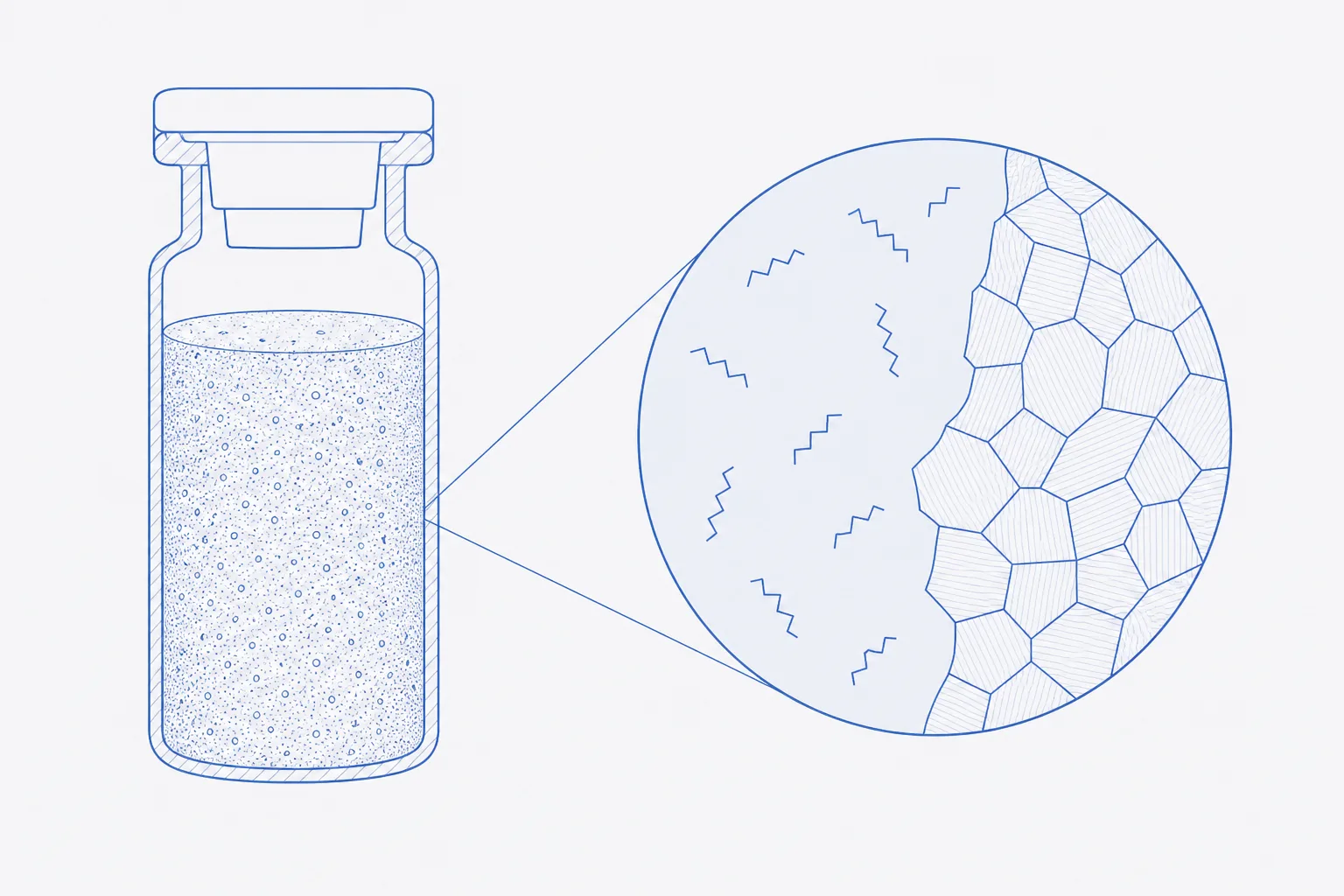
Sucrose and trehalose do not crystallise from a frozen solution under normal lyophilisation conditions. As ice forms they are concentrated into an amorphous phase that becomes a glass at Tg′: about −32 °C for sucrose and −29 °C for trehalose 8. The peptide is concentrated into the same phase and dispersed in the sugar. After drying, the sugar glass has a far higher glass transition, roughly 75 °C for dry sucrose and roughly 115 °C for dry trehalose, and the lower the residual water the higher it sits 24.
Two rules follow. First, the sugar must stay amorphous: a sugar that crystallises during drying or storage expels the peptide from the glass and stops protecting it, which is why sucrose cakes at high residual moisture or high humidity can lose stability abruptly 2. Second, quantity matters. Carpenter and colleagues recommend a sugar-to-protein mass ratio of at least 1:1 as a starting point, and ratios of 1:1 to 5:1 are common in practice 1. For a small peptide at 1 mg per vial this is a few milligrams of sugar, far less than a bulking agent supplies, which is why the two classes are so often combined.
Vitrification and water replacement as stabilisation hypotheses
Two explanations are offered for why an amorphous sugar protects a peptide or protein in the dried state, and the solid-state evidence supports both acting together 4. The vitrification hypothesis holds that the glass is so viscous that molecular motion is arrested: the molecule cannot unfold, cannot diffuse to meet another and aggregate, and reactions that need two partners to meet are slowed by orders of magnitude. On this view stability tracks the gap between the storage temperature and the glass transition of the dried cake, and a cake stored far below its Tg is a cake in which little moves.
The water-replacement hypothesis holds that the sugar substitutes for the water that is removed. Hydroxyl groups on the sugar hydrogen-bond to the backbone and side chains where water molecules used to be, preserving the hydrated conformation through drying. The infrared evidence is direct: Allison and colleagues showed by FTIR that sugars which hydrogen-bond to a model protein during dehydration prevent the unfolding seen when the protein is dried alone, and that the extent of protection follows the extent of bonding 7. This is in vitro spectroscopy on dried solids, not a biological result, and it should be read as such.
Buffers and salts: pH shifts on freezing, Tg′ depression
Buffers do their work in solution. On freezing, water is removed into ice, every solute is concentrated by a factor of ten to a hundred in the unfrozen phase, and a buffer whose components differ in solubility may crystallise one of them selectively. Sodium phosphate is the classic case: disodium hydrogen phosphate dodecahydrate crystallises out of the concentrating solution, leaving the acidic monosodium salt behind, and the pH of the remaining liquid falls. Gómez, Pikal and Rodríguez-Hornedo measured the shift in frozen sodium phosphate solutions and found decreases of several pH units in concentrated buffers, with the size of the drop depending on the initial concentration and composition 6. Potassium phosphate shifts the other way, because the monopotassium salt is the one that crystallises.
| Excipient | Role | Solid state in cake | Tg′ or eutectic | Typical level | Known problems |
|---|---|---|---|---|---|
| Mannitol | Bulking agent | Crystalline (α, β, δ; hemihydrate) | Eutectic ≈ −1.5 °C; amorphous fraction Tg′ ≈ −30 °C | 2 to 5% w/v | Hemihydrate releases water on storage; vial breakage on crystallisation; protects nothing |
| Glycine | Bulking agent | Crystalline, polymorphic | Eutectic ≈ −3.5 °C | 1 to 3% w/v | Stays partly amorphous without annealing; protects nothing |
| Sucrose | Lyoprotectant | Amorphous glass | Tg′ ≈ −32 °C; dry Tg ≈ 75 °C | 1 to 10% w/v; at least 1:1 to active by mass | Crystallises at high moisture; hydrolyses to reducing sugars at low pH |
| Trehalose | Lyoprotectant | Amorphous glass | Tg′ ≈ −29 °C; dry Tg ≈ 115 °C | 1 to 10% w/v; at least 1:1 to active by mass | Dihydrate can form at high humidity; slower to dissolve at high load |
| Sodium phosphate | Buffer | Partly crystalline (disodium dodecahydrate) | Lowers Tg′ | 5 to 20 mM | pH falls by several units on freezing |
| Citrate, histidine, Tris | Buffer | Amorphous | Lowers Tg′ modestly | 5 to 20 mM | Histidine photo-oxidises; Tris pKa shifts strongly with temperature |
| Sodium chloride | Tonicity agent; not needed in research material | Crystalline | Eutectic ≈ −21 °C; depresses Tg′ sharply | Avoided | Forces colder primary drying; hygroscopic cake |
| Polysorbate 20 or 80 | Surfactant | Amorphous, trace | Negligible | 0.01 to 0.05% w/v | Peroxide impurities oxidise Met and Trp; foams on agitation |
| Dextran, hydroxyethyl starch | Bulking agent with high Tg′ | Amorphous | Tg′ ≈ −10 °C | 1 to 5% w/v | Poor protectant alone; can phase-separate from sugars |
Mannitol hemihydrate, vial breakage and annealing
Yu and colleagues identified a mannitol hydrate in freeze-dried cakes in 1999: a hemihydrate, half a molecule of water per molecule of mannitol, formed when mannitol crystallises from the frozen solution 5. The hydrate is stable enough to survive secondary drying and unstable enough to dehydrate during storage, particularly at elevated temperature, releasing its water of crystallisation into the cake. Stoichiometrically the hemihydrate is 4.7% water by mass. In a vial holding 50 mg of mannitol entirely as hemihydrate, there would be 2.4 mg of bound water that a Karl Fischer titration counts and a loss-on-drying method may not; released into the few milligrams of amorphous phase that contains the peptide, that water plasticises the glass and can raise the degradation rate sharply 35.
Vial breakage is the second mannitol-specific failure. When amorphous mannitol crystallises in a frozen solution during warming, the crystallising mass expands against ice that has already set, and the stress can crack the vial, typically as a clean ring near the base or a vertical split. The reviewed evidence links breakage to high mannitol concentration, high fill depth, fast freezing that leaves more mannitol amorphous, and rapid warming through the crystallisation range 3. Mitigations are to keep mannitol at or below about 5% w/v, to keep fill depth modest, and to anneal.
Annealing is a hold at a temperature above Tg′ but below the eutectic, typically around −20 °C for several hours, inserted after freezing and before primary drying 8. It completes mannitol or glycine crystallisation under control, reduces the fraction that ends up as hemihydrate, grows larger ice crystals that sublime faster, and evens out vial-to-vial differences caused by random nucleation. A formulation containing a crystallising excipient should be annealed as a rule. A purely amorphous sucrose or trehalose formulation gains less from it and can lose, because time spent above Tg′ lets the amorphous phase relax and, in some systems, begin to crystallise.
Reading excipient content from a label and a COA
A product label lists excipients by name or by mass. A certificate of analysis for a research-grade peptide usually lists none, because there are none, and instead reports counter-ion, water and net peptide content. The procedure reads either.
- Read the label for a list of excipients. A formulated product names each one; a research-grade peptide label gives sequence, salt form, gross quantity and lot. If no excipient is named, assume none, and treat the gross quantity as peptide plus counter-ion plus water until the certificate says otherwise.
- Find the quantities. A mass per vial (mannitol 50 mg) is direct. A concentration (5% w/v) applies to the fill volume before drying; multiply by the fill volume to get mass per vial.
- Classify each excipient using the table above: bulking agent, lyoprotectant, buffer, surfactant, tonicity agent. Decide which phase the peptide will occupy in the cake: crystalline excipients exclude it, amorphous ones contain it.
- On the certificate, read water content (Karl Fischer), counter-ion content, and either net peptide content or the peptide content fraction. Where a hemihydrate-forming excipient is present, expect the Karl Fischer figure to include bound water of crystallisation.
- Compute the dried-solid mass as peptide-as-salt plus excipients plus residual water, then the peptide's share. With 1 mg of peptide beside 50 mg of mannitol it is about 2%.
- Check the sugar-to-peptide ratio where a lyoprotectant is present. Below 1:1 by mass, protection is likely to be incomplete; above about 5:1, dissolution is slower and the cake harder to dry, without proportionate benefit.
- Read the buffer. Identify the species and concentration. If sodium phosphate above about 20 mM is present, expect a freezing pH shift and look for deamidation-related peaks in the purity chromatogram across the stability record.
- Reconcile appearance with composition. A full, opaque, rigid cake implies a crystalline bulking agent; a translucent, shrunken cake implies an amorphous sugar matrix; a film or flakes implies no excipient. An appearance that contradicts the stated composition is a question for the supplier.
- Record the composition, the per-vial masses and the peptide share in the receipt record beside the lot number, so that every later gravimetric step uses net peptide mass and not gross cake mass.
Excipients are not inert in the sense of doing nothing. They set the cake's structure, its drying temperature, its moisture behaviour, its dissolution and much of its stability, and they set the ratio between what the balance reads and what the peptide weighs. Reading them off the label and the certificate is the first calculation in any work with a lyophilised material, and the one most often skipped 12.
References
- Rational design of stable lyophilized protein formulations: some practical advice
- Lyophilization and development of solid protein pharmaceuticals
- Mannitol as an Excipient for Lyophilized Injectable Formulations
- Mechanisms of protein stabilization in the solid state
- Existence of a mannitol hydrate during freeze-drying and practical implications
- Effect of initial buffer composition on pH changes during far-from-equilibrium freezing of sodium phosphate buffer solutions
- Hydrogen bonding between sugar and protein is responsible for inhibition of dehydration-induced protein unfolding
- Design of freeze-drying processes for pharmaceuticals: practical advice