analytical calculations
Significant Figures and Rounding: How a Result Should Be Reported
The number of digits in a result is a claim about the method that produced it. Counting rules, rounding once and at the end, rounding against an uncertainty, comparing with a specification, and why 99.47%, 99.5% and 99% say different things.
An analytical result should carry the digits its method can support and no more. In practice that means rounding the expanded uncertainty to one or two significant figures, rounding the result to the same decimal place, and doing both once, at the end of the calculation, not at each step. Where no uncertainty has been evaluated, the method's demonstrated precision sets the last reported digit. When the result is compared with a specification, the specification must also say whether the comparison uses the rounded or the unrounded value.
This page deals with the digits. How the uncertainty itself is built — Type A and Type B contributions, the budget, the coverage factor — sits in the companion reference on uncertainty of measurement in practice. Here the uncertainty is taken as given and the question is what to write down.
Counting significant figures
A significant figure is any digit that carries information about the size of the measured value, as opposed to digits that only fix the position of the decimal point. The counting rules are short and have one genuine ambiguity.
| Case | Rule | Example | Significant figures |
|---|---|---|---|
| Non-zero digits | Always significant | 97.6 | 3 |
| Zeros between non-zero digits | Always significant | 1,005 | 4 |
| Leading zeros | Never significant; they place the decimal point | 0.0062 | 2 |
| Trailing zeros after a decimal point | Significant; they were measured | 3.60 | 3 |
| Trailing zeros in a whole number | Ambiguous; rewrite in scientific notation | 1,500 | 2, 3 or 4 |
| Scientific notation | All digits in the mantissa are significant | 1.50 × 10³ | 3 |
| Exact numbers | Unlimited; they are definitions or counts | 10 residues, 1,000 mg per g | Not limiting |
The trailing-zero rule matters in records. A delivered volume written as 2 mL and one written as 2.00 mL are different statements; the second says the volume was known to about a hundredth of a millilitre. Writing the zeros that were measured, and only those, is the cheapest precision statement a laboratory can make.
Why 99.47%, 99.5% and 99% are different claims
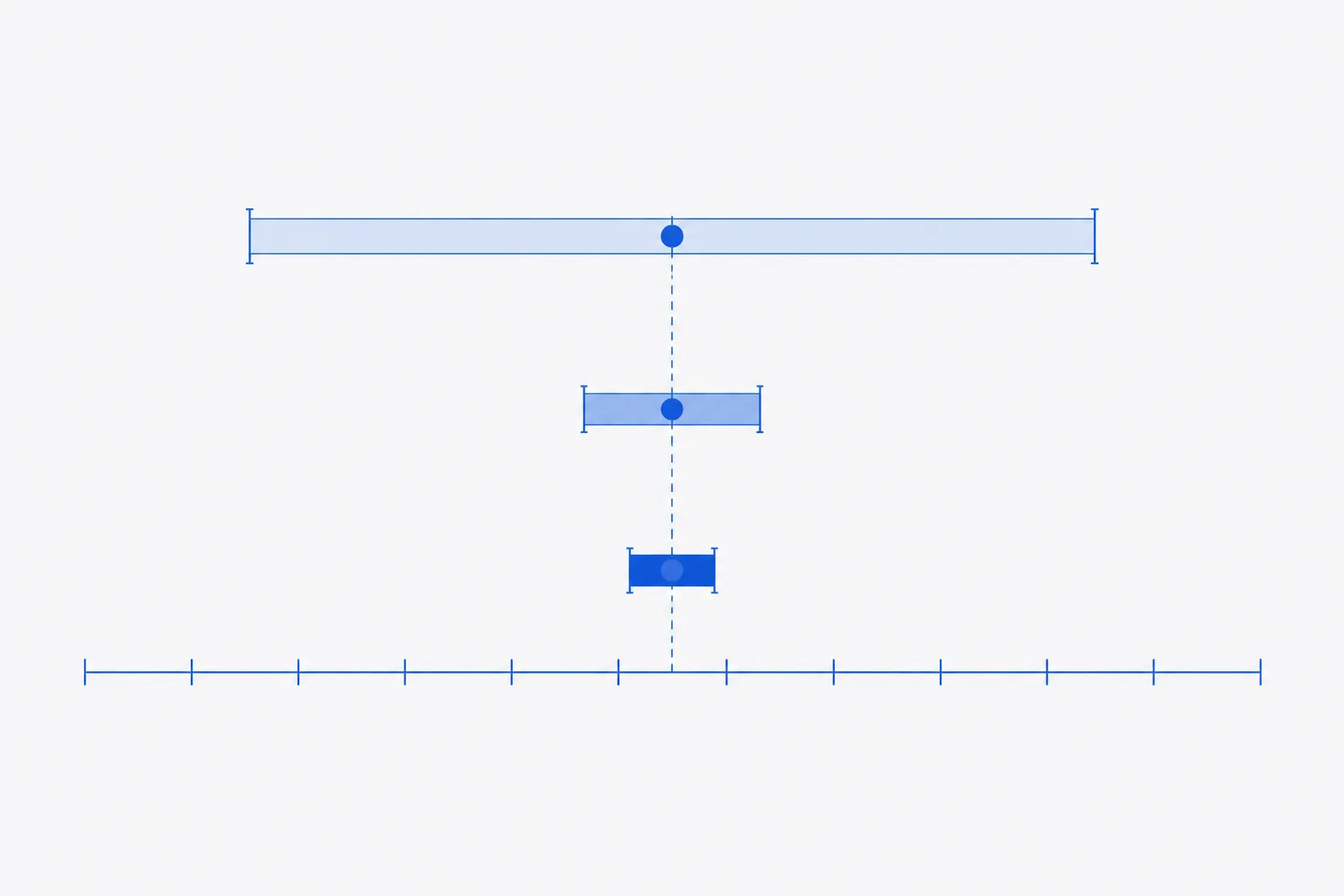
A reported value implies that the true value lies within half a unit of its last digit. That implication is read by everyone who uses the number, whether or not the laboratory intended it.
| Reported | Last digit | Implied interval | Width |
|---|---|---|---|
| 99% | Units | 98.5% to 99.5% | 1.0 percentage point |
| 99.5% | Tenths | 99.45% to 99.55% | 0.10 percentage point |
| 99.47% | Hundredths | 99.465% to 99.475% | 0.010 percentage point |
Chromatographic purity by area normalisation typically has an intermediate precision of a few tenths of a percentage point. Against that, 99.47% claims an interval about thirty times narrower than the method delivers. The extra digit is not more information. It is a false statement about the method, and it invites comparisons — 99.47% against 99.41% on the next lot — that the method cannot resolve. The honest report is 99.5%, and if the expanded uncertainty is near one percentage point, 99% with the uncertainty stated beside it says the same thing more plainly 4.
Rounding: once, at the end
Rounding discards information, so it is done once, after the last arithmetic operation. Intermediate values are carried at full calculator precision, or at least two digits beyond the final reporting place. Rounding at each step compounds small biases and can move the final digit.
- Carry every intermediate value unrounded, or with at least two guard digits beyond the reporting place.
- Decide the reporting place first, from the uncertainty or the method precision, not from the calculator display.
- Look only at the digit immediately to the right of the reporting place. Below 5, leave the retained digit unchanged. Above 5, or 5 followed by any non-zero digit, increase it by one.
- For an exact tie — a 5 with nothing after it — apply the laboratory's stated convention. Round half up and round half to even are both in use; the procedure must name one.
- Round in a single step from the unrounded value. Never round a rounded number again.
- Record the unrounded value in the raw data, and the rounded value in the report.
Step five is where most rounding errors arise. The value 99.447% reported to one decimal place is 99.4%, because the digit after the reporting place is 4. Rounding first to 99.45% and then to one decimal gives 99.5%, which is wrong. Stepwise rounding has quietly added 0.1 percentage point, and if the specification is not less than 99.5% it has also changed the conformance decision.
Rounding to an uncertainty
Where an uncertainty has been evaluated, it sets the reporting place. The GUM's guidance is that neither the result nor its uncertainty should be given with an excessive number of digits, and that it usually suffices to quote the standard or expanded uncertainty to at most two significant figures 1. Round the uncertainty first, then round the result to the same decimal place.
| Unrounded result | Unrounded U | U reported | Result reported |
|---|---|---|---|
| 97.634% | 0.462% | 0.46% | 97.63 ± 0.46% |
| 97.634% | 0.462% | 0.5% | 97.6 ± 0.5% |
| 3.0792 mmol·L⁻¹ | 0.0871 mmol·L⁻¹ | 0.087 mmol·L⁻¹ | 3.079 ± 0.087 mmol·L⁻¹ |
| 0.2297 µg·mL⁻¹ | 0.0213 µg·mL⁻¹ | 0.021 µg·mL⁻¹ | 0.230 ± 0.021 µg·mL⁻¹ |
The first two rows are both acceptable. Two figures in the uncertainty are preferred when the leading digit is small, since rounding 0.14 to 0.1 changes it by nearly 30%; one figure is adequate when the leading digit is large. Some laboratories round uncertainties upward rather than to nearest, on the grounds that understating an uncertainty is the worse error. Whichever convention is chosen, the report must state the coverage factor, and the rounded uncertainty must never be used as an input to a further calculation 4.
Digits through a calculation
Where no formal uncertainty is available, two rules of thumb approximate one. For multiplication and division, the result keeps the number of significant figures of the least precise input. For addition and subtraction, it keeps the decimal place of the least precise input. Both are crude, and both are better than reporting whatever the display shows.
A worked case from the mass-to-amount conversion: 7.20 mg of peptide divided by a molar mass of 1,169.35 g·mol⁻¹ displays as 6.15726… µmol. The mass has three significant figures and the molar mass six, so the result is reported as 6.16 µmol. The molar mass is effectively exact by comparison and does not limit anything. The content figure behind the 7.20 mg does. Improving the molar mass to eight figures changes nothing; improving the content figure changes the result.
Subtraction deserves care because it destroys significant figures. A difference of two close values, such as 99.6% minus 99.4%, has one significant figure however many the inputs had. Differences between lots, between laboratories or between time points in a stability series should be judged against the uncertainty of the difference, not against the digits of the inputs.
Differences between percentages need one further distinction. A fall in purity from 98.0% to 97.0% is a change of one percentage point, and also a relative change of about 1.0%. A rise in an impurity from 0.10% to 0.20% is a change of 0.10 percentage point, and a relative change of 100%. Both descriptions are correct and they are not interchangeable. Write percentage point for the absolute difference, state the relative change separately if it is needed, and never let the word per cent stand for both in the same report.
Comparing a result with a specification
A specification limit written as not less than 98% is incomplete until it says how a result such as 97.96% is to be treated. ASTM E29 names the two possibilities. Under the absolute method, the limit is exact and the unrounded result is compared with it directly. Under the rounding method, the result is first rounded to the number of places in the limit and the rounded value is compared; the effect is to extend the limit by half a rounding interval. The standard is explicit that a reference to it means nothing unless the method is specified 2.
| Unrounded result | Absolute method | Rounded to units | Rounding method |
|---|---|---|---|
| 98.40% | Conforms | 98% | Conforms |
| 97.96% | Does not conform | 98% | Conforms |
| 97.51% | Does not conform | 98% | Conforms |
| 97.49% | Does not conform | 97% | Does not conform |
Neither method is more correct. The choice belongs to whoever writes the specification, and it must be written into the specification and the procedure before results exist. A laboratory that selects the method after seeing a borderline result has not rounded; it has decided. Where results are close to a limit, the uncertainty of measurement also matters, and a decision rule that takes it into account should be stated with the report 5.
Impurity results and totals
Pharmaceutical impurity reporting uses a fixed convention worth borrowing. Under ICH Q3A(R2), individual impurity results below 1.0% are reported to two decimal places, and results at or above 1.0% to one decimal place, rounded by conventional rules; a result rounded to the decimal place of a threshold is compared with that threshold directly 3. The convention ties the reporting place to the size of the number, which is roughly how chromatographic precision behaves.
Totals are calculated from unrounded values and rounded once. Three impurities at 0.144%, 0.144% and 0.144% are each reported as 0.14%, but the total is 0.432%, reported as 0.43%, not the 0.42% that summing the rounded values would give. The same applies to mass balances and to purity calculated as 100% minus the sum of impurities: subtract from the unrounded sum.
Reporting checklist
- Fix the reporting place in the written procedure, from validation precision or an uncertainty budget.
- State the tie-breaking convention and the specification comparison method, absolute or rounding, in the same document.
- Retain unrounded values in the raw data and calculation record.
- Round the uncertainty to one or two significant figures, then round the result to the same decimal place, in one step.
- Report value, expanded uncertainty, coverage factor and units together.
- Compute sums, differences and mass balances from unrounded values, then round the outcome.
- Write trailing zeros that were measured; express ambiguous whole numbers in scientific notation.
A certificate figure with more digits than its method can support is common, and it is best read by discarding the unsupported digits before comparing it with anything 5. The same discipline applied to a laboratory's own reports costs nothing and prevents the most visible kind of overstatement.
References
- JCGM 100:2008 Evaluation of measurement data — Guide to the expression of uncertainty in measurement
- ASTM E29 Standard Practice for Using Significant Digits in Test Data to Determine Conformance with Specifications
- ICH Q3A(R2) Impurities in New Drug Substances
- Quantifying Uncertainty in Analytical Measurement, Eurachem/CITAC Guide CG 4, third edition
- ISO/IEC 17025:2017 General requirements for the competence of testing and calibration laboratories