analytical method design
Synthesis-Related Impurities: Deletion, Truncation, Incomplete Deprotection and Racemisation
Solid-phase synthesis produces a predictable family of near-copies of the target. The impurity classes, the mass shift and chromatographic behaviour of each, why a single purity figure can hide them, and what an impurity-aware certificate lists.
Solid-phase peptide synthesis builds a chain one residue at a time, and every step that falls short of completion leaves a slightly different molecule behind. The main classes are deletion sequences (one residue missing), truncated sequences (a chain that stopped early), insertion sequences (one residue added twice), chains still carrying a protecting group, side-reaction products such as aspartimide, and stereoisomers from racemisation. Each has a characteristic mass shift and a characteristic place in the chromatogram. Most sit close to the main peak, and some have exactly the target's mass.
The handbook's article on HPLC purity explains what a purity percentage measures and why close-eluting species inflate it. This page is the catalogue behind that argument: where each impurity class comes from, how it presents to ultraviolet and mass-spectrometric detection, and what a certificate should list if it is to describe the impurity profile rather than summarise it.
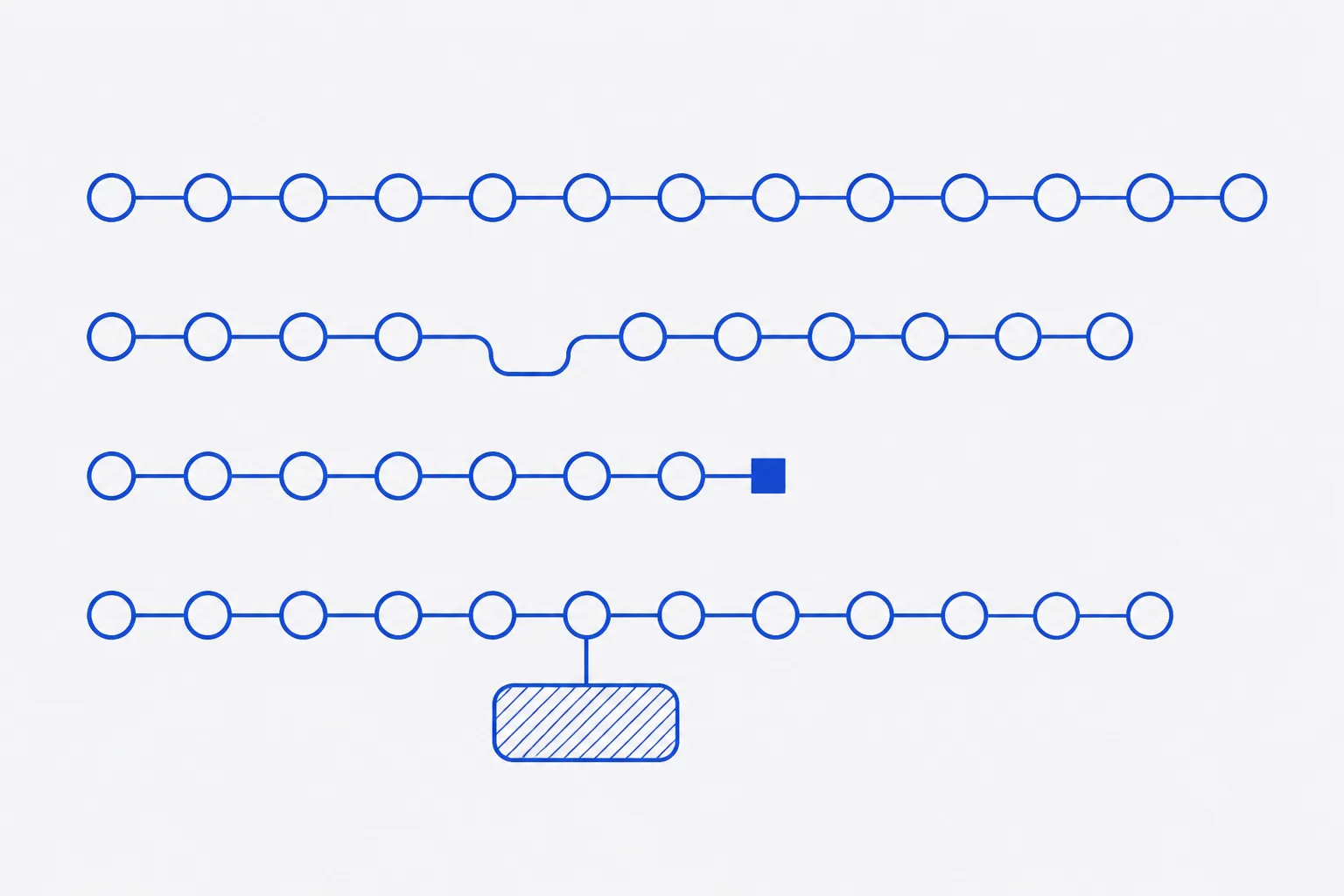
Where the impurities come from
The chain is anchored to an insoluble resin and extended by repeated cycles: remove the temporary protecting group from the terminal amine, wash, couple the next protected amino acid, wash again 3. Side chains carry permanent protecting groups that are removed only at the end, in a strongly acidic cleavage step that also releases the peptide from the resin. The chemistry is efficient but not perfect, and the imperfections compound over the length of the chain.
The arithmetic makes the point. A 20-residue peptide needs 19 couplings after the first residue is loaded. If every coupling is 99% complete, the fraction of chains that received every residue is 0.99 raised to the 19th power, about 83%. The rest is a distribution of chains each missing one or more residues. The table is an illustration of compounding, not a measured yield; real crude profiles depend heavily on the sequence.
| Per-coupling completion | Full-length chains | Chains with at least one fault |
|---|---|---|
| 98.0% | 68.1% | 31.9% |
| 99.0% | 82.6% | 17.4% |
| 99.5% | 90.9% | 9.1% |
| 99.9% | 98.1% | 1.9% |
Purification removes most of this, but the species hardest to remove are exactly those most similar to the target. A review of related impurities in peptide medicines grouped them by origin — the synthesis process itself, degradation of the peptide, and interactions with other components — and noted that synthesis-derived species such as deletions and insertions are structurally close enough to the target to challenge both separation and detection 1.
The impurity classes
The European guideline on synthetic peptides, adopted in late 2025, sets out the same classes and their mechanisms 2. Deletion sequences arise from incomplete coupling or incomplete removal of the temporary protecting group, so the next residue is added to a chain that skipped one. Their formation is limited by repeating couplings and by capping: unreacted amines are acetylated so that they cannot extend further, which converts a would-be deletion into a truncated, N-acetylated sequence. Insertion sequences arise when a residue couples twice, through free amino acid in the protected building block, premature deprotection during a long coupling, or incomplete washing before the next deprotection. Cleavage releases reactive cations from the protecting groups that can alkylate tryptophan, tyrosine and methionine unless scavengers are present, and incomplete cleavage leaves protecting groups attached.
| Class | Origin | Mass shift | Typical RP-HPLC behaviour |
|---|---|---|---|
| Deletion (des-X) | Incomplete coupling or deprotection | Minus one residue, e.g. −57.021 Gly, −71.037 Ala, −113.084 Leu | Close to the main peak; earlier if a hydrophobic residue is lost |
| Truncation, capped | Unreacted chain acetylated during capping | Mass of the short chain +42.011 (acetyl) | Usually well resolved; shorter chains generally elute earlier |
| Insertion (endo-X) | Double coupling of one residue | Plus one residue mass | Close to the main peak |
| Residual tert-butyl | Incomplete side-chain deprotection or cation alkylation | +56.063 per group | Later; more hydrophobic |
| Residual Boc | Incomplete deprotection | +100.052 | Later |
| Residual trityl | Incomplete deprotection of Asn, Gln, His or Cys | +242.110 | Much later; strongly hydrophobic |
| Residual Pbf | Incomplete deprotection of Arg | +252.082 | Much later |
| Aspartimide | Base-catalysed ring closure at aspartate | −18.011 | Close to the main peak |
| Aspartimide piperidide | Ring opening of aspartimide by piperidine | +67.079 | Resolved; often later |
| β-aspartyl isomer | Aspartimide ring opening to the wrong carbonyl | 0 (same mass) | Very close to the main peak; may co-elute |
| Diastereomer (racemisation) | Epimerisation during activation or from impure building blocks | 0 (same mass) | Partial resolution at best on many methods |
| Leucine/isoleucine exchange | Wrong building block | 0 (same mass) | Often co-elutes |
| Oxidation | Methionine or tryptophan during cleavage or handling | +15.995 | Usually earlier; more polar |
Aspartimide and the same-mass problem
Aspartimide formation is the best-studied side reaction in Fmoc chemistry. The repeated base treatments used to remove the Fmoc group allow the backbone nitrogen following an aspartate to attack the side-chain ester, closing a five-membered ring and losing water. The ring then reopens in either direction, giving back the normal peptide, the β-aspartyl isomer, or — if piperidine attacks — piperidide adducts. Sequences where aspartate is followed by glycine are particularly prone; systematic work on a model hexapeptide containing that motif showed that the choice of side-chain protecting group and deprotection conditions changes the extent of aspartimide and related by-products substantially 4.
The β-aspartyl isomer is the practical difficulty. It has exactly the target's mass, so a mass spectrum cannot flag it, and it elutes very close to the target, so an ultraviolet purity method may not separate it. Diastereomers from racemisation and leucine/isoleucine substitutions share the same property. The European guideline notes that control of diastereomers may require specific methods, and describes chiral analysis of the amino acids after hydrolysis, or chromatography against reference standards of the likely epimers, as the means of detecting them 2.
How each class shows on a chromatogram
Reversed-phase retention follows overall hydrophobicity, with each residue contributing roughly additively 5. That gives a working guide to where to look. Species carrying leftover protecting groups are far more hydrophobic and elute well after the main peak, often in the wash; a gradient stopped shortly after the main peak never reports them. Short truncations are usually well separated and earlier. Deletions and insertions of a single residue, oxidised forms and aspartimide sit within a minute or two of the main peak on a typical gradient. Same-mass isomers sit closest of all.
- Run the gradient through a high-organic wash and integrate the whole run, so late-eluting protected species are seen.
- Flatten the gradient around the main peak until its flanks return to baseline; shoulders are where deletions hide.
- Run LC-MS on the same separation and extract the ion chromatogram for each expected impurity mass from the table above.
- Where the sequence contains aspartate followed by glycine, asparagine, serine or another prone residue, look specifically for the −18.011 Da species and for same-mass shoulders.
- Where racemisation is a concern, confirm with a method designed for it; a standard purity method is not evidence of stereochemical purity.
- Record each impurity by relative retention time, area percentage and assigned mass.
Why a purity figure hides them
A single area-percent figure can conceal these classes in four ways. A deletion that co-elutes is integrated into the main peak and adds to the purity. A same-mass isomer that co-elutes is invisible to both ultraviolet and mass-spectrometric detection unless the method was designed to separate it. Late-eluting protected species fall outside a short gradient. And a certificate that reports only total purity gives no way of telling which of these were looked for.
Regulatory practice for synthetic medicines addresses co-elution directly. The European guideline sets thresholds for peptide-related impurities from the Ph. Eur. general monograph on substances for pharmaceutical use, and states that when co-eluting impurities are observed as one peak, the qualification threshold applies to that combined peak unless otherwise justified. It also discourages grouping impurities that could be separated 2. A research laboratory is not bound by these thresholds, but they are a useful reference for what a well-characterised impurity profile looks like.
| Threshold | Level | Meaning |
|---|---|---|
| Reporting | Above 0.1% | The impurity is listed individually |
| Identification | Above 0.5% | Its structure is established |
| Qualification | Above 1.0% | Its biological safety is justified; applies to a combined peak where impurities co-elute |
What an impurity-aware certificate lists
- The purity method in full: column, mobile phases, gradient including the wash, temperature and wavelength.
- Each individual impurity above the stated reporting level, by relative retention time and area percentage.
- The largest single impurity, stated separately from the total.
- An assigned identity, by mass, for each impurity above the identification level, for example des-Gly or +56 Da.
- The mass-spectrometric data behind those assignments.
- A statement on stereochemical purity, and the method used, or an explicit note that it was not assessed.
- Total impurities, and the reporting threshold used to calculate it.
- The chromatogram, with the impurity peaks marked.
A certificate carrying these items describes the impurity profile. One carrying a single purity percentage, with no method, no individual impurities and no mass assignments, describes the main peak only. Both may be accurate. Only the first allows a reader to see whether the synthesis relatives described on this page were separated, detected and counted.