contamination control
Aseptic Technique at the Bench: Cabinets, Surfaces and Movement
Aseptic technique is a sequence of movements and surfaces, not a piece of equipment. Cabinet classes, disinfectant contact times, the errors that break first air, and what an open bench actually costs.
Aseptic technique is a sequence of movements, surfaces and decisions. It is not a piece of equipment. A cabinet does not confer it: one operated carelessly protects less than an open bench worked deliberately, because it supplies confidence that has not been earned. The object is narrow and mechanical — keep viable organisms and particulate out of an open container during the seconds it stands open, and out of every tool, surface and diluent it will touch.
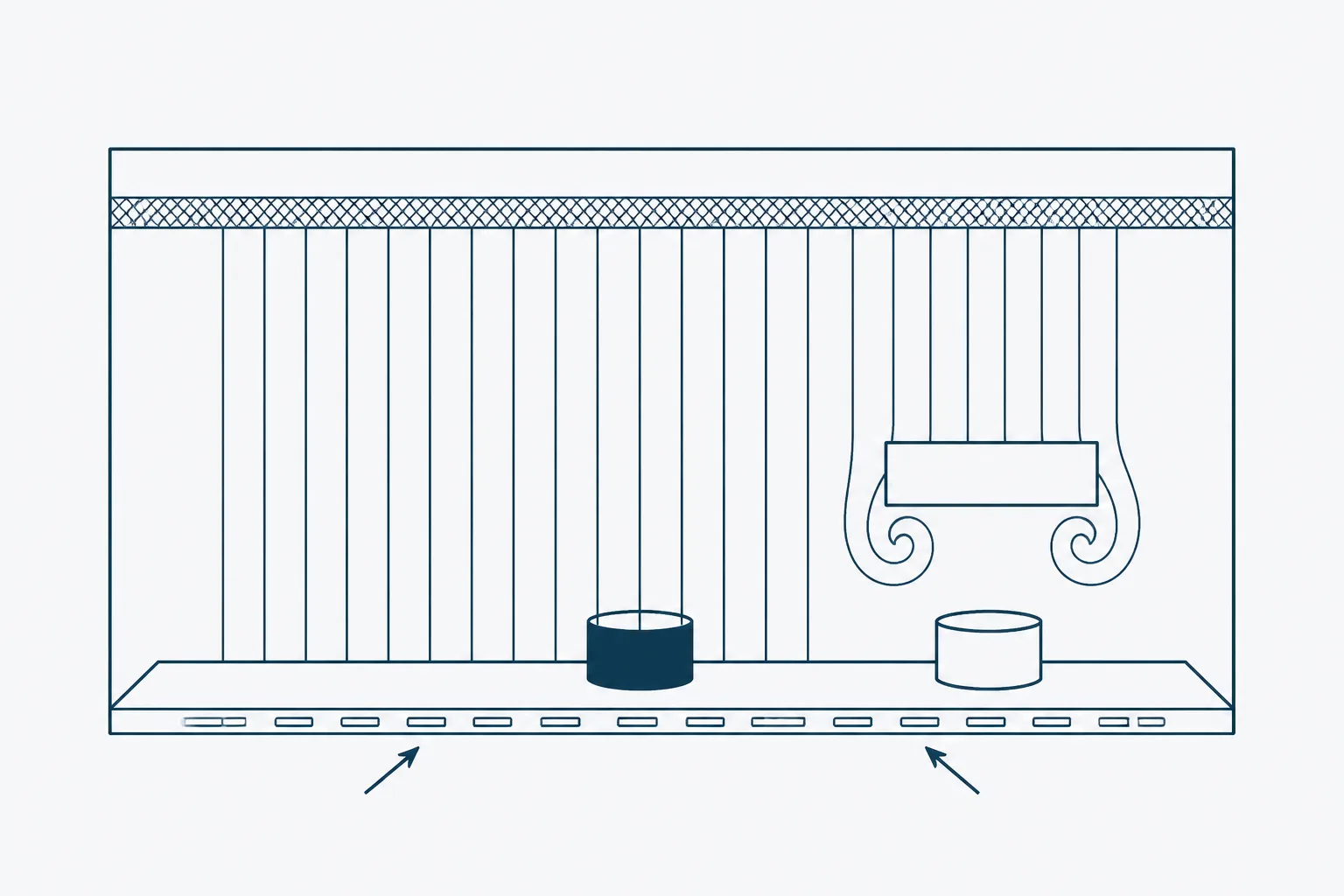
What aseptic technique protects against
Three classes of contaminant are in play, and they call for different controls. Viable organisms — vegetative bacteria, yeasts, moulds, bacterial and fungal spores, and the wall-less mycoplasmas — multiply after arrival, so a single cell is not a trace quantity but an inoculum. Non-viable particulate — skin scale, fibre, dust, glass fragments — does not multiply, but carries organisms and appears independently as an optical and chromatographic interferent. Chemical carryover is the third class and is controlled separately, because no disinfectant addresses it.
The operator is the dominant source in any ordinary laboratory: skin scale, hair, respiratory aerosol and clothing shed continuously, at a rate that rises sharply with movement. The room is second — circulating air, corridor traffic, door swings. The material itself is third and most often overlooked: a vial closure and the outside of a stock bottle have been handled, stored and transported, and neither is clean because the contents are.
The consequence is rarely dramatic. Contamination that is visible has been proceeding for some time already. What matters analytically is the invisible case: microbial peptidases degrading peptide in a buffer held over days, metabolic acid shifting the pH of an unbuffered preparation, endotoxin accumulating from Gram-negative growth. In cell-based work the canonical example is mycoplasma, which produces no turbidity, no pH change and no visible effect, and which has silently invalidated a large body of published work 4. Assume the thing you cannot see is the thing that costs the experiment 1.
Cabinets, classes, and working inside one
A cabinet works by unidirectional flow. Air passes through a high-efficiency particulate air filter and crosses the work zone as a parallel stream that sweeps particles away before they settle. Air cleanliness is classified by particle concentration rather than by the equipment that produced it, and a certified cabinet work zone is held to the cleanest practical class in that scheme 2. Turbulence is the failure mode: wherever the parallel stream breaks, room air mixes in and the classification no longer describes that spot.
| Enclosure | Protects the work | Protects the operator | Airflow | Note |
|---|---|---|---|---|
| Horizontal laminar flow clean bench | Yes | No | Filtered air from the rear, across the work, onto the operator | Never for hazardous or powdered material |
| Vertical laminar flow clean bench | Yes | No | Filtered downflow, exhausted forward at the front | Product protection only, despite resembling a Class II |
| Class I safety cabinet | No | Yes | Unfiltered inward face flow, filtered exhaust | Containment only. Room air crosses the work |
| Class II safety cabinet | Yes | Yes | Filtered downflow plus inward face flow, filtered exhaust | The general-purpose choice for open aseptic work |
| Class III cabinet or isolator | Yes | Yes | Sealed, gas-tight, glove ports, filtered supply and exhaust | Maximum containment. Dexterity is the cost |
| Fume cupboard | No | Yes, for vapour | Unfiltered inward flow to external discharge | A chemical control. No aseptic protection at all |
The distinction that matters most is between a clean bench and a safety cabinet, because they look alike and behave oppositely. A horizontal clean bench delivers filtered air over the work and then onto the person sitting at it: excellent product protection, and negative operator protection, since any aerosol raised at the surface goes into the breathing zone. A Class II cabinet adds an inward air curtain and a filtered exhaust, protecting work, operator and room at once 1.
- Run the cabinet for the stated purge period — commonly three to five minutes — before work begins and again after it ends.
- Set the sash at the marked working height and leave it there. Airflow is balanced at that height and no other.
- Never obstruct the front or rear grilles. A wrapper across a grille disables the air curtain.
- Work at least 100 to 150 mm inside the front grille, where cabinet air is not yet mixing with room air.
- Do not use the cabinet as storage, and do not run centrifuges or vortex mixers inside the work zone.
- Recertify on installation, after any relocation, and on schedule. A cabinet that has been moved is uncertified until retested.
- Treat an airflow alarm as a stop condition, not as a nuisance to be silenced.
Surface disinfection: agent, concentration, contact time
Disinfection is two operations, always in that order. Cleaning removes soil; disinfection kills what remains. Organic soil inactivates every agent in common use, so a disinfectant applied to a dirty surface is largely consumed before it reaches an organism 3. Wipe to clean, then wipe to disinfect, and treat the second wipe as the one carrying a specification.
That specification is contact time: the period the surface must stay visibly wet with the agent at working concentration. It is the parameter most often ignored and the one that decides the outcome. Seventy per cent alcohol on a smooth surface evaporates within roughly fifteen to thirty seconds, shorter than the contact time any label states, so a single alcohol wipe is a cleaning step mistaken for a disinfection step. Where the stated time exceeds the drying time, reapply until the clock is satisfied 3.
| Agent | Working strength | Typical contact time | Spores | Residue and material effects |
|---|---|---|---|---|
| Ethanol or isopropanol in water | 60 to 80 per cent by volume | 30 seconds to 1 minute, kept wet | No | Evaporates clean. Attacks acrylic sashes over time |
| Sodium hypochlorite | 1,000 to 5,000 ppm available chlorine | 5 to 10 minutes | Yes, at the higher strength | Corrodes stainless steel. Needs a water then alcohol wipe |
| Hydrogen peroxide solution | 3 to 7 per cent | 5 to 10 minutes | Yes, with extended contact | Decomposes to water and oxygen. Bleaches some surfaces |
| Peracetic acid blends | Per label | 5 to 10 minutes | Yes | Corrosive. Needs ventilation and rinsing |
| Quaternary ammonium compounds | Per label | 10 minutes | No | Leaves a cationic film that interferes with assays |
Two consequences follow. An alcohol-only regime never touches spores, so a sporicidal agent must be rotated in on a defined schedule regardless of how clean the bench looks. And every sporicidal agent leaves something behind — chloride, oxidiser or a cationic film — so each application ends with a water wipe and then an alcohol wipe 3. Skipping that step trades a microbiological problem for an analytical one.
What gets disinfected matters as much as the agent. The cabinet interior, before and after every session. The outer surface of every item carried into the work zone, since the enclosure filters air, not objects. Gloved hands, between operations rather than once at the start. And the closure of any vial to be punctured: wet it, allow the contact time, let it dry — a wet septum drags liquid inward on the first pass.
Movement, first air, and the errors that recur
First air is filtered air that has travelled from the filter face to the critical point without passing over anything. It is the only air in the cabinet with a known cleanliness, and it stops being first air the instant it crosses a hand, a bottle or a lid. Every rule below restates one principle: keep the line between filter and open aperture unobstructed, and everything else downstream of it.
- Reaching over an open container. The hand is upstream, the opening downstream, and anything on the glove has a direct path in.
- Moving quickly. A sweeping arm leaves a wake that pulls unfiltered room air centimetres into the work zone.
- Laying a closure face down on the work surface, then returning it to the vial.
- Working at the front lip, where cabinet air and room air are actively mixing.
- Talking or coughing across open work, and leaning into the aperture to see better.
- Using an open flame in a Class II cabinet. The thermal plume destroys the downflow pattern.
- Siting a cabinet in a doorway or under a ventilation diffuser, so room currents overwhelm the face velocity.
- Opening several containers at once, so each stands open for the whole session rather than its own step.
Sequence the work clean to dirty and back to front: sterile and open items toward the rear, waste toward the front, movement in one direction. Keep containers closed by default — a lid replaced between steps costs two seconds and removes the exposure entirely. Slow movement is not a stylistic preference; it is the control on turbulence, and it is free.
Working without a cabinet, and a bench checklist
Most laboratories doing occasional handling work have no cabinet, and the honest position is that an open bench cannot produce a sterile preparation. It can lower bioburden, and the gap between a careless open bench and a careful one is wide enough to be worth the effort. What is lost is the unidirectional air: exposure is now set by the room load, traffic and ventilation, none of them under the operator control during the procedure. What remains controllable is time, distance, surfaces and sequence.
- Choose a bench away from doors, walkways and any air diffuser. Ask for the door to stay shut for the session.
- Clear the bench. Clean the surface of soil, then disinfect it and observe the full contact time.
- Lay a fresh disposable liner and assemble every item the procedure needs, so nothing is fetched mid-session.
- Disinfect the outer surface of every item as it comes onto the liner.
- Tie back hair, fasten the coat, glove up, then disinfect the gloves and let them dry.
- Write the sequence down first, with each open period identified. The written order prevents improvisation.
- Disinfect each closure, allow the contact time, and let it dry before puncture.
- Open one container at a time and close it before opening the next.
- Keep hands, sleeves and tools beside apertures, never above them, and move slowly throughout.
- Use single-use tools for anything touching material. Never lay a used tool down and pick it up again.
- Close everything, remove waste, then clean and disinfect the surface again before recording the session as finished.
Finish by writing down what the environment actually was: bench or cabinet, the cabinet certification date if one was used, the agents and contact times applied, and any interruption. That record is what makes an anomalous result diagnosable three weeks later, and it is what separates a preparation of reduced bioburden — which is what an open bench delivers — from a sterile one, which it does not 1. Where the downstream work cannot tolerate that limit, the answer is a change of facility or design, not a more optimistic description of the same bench.
References
- Laboratory biosafety manual, fourth edition
- ISO 14644-1:2015 Cleanrooms and associated controlled environments — Part 1: Classification of air cleanliness by particle concentration
- Disinfection and Sterilization in Health Care Facilities: An Overview and Current Issues
- Guidelines for the use of cell lines in biomedical research