contamination control
Sterile Filtration and the Bubble Point Test: What a 0.22 Micrometre Rating Claims
A sterilising rating is a bacterial retention claim validated against one organism, not a statement about hole size. Bubble point physics, wetting, adsorption by membrane material, capacity limits, and the contaminant filtration never removes.
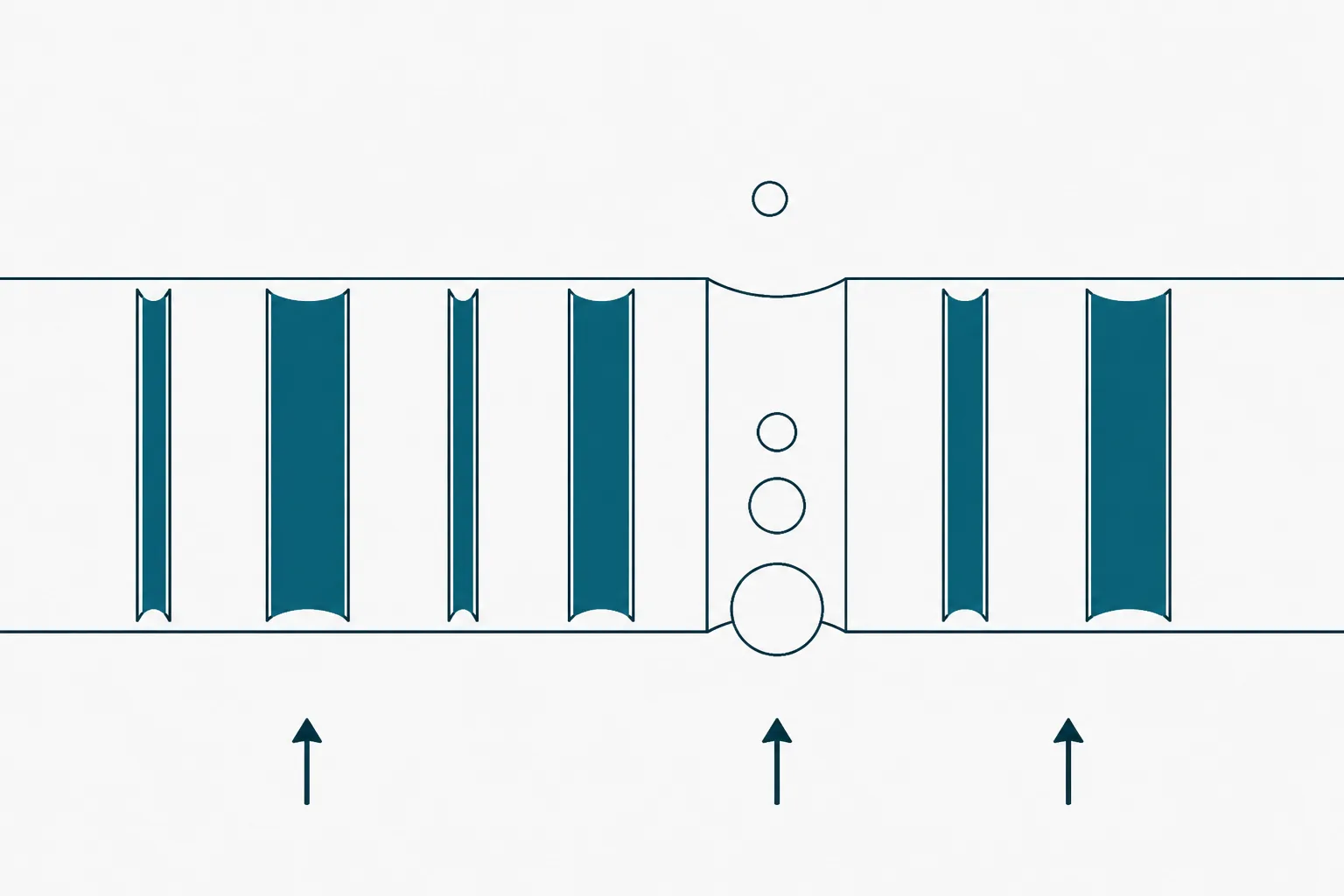
A membrane marked 0.22 micrometres does not claim that no pore exceeds 0.22 micrometres. It claims a performance: that the membrane retains a defined bacterial challenge under defined conditions. That distinction governs everything downstream — what an integrity test can prove, why a filter that passed yesterday can fail today, and why a preparation can be simultaneously sterile and biologically unusable. Membranes have a pore size distribution, and the rating is a retention specification derived from a bacterial challenge, not a measurement of hole diameter.
What the rating actually claims
The sterilising-grade designation rests on a standardised bacterial challenge. A membrane is challenged with a suspension of a very small bacterium at a high concentration per unit of effective filtration area, and the filtrate must be sterile 1. That test defines the claim: this membrane, at this challenge level, under these conditions of pressure, flow and suspending fluid, produces a sterile effluent. It is a statement about a validated performance, not a geometric description of the membrane, and regulatory expectations for aseptic processing are written around that validation rather than around the nominal micrometre figure 3.
The historical reason for the specific figure is instructive. Membranes rated at 0.45 micrometres were once treated as sterilising until organisms were isolated that passed them reliably, and the rating was tightened in response. The lesson generalises: a retention rating is an empirical result against the organisms someone thought to test, and organisms smaller or more deformable than the challenge strain are outside the claim.
Retention also has more than one mechanism. Sieving — mechanical exclusion of anything larger than the channel — is the intuitive one, but a significant part of retention on a sterilising membrane is adsorptive, with cells captured by electrostatic and hydrophobic interaction on the internal surfaces of a tortuous structure. Adsorptive retention is conditional. It weakens at high differential pressure, at low ionic strength, in the presence of surfactants, and when the challenge is prolonged. This is why validation is specified against a fluid and a set of process conditions, and why changing the buffer, the pressure or the duration means the validated claim no longer strictly applies 3.
Bubble point: the physics and the test
A fully wetted membrane holds liquid inside its pores by capillary force. To push gas through, the applied pressure must exceed that force. The relationship is the standard capillary expression: the pressure required is proportional to the surface tension of the wetting liquid and to the cosine of its contact angle with the membrane, and inversely proportional to the pore diameter, with a shape factor for pore geometry 2. Everything useful about the test follows from the inverse relationship with diameter.
- Because pressure varies inversely with diameter, gas breaks through the widest channel first. The test reports the largest pore, which is exactly the defect that would let an organism through.
- Because it depends on surface tension, the result is specific to the wetting liquid. Water has roughly three times the surface tension of isopropanol, so the water bubble point of the same membrane is roughly three times higher.
- Because surface tension falls as temperature rises, the bubble point falls with temperature. Compare like with like, or correct.
- Because it depends on contact angle, the membrane must be wetted by the test liquid. A hydrophobic membrane cannot be water bubble-point tested without a wetting solvent.
- Because it is non-destructive, the same filter can be tested and then used — or, more usefully, used and then tested.
- Because it correlates with retention rather than measuring it, a passing bubble point is evidence of integrity, not proof of sterility.
- Wet the membrane completely with the liquid the manufacturer specifies, allowing time for full penetration rather than surface wetting alone.
- Clear the downstream side of standing liquid, and keep the downstream volume small so the transition is visible.
- Apply gas upstream and raise the pressure slowly in small increments, holding at each step.
- Watch the downstream side. Steady fine bubbling below the expected pressure is diffusive flow of dissolved gas through the wetted membrane and is normal.
- Record the pressure at which bulk gas flow begins — a continuous vigorous stream, not the first isolated bubble.
- Compare that value against the minimum bubble point the manufacturer specifies for that membrane and that wetting liquid.
- Record the result, the wetting liquid and the temperature. A bubble point without those two attributes is not interpretable.
Three failure modes account for most bad results. Incomplete wetting leaves a dry channel through which gas passes immediately, giving a falsely low value and condemning a sound filter. Pressurising too fast overshoots the transition, giving a falsely high one. And a large downstream hold-up volume absorbs the initial gas flow, so the operator sees nothing until well past the true value. Where the filtration area is large, the quantitative alternative is a diffusive flow measurement: hold at a set pressure below the expected bubble point and measure the gas flow rate against a specified limit, which is more sensitive to small defects than watching for bubbles 2.
The timing of the test decides its value. A pre-use test confirms the filter was intact before the batch went through it. A post-use test confirms it was still intact afterwards, which is the only version that says anything about the material that actually passed, and it is the expectation in aseptic processing for that reason 3. For small disposable syringe devices a formal bubble point is often impractical, and the practical controls become the manufacturer's release testing, staying within the rated pressure, and never reusing the device.
Wetting, pre-rinsing and membrane adsorption
Wetting matters beyond the integrity test. A membrane that is not fully wetted passes liquid only through the wetted fraction of its area, which raises the local flux and the local pressure, reduces effective capacity, and can compromise adsorptive retention. Hydrophilic membranes wet with aqueous fluid directly. Hydrophobic ones — polytetrafluoroethylene in particular — do not, and require an alcohol pre-wet followed by displacement with the aqueous fluid, or a grade that has been surface-treated to be water-wettable.
Pre-rinsing serves two purposes and should be treated as part of the procedure rather than an optional refinement. It flushes manufacturing residues — wetting agents, glycerol and other extractables — that would otherwise appear in the filtrate and interfere downstream. And it occupies binding sites on the membrane before the sample arrives, because the membrane presents an enormous internal surface area to a small volume and adsorbs peptide onto it. Pass a sacrificial volume of the same buffer, or a sacrificial aliquot of the sample itself, and discard it.
| Material | Binding tendency | Wetting | Note |
|---|---|---|---|
| Regenerated and modified cellulose | Lowest of the common group | Hydrophilic | Narrow solvent range. Chosen where recovery matters most |
| Polyethersulfone | Low | Hydrophilic | High flow at low pressure. A common default for aqueous buffers |
| Polyvinylidene fluoride | Low in hydrophilic low-binding grades | Requires a hydrophilic grade for aqueous use | Broad compatibility. Untreated grades bind considerably more |
| Track-etched polycarbonate | Low | Hydrophilic | Uniform straight-through pores, but very low capacity |
| Nylon | High | Hydrophilic | Binds peptide strongly. Common in stock and the classic avoidable error |
| Polytetrafluoroethylene | Low, but not water-wettable | Hydrophobic unless treated | For solvents and gas. Needs pre-wetting for aqueous work |
Manufacturer figures for binding capacity are measured against protein standards under stated conditions, and they rank materials usefully but do not predict what a particular sequence will do in a particular buffer. Adsorption depends on the hydrophobicity and net charge of the sequence, the pH and ionic strength, any carrier or surfactant present, and the ratio of sample volume to membrane area. The only defensible figure is a measured one: assay the solution before filtration and again after, using the same method, and carry the second figure forward.
Capacity, and when a filter has stopped working
Capacity is the volume a device will pass before it plugs, and it is set by the particulate and aggregate load of the sample rather than by the dissolved solute. It is finite and frequently much lower than operators expect for a solution containing any submicron aggregate. Plugging announces itself in two equivalent ways: back-pressure rising at constant flow, or flow falling at constant pressure. Either is the signal to stop.
- Do not force a plugging device. Exceeding the rated differential pressure can rupture the membrane, unseat the seal, or drive retained material through the structure.
- Fit a coarser prefilter — a 0.45 micrometre membrane or a glass-fibre depth layer — when the load is high. It protects capacity on the sterilising membrane.
- Increase the membrane area rather than the pressure when throughput is short.
- Never reuse a disposable device and never back-flush one. Both defeat the retention structure.
- Treat a device that plugged before delivering the volume as an indicator that the solution contains aggregate, and investigate that rather than repeating the filtration.
- Record the device, the rating, the material and the volume passed. Filtration performed without those recorded is not a reproducible step.
What filtration does not remove
A sterilising membrane is a size and adsorption barrier, and its blind spots follow directly from that. Anything dissolved and small passes: salts, buffer components, residual solvents, counterions. Degradation products pass, because a deamidated, oxidised or truncated peptide is altered rather than enlarged. Soluble oligomers below the rating pass. Viruses pass, being far smaller than the rating. Mycoplasmas, which lack a cell wall and are both small and deformable, pass ordinary sterilising membranes and are a recognised route by which cultures become contaminated despite filtration 4. Detergent residue, plasticiser and every other chemical contaminant discussed elsewhere passes untouched.
The most consequential omission is endotoxin. Lipopolysaccharide from the outer membrane of Gram-negative bacteria is released when cells divide and when they die, so a bacterial population that has been removed by filtration leaves its endotoxin behind in the filtrate. The molecule is small enough to cross a sterilising membrane freely, it is heat-stable and survives autoclaving, and it is biologically active at picogram concentrations, where it activates cells and confounds any assay with an immune or inflammatory readout 5. Removing it requires a different operation entirely — ultrafiltration with an appropriate molecular weight cut-off, charged or affinity media, or dry heat depyrogenation of the apparatus before use.
The honest summary is that sterility and endotoxin content are independent properties of a preparation, and that filtration addresses only the first. A filtrate can pass a sterility test and still carry an endotoxin load high enough to invalidate the experiment it was prepared for 5. Filtration is a control on viable organisms in a solution, applied at a defined point, with a defined and validated claim. It is not a purification step, not a rescue for a preparation that has gone wrong, and not a substitute for keeping contamination out of the preparation in the first place.
References
- ASTM F838-20 Standard Test Method for Determining Bacterial Retention of Membrane Filters Utilized for Liquid Filtration
- ASTM F316-03(2019) Standard Test Methods for Pore Size Characteristics of Membrane Filters by Bubble Point and Mean Flow Pore Test
- Guidance for Industry: Sterile Drug Products Produced by Aseptic Processing — Current Good Manufacturing Practice
- Mycoplasma contamination of cell cultures: Incidence, sources, effects, detection, elimination, prevention
- Endotoxin: the uninvited guest