contamination control
Cross-Contamination Between Vials and Tools: Routes, Static and Detection
Carryover moves material between containers on spatulas, needles, gloves and shared surfaces — and, for lyophilised powder, without contact at all. The routes, the controls, the sequencing rule, and what detection can and cannot find afterwards.
Carryover is the movement of material from one container into another by a route nobody chose. It is distinct from microbial contamination, which arrives from the environment, and it defeats the controls built for that problem: a fully aseptic procedure with a shared spatula produces a sterile preparation of the wrong composition. For lyophilised material it is worse than for solutions, because dry powder travels a route requiring no contact.
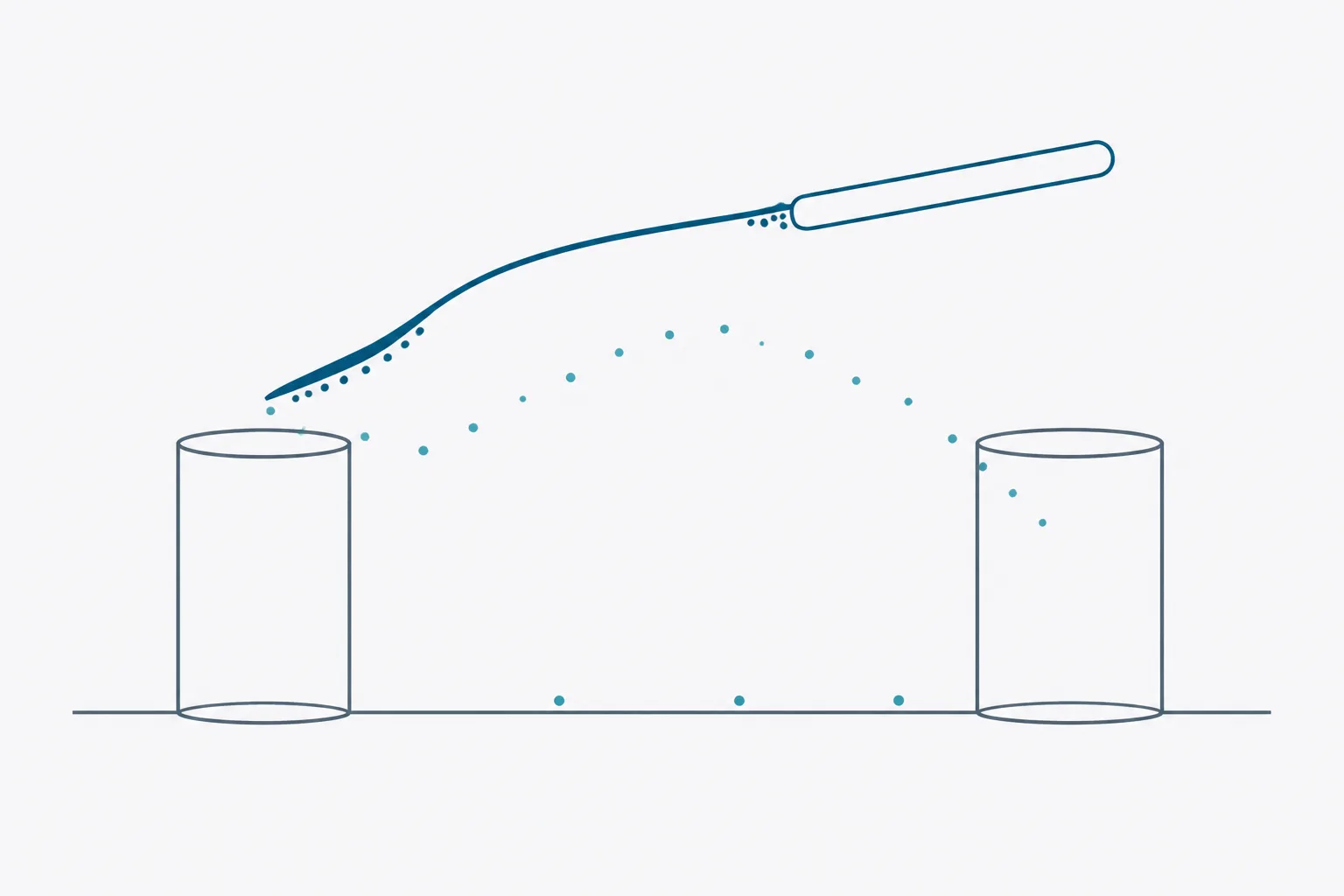
The routes carryover travels
Carryover has a small number of routes, and enumerating them is most of the work. Each is controlled differently, so a single blanket habit — changing gloves, say — closes one route and leaves the rest open. The table below is the inventory; the section after it deals with the route that behaves unlike the others.
| Route | Mechanism | Control |
|---|---|---|
| Spatula or scoop | Residue held in the blade flute and in the joint where blade meets handle | Single-use, or one dedicated tool per material, stored labelled |
| Needle or cannula | Film on the outer shaft and inside the lumen; septum fragments carried through | One needle per container. Never re-enter a second container with a used needle |
| Pipette | Aerosol drawn into the shaft; liquid retained in the tip cone | Filter tips; positive displacement for viscous or volatile solutions |
| Gloves | Dry powder and dried solution films on the fingertips; gloves act as a fomite | Change between materials, not between sessions |
| Shared surfaces | Powder and dried solution on the bench, balance pan, rack or cabinet floor | Disposable liner per material; clean and disinfect between materials |
| Shared diluent stock | Back-contamination when a used needle re-enters the stock bottle | Aliquot the diluent once. Never return anything to the stock |
| Closures and septa | The outer face of a septum touched by a contaminated glove or laid down | Disinfect before puncture; never place a closure face down |
| Electrostatic transfer | Charged particles leave the source and settle elsewhere with no contact | Humidity, ionisation, earthed tools, and not opening the powder at all |
Two features make this list harder than it looks. The quantities are small enough to be invisible and large enough to matter: a few micrograms of residue is nothing against a hundred-milligram weighing and everything against a hundred-microgram one, so carryover scales badly in exactly the direction this work runs. And it is directional in time — a route contaminated on Monday delivers on Thursday, because a spatula returned to a drawer and a bench never cleaned both hold material indefinitely.
Static and airborne powder transfer
Lyophilised material is the awkward case. Freeze-drying produces a porous, low-density cake whose structure is largely void, and that cake is mechanically fragile: tapping, scraping or simply inverting the container fractures it into fine particles with very high surface-area-to-mass ratio 5. Those particles have almost no inertia. Air movement that would not disturb a crystalline solid carries them across a bench.
On top of that sits electrostatic charging. Contact and separation between dissimilar materials transfers charge across the interface — the triboelectric effect — and every surface here is a good charge generator and a poor conductor: glass vial walls, polymer spatulas, plastic weighing vessels, nitrile gloves. Charge on an insulating powder has nowhere to go, so it accumulates and persists, and the levels routinely reached during ordinary handling are enough to change how the powder behaves 1.
The behavioural consequences are specific and recognisable. Powder adheres to the inside wall of the vial and will not fall. It jumps from a spatula before the spatula reaches the receiving vessel. It repels from a weighing vessel, or clings to the outside of it. A balance reading drifts and refuses to settle. And material leaves the working area entirely, landing on the bench, on gloves and in whatever else is open nearby 1. The last of those matters most, because it is the only one that does not announce itself.
Two features make this route uniquely dangerous. It is non-contact, so every control built around cleaning tools is irrelevant to it. And it is non-local: a charged particle does not land where it was released, so contamination can appear in a vessel that was never near the source. Relative humidity governs the severity — charge dissipates slowly below roughly 40 per cent relative humidity and much faster in the 45 to 60 per cent band — which is why a procedure that behaves in summer misbehaves in a heated laboratory in winter.
- Hold the laboratory in the 45 to 60 per cent relative humidity band where the work allows it. It is the single most effective control.
- Use an ionising blower or antistatic bar directed at the transfer area to neutralise charge before and during transfer.
- Prefer earthed metal spatulas and conductive weighing vessels over plain polymer ones, and earth the balance.
- Avoid plastic draught shields, film wraps and self-sealing bags near the transfer point.
- Move slowly. Rapid separation of two surfaces generates more charge than slow separation.
- Do not direct a dry gas stream at open powder; blowing generates charge as well as moving material.
- Keep every other container closed while powder is open, and work over a liner discarded with the material.
- Where the protocol permits, dissolve in the original container and skip the powder transfer entirely.
That final item is the substantive recommendation. Every control above reduces electrostatic transfer; none eliminates it. The route that eliminates it is not to create free powder at all — introduce diluent into the supplied container through its closure, dissolve in place, and perform all subsequent handling in solution, where the material has mass, stays where it is put, and carries no charge. This is also the more accurate route on quantitative grounds, since it removes a small-mass weighing from the calculation.
Dedicated tools against cleaned tools
Three strategies exist for anything that touches material, and the choice between them is economic rather than technical. Single-use: the item is discarded after one material. Dedicated: permanently assigned to one material, labelled and stored separately. Cleaned and verified: cleaned between materials, with residue demonstrated below a defined limit. Only the third requires evidence, and it is the one most laboratories claim while practising the first half of it.
| Item | Strategy | Reasoning |
|---|---|---|
| Pipette tips, needles, syringes, weighing boats, liners | Single-use | Replacement cost is far below the cost of a cleaning study |
| Spatulas and scoops | Dedicated per material, or single-use where available | Cheap enough to duplicate; flutes and joints are hard to verify clean |
| Volumetric glassware, reusable vials | Cleaned and verified | Too costly to dedicate. Requires a documented rinse recovery, not a look |
| Balances, benches, cabinet interiors | Cleaned between materials | Cannot be dedicated. Control is procedural and scheduled |
| Mortars, sieves, mills, anything porous or textured | Dedicated, or excluded from the workflow | Surface texture makes verified cleaning impractical |
The economics are usually decisive. A validated cleaning procedure needs an acceptance limit, a recovery study showing the sampling method finds residue at that limit, and a blank each time it is applied. That is a real analytical burden, and a second spatula costs almost nothing. Dedicate wherever dedication is affordable, use single-use wherever it exists, and reserve verified cleaning for items that cannot be duplicated. The rule that keeps this honest is short: visually clean is not clean.
Sequencing the work
Sequence is a free control. Because carryover is directional — from earlier operations into later ones — the order of work sets how much of it matters, at no cost in time or consumables.
- Plan the session in writing before anything is opened, listing every material and the order it will be handled.
- Handle one material completely — open, transfer, close, label, clear away — before the next appears on the bench.
- Work from lowest concentration and potency to highest, so residual carryover travels into the least sensitive samples.
- Separate materials a downstream assay could not tell apart; run them on different days if necessary.
- Change the liner and gloves and clean shared surfaces between materials, not merely between sessions.
- Aliquot diluent once at the start into single-use portions. Nothing returns to a stock container.
- Cap every container the moment its step finishes. Open containers on a bench are receivers.
- Run a blank vessel through the identical procedure, handled at the same points with the same tools.
- Clean the working surface at the end and record it, so the next session starts from a known state.
- Record the actual order of work, not the planned order. Where they differ, the record makes a later anomaly traceable.
Item eight is the one usually omitted and the one that pays. A procedural blank — a clean vessel taken through every step with no material added — converts carryover from an untestable worry into a measurement. It costs one vessel and one assay injection, and it is the only thing on the bench that can tell you, afterwards, whether the session was clean.
Detecting carryover after the fact
Detection is the weaker half of the problem. A procedural blank assayed by the working method reveals carryover the method can see: an unexpected peak at the retention time of the previous material, or an unexpected mass in a spectrum. A solvent blank injected after a sample separates instrument carryover from bench carryover, which matters because the two have different fixes. A rinse or swab recovery from a cleaned tool quantifies residue against a limit. Microbial carryover needs bioburden testing rather than a chemical assay.
All of that has the same two limits. Detection is bounded by the limit of detection of the method, so trace carryover below it is reported as absence rather than as trace. And detection is bounded by resolution: where the contaminant is chemically similar to the analyte — a closely related sequence, a different salt form of the same compound — it may co-elute and share fragments, and no amount of care in running the assay will separate them. The cases where carryover matters most are exactly the cases hardest to detect.
The strongest available evidence for how badly this scales comes from adjacent practice. Cell-line cross-contamination went undetected across decades and thousands of publications, not because detection was impossible but because nobody looked, and it was resolved only when identity confirmation became a routine, scheduled step rather than an investigation triggered by suspicion 23. The same pattern holds for mycoplasma, which produces no visible change in a culture and is found only by testing on a schedule 4. The transferable lesson is procedural: identity and blank checks belong in the routine at fixed intervals, because contamination that produces no symptom is never investigated.
Set the record up so a later question has an answer. Against each preparation, note the tools used and their status — single-use, dedicated or cleaned — the surfaces worked on, what was handled immediately before on that bench, and the blank result. When a result comes out wrong six weeks later, that entry decides whether carryover can be ruled out in an afternoon or whether the batch is simply unexplainable.
References
- The impact of electrostatic charge in pharmaceutical powders with specific focus on inhalation-powders
- Check your cultures! A list of cross-contaminated or misidentified cell lines
- Guidelines for the use of cell lines in biomedical research
- Mycoplasma contamination of cell cultures: Incidence, sources, effects, detection, elimination, prevention
- Lyophilization and development of solid protein pharmaceuticals