contamination control
Glassware Cleaning and Detergent Residue: Rinse Sequences and the Adsorption Penalty
Detergent residue survives a casual rinse and reappears as ion suppression, ghost peaks and failed assays. Rinse sequences, the final-rinse rule, when acid washing is warranted, and why scrupulously clean glass binds peptide harder than dirty glass did.
Detergent is designed to persist on a surface and to resist being rinsed away. That is what a surfactant does. The consequence is that a vessel which looks clean, and which passed through a machine cycle, routinely carries a residual film measured in nanograms per square centimetre — enough to dominate a mass spectrum, suppress an ionisation, kill a cell culture, or change the surface chemistry a dilute peptide solution meets. Cleaning glassware is not the removal of visible soil. It is the control of an invisible film whose composition you chose.
Why detergent residue is an analytical interferent
Laboratory detergents fall into four groups, and each fails differently. Non-ionic ethoxylated surfactants are polymers built from repeating ethylene oxide units; they ionise with unusual efficiency in electrospray and appear as a regular series of ions spaced by the mass of the repeating unit, riding across the spectrum and suppressing the analyte. They are among the most frequently identified contaminants in mass spectrometry laboratories 1. Anionic detergents suppress ionisation and foul reversed-phase columns. Cationic quaternary compounds adsorb tenaciously to negatively charged glass and are cytotoxic well below anything visible. Alkaline and enzymatic cleaners leave inorganic residue and, in the alkaline case, attack the glass itself.
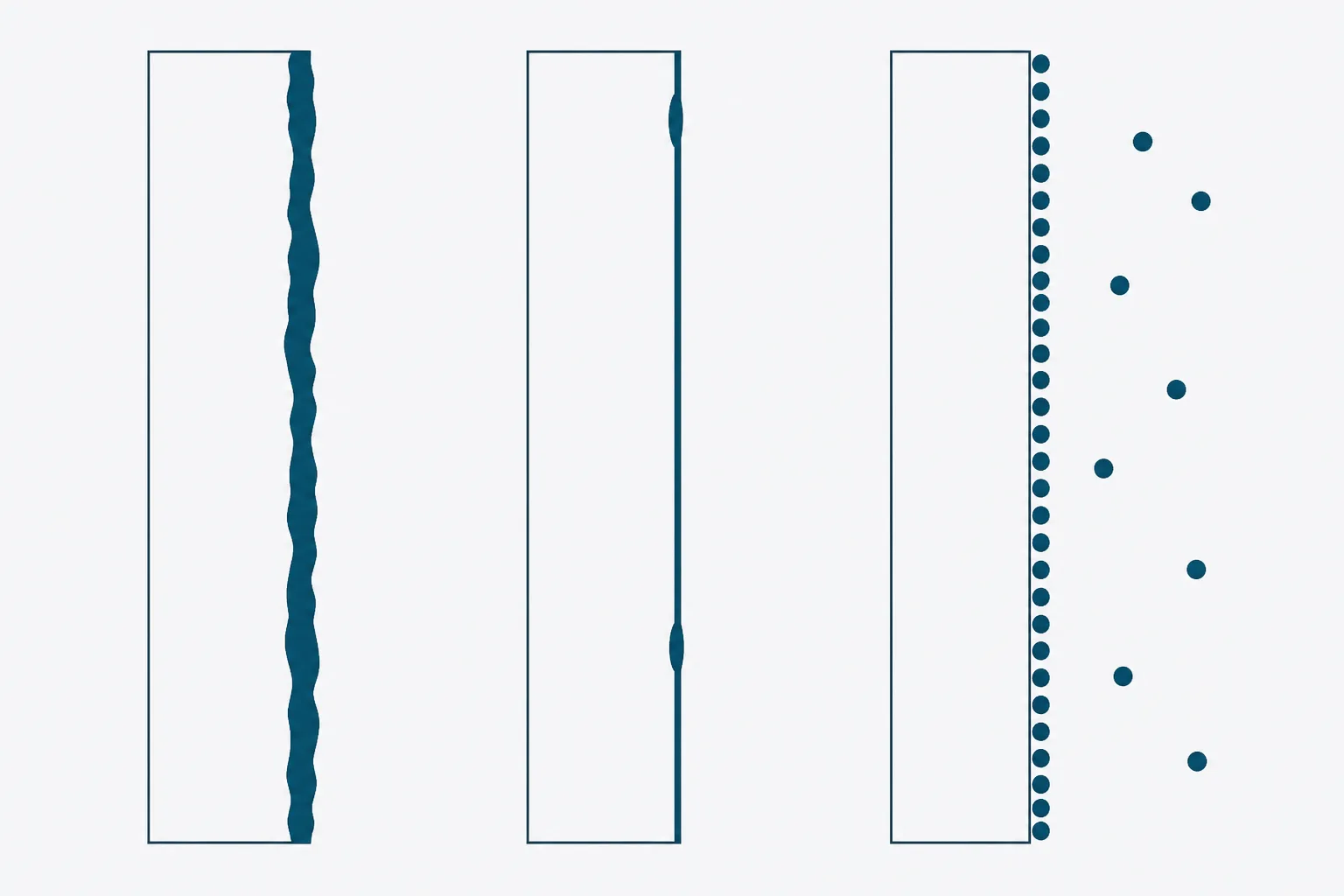
Residue survives for structural reasons rather than through carelessness. Liquid drains from a vertical wall as a film, not to dryness, so every rinse leaves a layer behind, and surfactants concentrate at that layer by definition. If the vessel dries without a further rinse, the residue concentrates at the meniscus line and in the base — exactly where a small sample volume will later sit. Ground-glass joints, stopcock bores, frits and threaded caps hold liquid by capillary action and are the last places a rinse reaches.
For peptide work there is a further complication. Residual surfactant does not merely interfere with detection; it changes behaviour. Surfactants are used deliberately in protein formulation because they occupy interfaces and reduce adsorption and interfacial aggregation 3. Unintended residue does the same thing, at an unknown concentration that varies vessel by vessel. Recovery improves in some vessels and not others, and the variability is attributed to the material rather than to the glassware. An uncontrolled excipient is worse than none.
The rinse sequence and the final-rinse rule
One rule governs the whole procedure: the contamination floor of a vessel is set by the last liquid that touched it. A vessel rinsed finally with tap water carries the dissolved solids of tap water, however immaculate the preceding steps. This is why the grade of the final rinse water is a specification rather than a preference, and why the analytical water standards exist to make it quotable 5.
- Empty and pre-rinse immediately after use, with a solvent that dissolves the residue in question. Never let a sample dry in a vessel; dried protein film is disproportionately hard to remove.
- Wash with the detergent at the stated dilution and temperature, with mechanical action — brush, ultrasonic bath or machine cycle. Concentration and contact time both matter.
- Rinse three times with tap or primary-treated water to remove the bulk of the detergent. This stage carries away most of the mass.
- Rinse three times with water of the grade the downstream work requires, using a small volume that wets the entire interior each time rather than a single fill.
- Where compatible, finish with a small rinse of the solvent or buffer the vessel will actually hold, so the final liquid is the working medium.
- Invert to drain fully. Standing liquid re-deposits whatever it holds at the meniscus as it evaporates.
- Verify, then record the cleaning state on the vessel or in the log. An unverified clean vessel is an assumption in glass.
Step four contains the arithmetic that most laboratories get wrong by intuition. A rinse does not remove residue; it dilutes the film left behind. If a vessel retains roughly a tenth of a millilitre as a film and is rinsed with ten millilitres, each rinse leaves about one part in a hundred of the previous residue. Three such rinses leave one part in a million. One rinse with thirty millilitres, by contrast, leaves about one part in three hundred. Same water, three orders of magnitude difference in outcome. Rinse volume enters linearly; rinse count enters as an exponent.
| Test | What it detects | Limitation |
|---|---|---|
| Visual inspection | Gross soil, films, deposits | Detects nothing at the concentrations that matter |
| Water-break test | Hydrophobic organic film; clean glass holds an unbroken water sheet, fouled glass beads | Qualitative, and insensitive to hydrophilic ionic residue |
| Conductivity of the final rinse against a blank | Ionic residue, including alkaline cleaner and acid carryover | Blind to non-ionic surfactant, which is the main offender |
| Ultraviolet absorbance of the final rinse | Aromatic and unsaturated organic residue | Many surfactants absorb weakly or not at all |
| Total organic carbon of the final rinse | Any organic residue, quantitatively | Requires an instrument and a clean sampling container |
| Rinse or swab recovery assayed by the working method | Residue as the working method would see it, against a defined limit | Needs a recovery study to know what fraction the sampling actually captures |
Acid washing and when it is warranted
Acid washing is a targeted treatment, not an upgrade to routine cleaning. It dissolves adsorbed metal ions, strips residual protein and removes phosphate deposits, and is warranted where those specific residues matter. The standard treatment is a soak in dilute nitric acid — commonly around ten per cent by volume — followed by exhaustive rinsing with high-grade water until the rinse returns to blank conductivity. Nitric is preferred to hydrochloric because chloride carryover interferes with several determinations.
Warranted for: trace element determination by atomic or plasma methods, where surface metal exceeds the analyte; phosphate and nucleic acid work; and any preparation where residual iron or copper would catalyse oxidation of methionine, cysteine, tryptophan or histidine, since that converts a cleaning question into a stability question. Not warranted for: routine aqueous buffer work, where the acid soak adds a day, consumes a controlled reagent, generates acid waste, and leaves a risk of residual acidity that shifts the pH of a small, weakly buffered volume.
- Chromic acid is obsolete. Hexavalent chromium is carcinogenic, the waste is a controlled disposal problem, and chromium adsorbs to glass and reappears in trace-metal work later.
- Strong oxidising mixtures of concentrated acid and peroxide are severe hazards, react violently with organic residue and must not be treated as a cleaning routine.
- Alkaline baths remove organics efficiently but etch borosilicate on prolonged contact, leaching sodium and boron, roughening the surface and eventually destroying volumetric accuracy.
- Never acid-wash volumetric glassware repeatedly; etching changes the calibrated volume, and the vessel will keep reporting the number engraved on it.
- Rinse until the rinse is blank, not until it seems reasonable. Residual acid is itself a contaminant, and a strong one in a small volume.
Borosilicate against plastic, and the adsorption penalty
The choice of material is usually framed as glass versus plastic and answered by habit. For peptide work it is better framed as a choice between two different adsorption mechanisms. Borosilicate presents a hydrophilic surface carrying ionisable silanol groups that are negatively charged at ordinary working pH, and it therefore binds cationic sequences — which is most of them, at pH values below the isoelectric point — by electrostatic attraction. Polypropylene presents a hydrophobic surface and binds hydrophobic sequences instead 2. Neither is inert. The question is which mechanism your particular sequence is vulnerable to.
| Material | Surface | Binds | Notes |
|---|---|---|---|
| Borosilicate glass | Hydrophilic, negatively charged silanols | Cationic sequences, strongly | Low extractables, reusable, autoclavable, no cleaning residue if properly rinsed |
| Silanised glass | Methylated, hydrophobic | Hydrophobic sequences | Reduces cationic binding; the coating is finite and degrades with cleaning |
| Polypropylene | Hydrophobic | Hydrophobic sequences | Single-use avoids cleaning entirely; leachable additives are the trade-off |
| Low-binding treated polypropylene | Surface-modified to reduce protein binding | Less of everything, but not nothing | A relative claim tested against protein standards, not against your sequence |
| Polystyrene | Hydrophobic, higher binding than polypropylene | Hydrophobic sequences, strongly | Common in plates and tubes; a frequent unrecognised source of loss |
| Fluoropolymer | Hydrophobic, very low energy | Least of the group in most cases | Lowest extractables and lowest binding. Expensive and opaque |
Here is the point generic cleaning guides omit. Cleaning glass more thoroughly makes it more adsorptive. A used vessel carries an organic conditioning layer that partially blocks the silanol surface; removing that layer — which is exactly what a good detergent wash and an acid soak achieve — exposes the bare, high-energy silica surface in full. Alkaline etching goes further and increases the effective surface area by roughening it. A scrupulously cleaned borosilicate vessel is therefore the most strongly binding state that vessel will ever be in, and the first dilute solution placed into it loses the most 2. Surface-induced adsorption also promotes conformational change and interfacial aggregation, so the loss is not always recoverable by rinsing it back off 4.
Three responses follow, in order of preference. For dilute solutions, use single-use low-binding plastic and remove the cleaning question altogether. Where glass is required, condition the vessel by sacrificing a first aliquot of the solution, or by pre-treating with a carrier protein or a permitted surfactant where the assay tolerates one 3. And in every case, measure recovery rather than assuming it: prepare a known concentration, hold it in the vessel for the intended time, and re-measure. That figure is a property of the vessel, the sequence and the buffer together, and it cannot be predicted from any of them alone.
Drying and storage
Drying is where clean glassware is most often recontaminated. Oven drying at moderate temperature suits general glassware but not volumetric ware, whose calibration drifts with repeated heating. Compressed air lines carry oil aerosol and particulate and should never be blown into a cleaned vessel; filtered inert gas or an oven is the alternative. Drying racks contaminate whatever touches their pegs, so invert vessels on a clean lint-free surface instead. Where residual water is unacceptable, a water-miscible solvent rinse followed by evaporation is the route, and that solvent then sets the floor.
Clean glassware has a shelf life. An open vessel on an open shelf collects airborne dust, fibre and organic vapour within hours, so anything not used promptly is stored covered and inverted. Cover with foil rather than plasticised film: film transfers plasticiser and polymer oligomers onto the surface it touches, and those are among the contaminants most commonly identified in mass spectrometry 1. Do not store rubber or cork closures inside cleaned vessels, and label each item with its cleaning state and date, so the next person can tell a cleaned vessel from an empty one. Where a preparation must also be free of endotoxin, note that ordinary cleaning and autoclaving do not achieve it — dry heat at around 250 degrees Celsius for at least thirty minutes is the conventional depyrogenation condition, and it is a separate operation from cleaning.
References
- Interferences and contaminants encountered in modern mass spectrometry
- The importance of using the optimal plasticware and glassware in studies involving peptides
- Instability, stabilization, and formulation of liquid protein pharmaceuticals
- Protein aggregation—pathways and influencing factors
- ISO 3696:1987 Water for analytical laboratory use — Specification and test methods