Decision Rules and Guard Bands: Conformity With Uncertainty
The step after the uncertainty budget and before the report: choosing, agreeing and recording the rule that turns a result with an expanded uncertainty into a statement of conformity under ISO/IEC 17025 clause 7.8.6. Simple acceptance, guard bands of w = kU, binary and non-binary statements and the probability of a false accept, worked for a generic purity specification.
A laboratory decides whether a result conforms by applying a documented decision rule, agreed with the customer before the work starts, that states how the measurement uncertainty is taken into account. ISO/IEC 17025:2017 clause 7.8.6 requires the rule to be documented, to consider the level of risk associated with it (false accept, false reject and the statistical assumptions behind them), and to be identified on the report unless the specification itself already contains it 1. A guard band of width w = kU moves the acceptance limit inside the specification limit by a multiple of the expanded uncertainty. ILAC-G8 tabulates the consequences: with simple acceptance (w = 0) the specific risk of a false accept for a result exactly on the limit may be as high as 50 %; with w = U it is below 2.5 %; with w = 1.5U it is below 0.16 % 2.
Two companion references cover the steps before this one: building the uncertainty budget, and writing the number to the right digit. This page covers the decision: which rule, what each rule costs in risk, how it is agreed, and how it appears on the report. The worked example uses an invented purity specification, not less than 98.0 % by a stated method, with an expanded uncertainty of 0.4 % at k = 2. It describes no real material or method.
What clause 7.8.6 requires before a conformity statement
Clause 7.8.6.1 of ISO/IEC 17025:2017 requires that when a statement of conformity to a specification or standard is provided, the laboratory documents the decision rule employed, taking into account the level of risk (such as false accept and false reject and statistical assumptions) associated with it, and applies that rule. Clause 7.8.6.2 requires the statement to identify which results it applies to, which specification or parts of it are met or not met, and the decision rule applied, unless the rule is inherent in the specification. Clause 7.1.3 fixes the timing: where a customer requests a statement of conformity, the specification and the decision rule are defined, communicated and agreed at review of the request, before the work is done 1.
Three consequences follow. The rule is chosen before the result exists. The rule is the customer's as much as the laboratory's. And the rule is a documented, auditable item in its own right. JCGM 106 defines a decision rule as a documented rule that describes how measurement uncertainty will be accounted for with regard to accepting or rejecting an item, given a specified requirement and the result of a measurement 4. Nothing in that definition requires the rule to be conservative. It requires the rule to be written down and its risk understood.
Simple acceptance and its hidden risk
Simple acceptance compares the measured value with the specification limit and ignores the uncertainty: a purity at or above 98.0 % passes, anything below fails. ILAC-G8 describes it as a guard band of zero width and calls it shared risk, because for a result exactly on the limit, the probability that the true value lies on the wrong side may be as high as 50 % under a symmetric normal distribution 2. The risk is not hidden from the statistics. It is hidden from the report, which says pass with the same confidence for a result of 99.5 % and for one of 98.0 %.
Simple acceptance is not prohibited. It is legitimate where the customer has accepted the shared risk, where the specification was written with the method's uncertainty already built in, or where the uncertainty is small against the tolerance. JCGM 106 expresses that last condition as a measurement capability index, the tolerance divided by four times the standard uncertainty; the larger the index, the less the choice of rule matters 4. The requirement is that the choice is deliberate, agreed and stated, not that it is avoided.
Guard bands: w = kU and the acceptance limit
A guard band is the interval between a tolerance limit and a corresponding acceptance limit 4. For a lower specification limit TL, the acceptance limit is AL = TL + w; for an upper limit it is TL − w. ILAC-G8 writes the band as a multiple r of the expanded uncertainty, w = rU, with w = U the common default; a binary rule then accepts a result at or beyond AL and rejects anything short of it 2. The specification does not move. The acceptance limit does.
| Rule | Guard band w | Acceptance limit | Specific false-accept risk at the acceptance limit |
|---|---|---|---|
| Six sigma | 3U | 99.2 % | Below 1 part per million |
| Three sigma | 1.5U | 98.6 % | Below 0.16 % |
| ILAC-G8 default | 1U | 98.4 % | Below 2.5 % |
| ISO 14253-1:2017 | 0.83U | 98.33 % | Below 5 % |
| Simple acceptance | 0 | 98.0 % | Up to 50 % |
| Uncritical | −U | 97.6 % | Rejection only beyond one U past the limit; false-reject risk below 2.5 % |
The multiplier is a risk setting and nothing more. A wider band protects whoever relies on a pass and penalises whoever supplied material that was in fact conforming; a narrower band does the reverse. The Eurachem/CITAC guide frames the choice in terms of who bears the consequences of each kind of error, and treats the acceptance limit and the probability it is designed to achieve as the two quantities a rule must fix 5.
Binary and non-binary statements
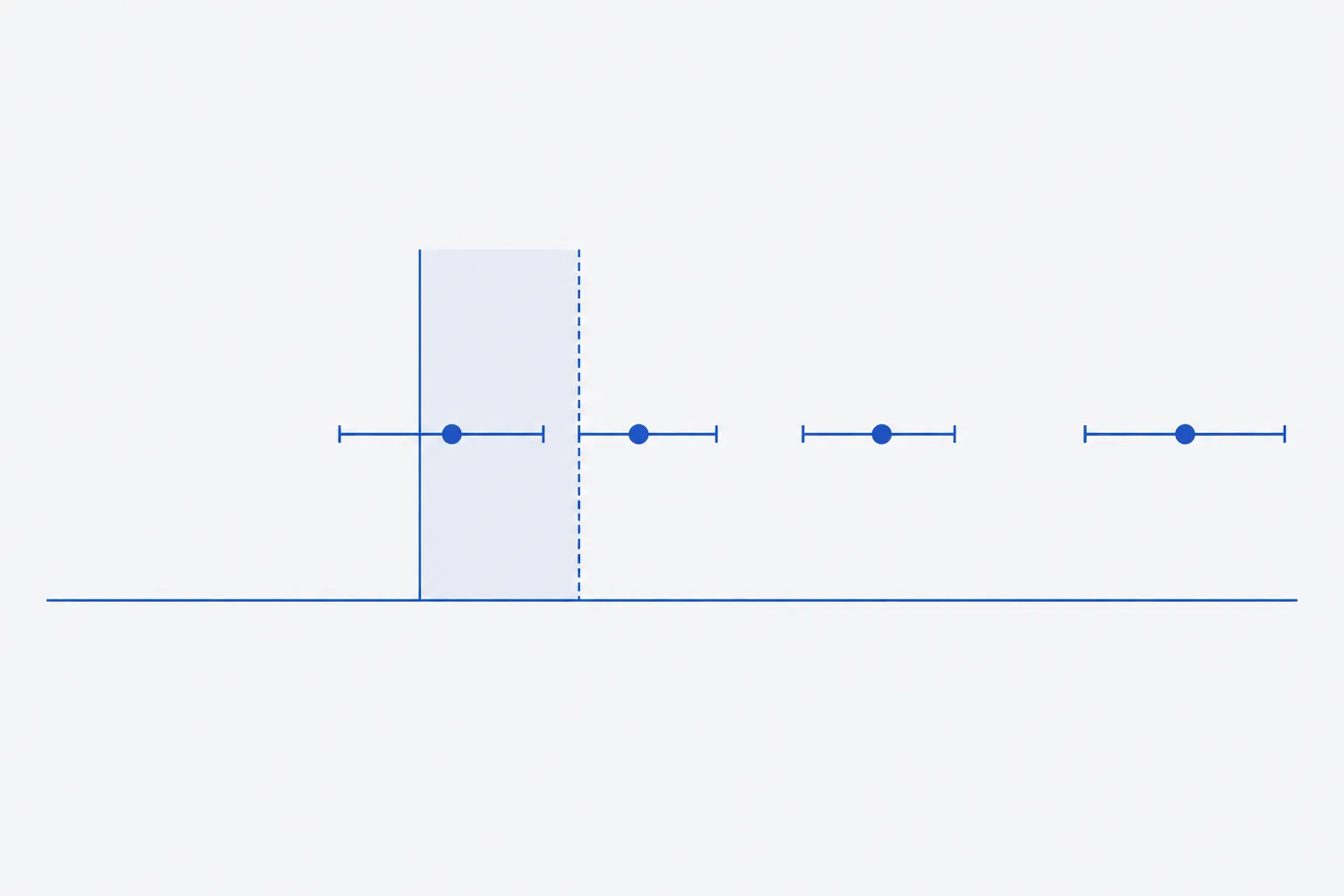
A binary rule has two outcomes, pass and fail. A non-binary rule has four: pass, conditional pass, conditional fail and fail 2. With a lower limit TL and a guard band w, the regions are: pass at or above TL + w; conditional pass from TL up to TL + w, inside the band but above the limit; conditional fail from TL − w up to TL, below the limit but within one band of it; fail below TL − w. The conditional terms carry the information a binary rule discards: the result is near enough to the limit that the uncertainty could place the true value on either side.
Non-binary statements suit development and investigation, where the recipient can act on the distinction. Binary statements suit release decisions, where the recipient needs an answer. Both must name the rule. A conditional pass without the guard band that defines it cannot be interpreted.
Probability of false accept and false reject
JCGM 106 distinguishes specific risk, the probability that this particular accepted item is non-conforming, from global risk, the probability that a non-conforming item will be accepted over future measurements; it defines a producer's risk in each case for the converse error, a conforming item rejected 4. ILAC-G8 and this page use the specific risk, which is the one a laboratory can compute from a single result and its uncertainty 2.
With a lower limit TL, a measured value x, a standard uncertainty u = U ÷ k and a normal distribution, the probability that the true value lies below TL is Φ((TL − x) ÷ u), where Φ is the standard normal cumulative distribution. For a result exactly on the acceptance limit under w = U, (TL − x) ÷ u = −2 and the probability is 2.3 %. Under w = 1.5U it is −3 and 0.13 %. Under simple acceptance it is 0 and 50 %. The figures in the ILAC table are these values rounded up to a stated ceiling 2.
The false-reject probability for a rejected result is the mirror image, 1 − Φ((TL − x) ÷ u). A result of 97.9 % against TL = 98.0 % with u = 0.2 % is rejected under simple acceptance, yet has a 31 % probability of belonging to conforming material. That is the producer's side of the shared risk, and it is why a laboratory that reports a bare fail near the limit should expect the question.
Worked example: a purity specification and five results
Specification: purity not less than 98.0 % by the stated method. Expanded uncertainty U = 0.4 % (k = 2), so u = 0.2 %. Five results from the same method, listed from furthest to nearest the limit. Illustrative figures only.
| Result | Probability true value is below 98.0 % | Simple acceptance (w = 0) | Binary, w = U (AL 98.4 %) | Non-binary, w = U | Binary, w = 1.5U (AL 98.6 %) |
|---|---|---|---|---|---|
| 99.1 % | Below 0.01 % | Pass | Pass | Pass | Pass |
| 98.5 % | 0.6 % | Pass | Pass | Pass | Fail |
| 98.3 % | 6.7 % | Pass | Fail | Conditional pass | Fail |
| 98.1 % | 31 % | Pass | Fail | Conditional pass | Fail |
| 97.9 % | 69 % | Fail | Fail | Conditional fail | Fail |
Read across the 98.1 % row. Under simple acceptance it passes, with a 31 % probability of being non-conforming. Under a binary guard band of one U it fails, although the true value is more likely than not above the limit. The non-binary rule reports what is actually known: above the limit, inside the band. None of the three is wrong. Each answers a different question, and the customer should have chosen which question before the sample was run.
Read across the 98.5 % row. It passes every rule except w = 1.5U, which rejects a result carrying a 0.6 % false-accept risk. A rule that strict is defensible where the consequence of a false accept is severe, and wasteful otherwise, because it rejects conforming material about one time in six when the true purity sits at 98.4 %.
Agreeing the rule with the customer and recording it
The procedure runs at contract review, before any sample is tested. UKAS LAB 48 sets out what an assessor expects to find: the rule documented, agreed, applied as written and identified on the report, with worked wording for binary and non-binary cases 3.
- Obtain the specification in writing, with its limits, units and the basis of the quantity (as is, anhydrous, or anhydrous and counterion-free).
- Take the method's expanded uncertainty at the specification limit from the current uncertainty budget, and state k.
- Check whether the specification already embeds a decision rule or guard band; pharmacopoeial and regulatory limits frequently do. If so, apply that rule and record where it is stated.
- If not, offer the customer the options: simple acceptance, a binary guard band at a stated multiple of U, or a non-binary statement, each with its false-accept and false-reject probability at the limit.
- Record the customer's choice, who made it and when, in the contract-review record. Silence is not agreement; a default applied without a response must be identified on the report as the laboratory's default.
- Compute and record the acceptance limit the rule produces for this specification and this uncertainty.
- Write the rule into the test procedure or the customer file so that the analyst applying it does not interpret it afresh.
- Revisit the agreement whenever the uncertainty changes materially, since the acceptance limit moves with it.
Report wording and the audit trail
A compliant statement lets a reader check the decision without the laboratory's help: the result, its uncertainty with k, the specification, the rule and the outcome, in one place 3. The following forms meet that test for the worked example.
| Situation | Statement on the report |
|---|---|
| Simple acceptance | Purity 98.1 % (U = 0.4 %, k = 2). Conforms to the specification of not less than 98.0 %. Decision rule: simple acceptance; measurement uncertainty not taken into account; shared risk accepted by the customer at contract review. |
| Binary, guard band w = U | Purity 98.3 % (U = 0.4 %, k = 2). Does not reach the acceptance limit of 98.4 %, derived from the specification of not less than 98.0 % with a guard band equal to U (ILAC-G8 binary rule). Fail. |
| Non-binary, guard band w = U | Purity 98.3 % (U = 0.4 %, k = 2). Above the specification limit of 98.0 % and within the guard band of 98.0 to 98.4 %. Conditional pass. |
| No rule agreed | Purity 98.3 % (U = 0.4 %, k = 2). No statement of conformity is made; no decision rule was agreed. |
The audit trail is the chain from contract review to report: the specification received, the version of the uncertainty budget, the rule and who agreed it, the acceptance limit computed, the result, and the statement. An assessor reading the report should be able to recompute the acceptance limit from the stated U and multiplier and arrive at the same outcome. If they cannot, the statement is not traceable, however correct it happens to be.
In one sentence
A conformity statement is a result, an uncertainty, a specification and a rule, agreed in advance and written so that a stranger can reproduce the decision; the rule sets the risk, the risk is the customer's to choose, and both are the laboratory's to state.
References
- ISO/IEC 17025:2017 General requirements for the competence of testing and calibration laboratories
- ILAC-G8:09/2019 Guidelines on Decision Rules and Statements of Conformity
- LAB 48: Decision Rules and Statements of Conformity, Edition 5
- JCGM 106:2012 Evaluation of measurement data — The role of measurement uncertainty in conformity assessment
- Use of uncertainty information in compliance assessment, second edition