Formulation and lyophilisation
Cake Inspection: Collapse, Meltback and Reconstitution Time
A bench procedure for inspecting a lyophilised cake: lighting and background, a defect vocabulary, a 1 to 5 grading scheme, what each defect says about moisture and drying temperature, the timed dissolution test, and the record to keep.
A lyophilised cake is inspected by eye, under defined light against a defined background, and graded against a written defect list. The cake is a record of the drying cycle: its height, texture and colour show whether the product stayed below its collapse temperature, whether primary drying finished, and whether residual moisture is likely to be high 12. Appearance is not proof of purity, but a cake that has collapsed or melted back is a reason to measure moisture and purity before the lot is used for anything.
This page is a bench procedure for research material. It covers the inspection conditions, the defect vocabulary, an in-house 1 to 5 grading scheme, the timed dissolution test used for receipt and stability records, and the record fields. The grading scheme is the desk's own convention for consistency between inspectors; it is not drawn from a standard, and a laboratory should adopt it only after calibrating its inspectors against reference vials.
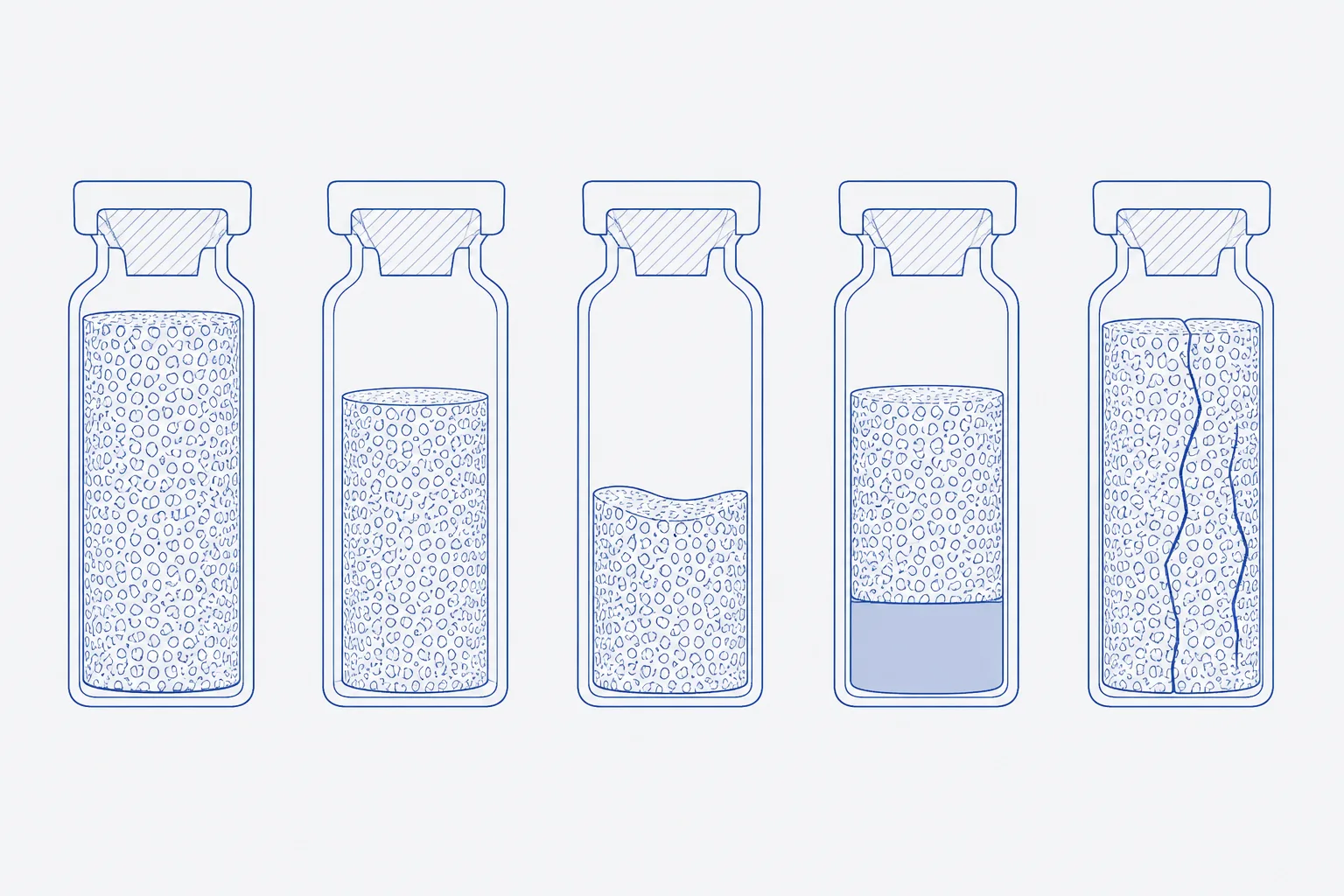
Why cake appearance is evidence, not cosmetics
FDA's inspection guide for lyophilisation treats cake appearance as a quality attribute to be checked on every finished container, and singles out meltback as the defect of most concern: a form of collapse from incomplete sublimation, associated with a change in the physical form of the solid or a pocket of moisture, and with poor solubility on reconstitution 1. The 2017 review by Patel and colleagues takes the opposite angle and asks which defects actually matter. Its argument is that appearance should be linked to performance, so that a defect is rejected because it predicts a failure and not merely because it looks wrong 2.
Both positions hold at the bench. A cosmetic variation that has no connection to moisture, structure or dissolution can be tolerated and recorded. A variation that does connect to them cannot be judged from the appearance alone, so the inspection prompts a measurement. ICH Q6A makes the same pairing in a regulatory context: a description test for appearance sits beside a water-content test and, for powders that must be dissolved, an acceptance criterion for reconstitution time with a justified diluent 4.
Inspection conditions: light, background, magnification
FDA's draft guidance on visible particulates says a manual inspection station should have a backdrop of one or more solid colours, such as black and white, for contrast, and that light intensity is critical and should be set with container colour, size and shape in mind 5. It does not give a number, so the laboratory must define one in its procedure and measure it with a lux meter at the inspection position.
- Inspect in a dedicated position with a matt black panel and a matt white panel side by side, and a light source that does not glare off the glass.
- Record the illuminance at the vial position in lux and re-measure it on a set schedule or when a lamp is changed.
- Clean the outside of the vial and handle it by the neck. Fingerprints on the wall are the commonest false defect.
- View the vial upright and still against each background in turn, then rotate it gently. Do not shake; a loose cake can fragment.
- Use a hand lens or low-power stereo microscope for fine cracks and for checking whether a dense layer is present at the base.
- Photograph the vial against the same backdrop every time, with a scale reference and the lot number in frame. Photographs are the only way to compare lots months apart.
Defect vocabulary: shrinkage, collapse, meltback, cracking, foaming, skin
The terms below follow common usage in the lyophilisation literature 12. Collapse is the loss of the porous structure when the product temperature during primary drying exceeds the temperature at which the amorphous matrix can no longer support itself; the collapse temperature is a property of the formulation and is measured, not assumed 3. Meltback is the more serious variant, in which a region of the cake has partly liquefied and refrozen or dried as a dense mass.
| Defect | Appearance | Probable cause | Acceptability |
|---|---|---|---|
| Intact | Full height, uniform, porous, touches the wall or lies slightly away | Product stayed below collapse temperature | Acceptable |
| Shrinkage | Cake pulled in from the wall, height reduced by a few per cent, structure intact | Matrix contraction on drying; fill depth; freezing history | Acceptable if structure is intact and dissolution time is normal |
| Partial collapse | Top surface sagged or slumped, with a glassy or sticky look, structure lost in a region | Product temperature briefly above collapse temperature in primary drying | Conditional: test moisture and dissolution |
| Total collapse | Dense, glassy, shrunken to a small plug, often darker or yellowed | Drying well above collapse temperature, or high residual moisture reducing the glass transition | Not acceptable without moisture, purity and dissolution results |
| Meltback | Dense, fused or wet-looking layer, usually at the base or against the wall, with porous cake above | Incomplete sublimation; product melting before drying finished; a moisture pocket | Not acceptable; indicates moisture and altered physical form |
| Cracking | Fissures through a full-height cake, or a cake in several pieces | Stress during drying or handling; deep fill; crystalline matrices | Conditional: cosmetic if structure and moisture are normal |
| Foaming or splatter on the wall | Droplet residue or foam marks above the cake | Boiling or splash during fill or at the start of evacuation | Record; acceptable if the residue is trivial and total mass is unaffected |
| Skin or crust | Thin dense film on the top surface over a porous body | Surface drying and densification early in primary drying | Acceptable if dissolution time is normal; note it |
A 1 to 5 grading scheme and its acceptability rules
A grade turns a description into something that can be tabulated across lots. Grade the cake on the worst defect present, not the average.
| Grade | Description | Action |
|---|---|---|
| 1 | Intact, full height, uniform texture, normal colour | Release to use; routine record |
| 2 | Shrinkage or skin only, structure intact | Release to use; record and photograph |
| 3 | Cracking or detachment, or minor surface collapse over less than a quarter of the cake | Test moisture; use after result is within specification |
| 4 | Partial collapse over more than a quarter of the cake, or any dense layer at the base | Quarantine; moisture, purity and dissolution time required |
| 5 | Total collapse, meltback, discolouration, wet appearance, or foreign matter | Quarantine; treat as a non-conformance |
What each defect implies about moisture and process temperature
Collapse in a finished cake can have two origins. The cake may have been dried above its collapse temperature, so that the structure failed during the cycle. Or the cake may have been dried correctly but picked up water afterwards, so that the glass transition of the dry solid fell below the storage temperature and the structure relaxed. The first is a process fault in manufacture; the second is a storage or closure fault. The two cannot be told apart by looking, which is why the water result is read alongside the grade 13.
A few per cent of residual water lowers the glass transition of a dried amorphous solid by tens of degrees. A cake that is intact at 5 °C may collapse at 25 °C once it has taken up water, and a cake that has not yet collapsed may be close to it. For that reason a defect never reduces to cosmetic when water is high, and a moisture result is the first follow-up for any grade of 3 or above. Fill error appears as a cake that is far taller or far shorter than its siblings in the same lot, and is checked by weight, not by eye.
The timed dissolution test: diluent, agitation, end-point
Reconstitution time is the elapsed time for the cake to dissolve completely in a stated diluent under stated agitation. ICH Q6A expects an acceptance criterion for it on any dry powder that must be dissolved, with the choice of diluent justified 4. For laboratory receipt and stability records the aim is repeatability, so every variable is fixed in the procedure. The test is carried out to prepare an assay sample or to compare lots; it is not preparation of anything for use.
- Select at least three vials per lot, with the lowest and highest grades if grades differ. Let them reach room temperature, with the closures intact, so that no condensation forms on the cake.
- Fix the diluent (water of the specified grade, or the buffer named in the procedure), its volume, and its temperature, and record all three. Use a calibrated pipette.
- Add the diluent down the vial wall, not onto the cake, and start the timer at the moment the diluent contacts the solid.
- Agitate in the defined way: gentle swirl at a stated rate or a fixed number of slow inversions. Do not vortex, which foams and denatures some peptides.
- Inspect against the black and white backgrounds at fixed intervals, for example every 15 seconds. The end-point is no visible solid, gel or undissolved film in either view, with the solution clear or uniformly opalescent as expected for the formulation.
- Stop the timer at the end-point. Record the time in seconds. Record whether foam persisted, whether bubbles clouded the reading, and whether any particle remained after a stated maximum time.
- Report the mean, the range, and the individual times. A single slow vial is information, not an outlier to be discarded.
What counts as normal depends on the formulation and is learnt from reference lots. A crystalline mannitol cake typically wets almost at once; an amorphous sugar cake takes longer; a peptide-only film may dissolve in seconds if the peptide is soluble. A lot whose time exceeds the in-house limit or the historical range for that product deserves the same follow-up as a grade 4 cake.
Linking inspection to residual moisture and purity results
| Finding | Question it raises | Measurement |
|---|---|---|
| Grade 3 or above | Is residual water high? | Karl Fischer titration on a whole vial |
| Discolouration | Has the peptide oxidised or reacted? | Reversed-phase HPLC purity, mass spectrometry |
| Slow dissolution | Is it aggregated or structurally altered? | Visual particle check, size-exclusion chromatography if available |
| Cake height outlier | Was the fill wrong? | Gross weight of the vial and net content from the certificate |
| Melted base | Did the product melt in manufacture? | Moisture, plus request for the cycle record from the supplier |
Karl Fischer titration is the specific water method, and a loss-on-drying result is accepted by ICH Q6A only where the effect of absorbed water against water of hydration has been characterised 4. Where a mannitol hemihydrate is present, bound water adds to the Karl Fischer figure and the result must be interpreted against the formulation. Research is also under way on automated inspection, including computed tomography with machine learning to find structural defects without opening the vial, but it is a development tool and does not replace a written visual procedure at the bench 6.
The inspection record and when to quarantine
The record exists so that a later reader can reconstruct the call. Without photographs, lux values and vial identifiers, a grade is an opinion.
| Field | Content |
|---|---|
| Lot and vial identifiers | Lot number, vial position, date and time of inspection |
| Inspector | Name and signature; reference-vial calibration date |
| Conditions | Illuminance in lux, backgrounds used, magnification |
| Findings | Defect names from the table, grade, cake height in mm |
| Photographs | File names, backdrop, scale reference |
| Dissolution test | Diluent, volume, temperature, agitation, end-point, time in seconds per vial |
| Follow-up results | Karl Fischer water, purity, identity; references to their records |
| Decision | Accept, conditional, quarantine; reason and approver |
Quarantine a lot on a grade of 4 or 5, on a dissolution time outside the historical range, on a cake that contradicts the supplier's description, or on any discrepancy between vials of one lot that the inspector cannot explain. Release from quarantine requires a documented moisture and purity result within specification and the approver's signature. A grade that was recorded and then quietly ignored is worse than one that was never recorded.
References
- Guide to Inspections of Lyophilization of Parenterals (7/93)
- Lyophilized Drug Product Cake Appearance: What Is Acceptable?
- The collapse temperature in freeze drying: Dependence on measurement methodology and rate of water removal from the glassy phase
- Specifications: Test Procedures and Acceptance Criteria for New Drug Substances and New Drug Products: Chemical Substances (ICH Q6A)
- Inspection of Injectable Products for Visible Particulates (draft guidance)
- Automated tomographic assessment of structural defects of freeze-dried pharmaceuticals