Residual Solvents in Lyophilised Peptides: USP <467> Headspace GC
Which organic solvents survive synthesis, purification and freeze-drying, how ICH Q3C classes and limits apply to them, and the USP <467> headspace GC workflow from sample preparation to the limit decision, with a worked ppm calculation for a small sample mass.
A synthetic peptide can retain N,N-dimethylformamide (DMF), N-methylpyrrolidone (NMP), dichloromethane (DCM), acetonitrile, methanol, diethyl ether and others from solid-phase synthesis, cleavage, precipitation, HPLC purification and freeze-drying. USP <467> identifies and quantifies them by static headspace gas chromatography with flame-ionisation detection, and compares the result with the concentration limits of ICH Q3C, which classes each solvent by toxicity 12. Headspace GC suits a lyophilised peptide because the sample is dissolved and only the vapour is injected, so the non-volatile peptide never reaches the column.
Residual solvent is the third residual class beside water and counter-ion. The companion references cover moisture by Karl Fischer and counter-ion content. This page covers the organic volatile fraction: where it enters, which limits apply, what Procedures A, B and C each establish, how the headspace is set, how a result in ppm is calculated from a small sample mass, and what is recorded. The chapter text itself is the controlling document; this page does not reproduce its tables or acceptance criteria.
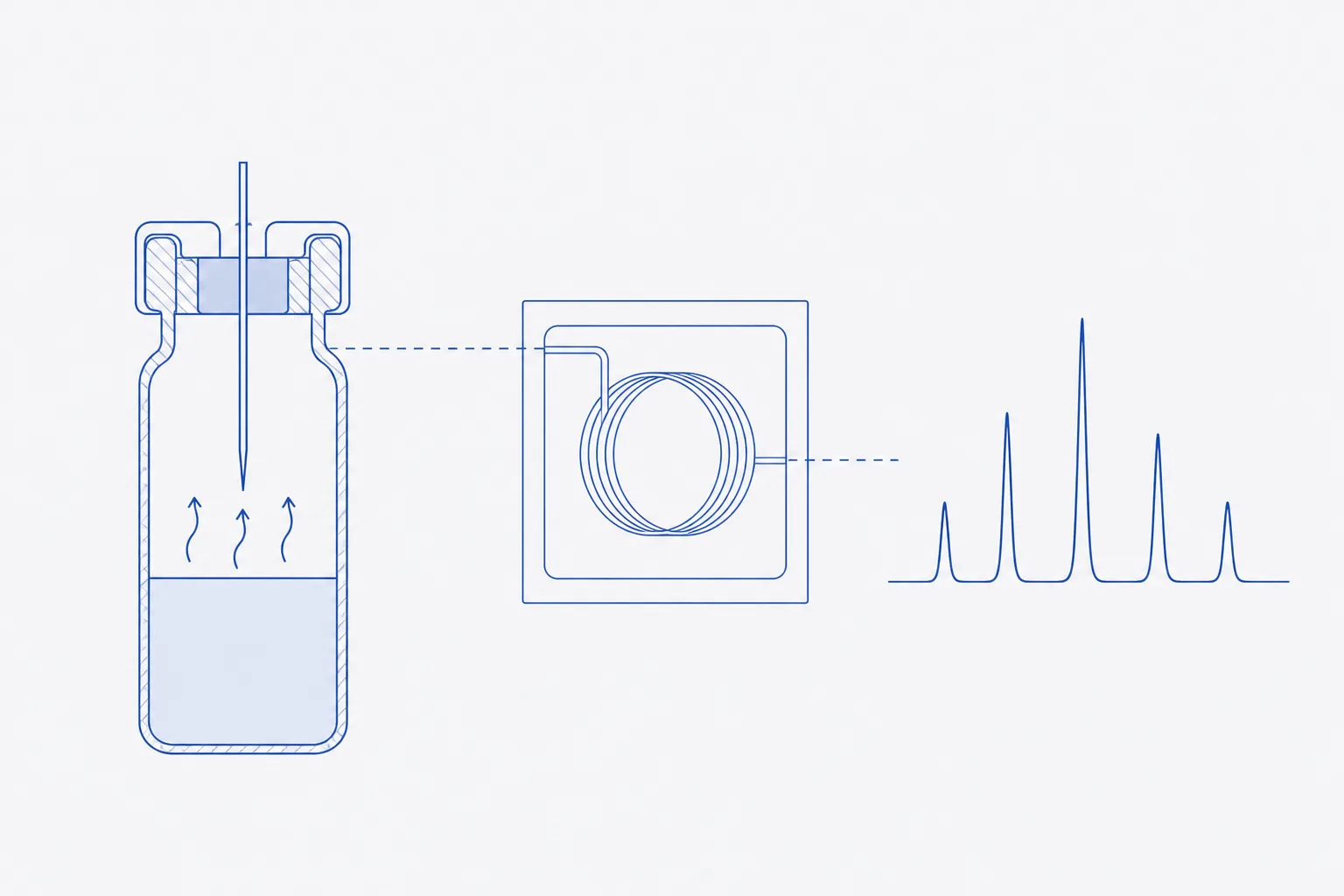
Where solvents enter
Every step after the first coupling uses an organic liquid, and each step leaves a different footprint. Solid-phase synthesis builds the chain on a resin swollen in DMF, NMP or DCM; deprotection and capping use further amines and bases. Cleavage from the resin is done in strong acid with scavengers. The crude peptide is then precipitated from cold ether, dissolved, and purified by reversed-phase HPLC in water and acetonitrile, with an acid modifier. The pooled fractions are freeze-dried. Water and acetonitrile sublime; solvents that bind to the peptide cake or have high boiling points stay behind.
| Solvent | Where it enters | Q3C class | Concentration limit |
|---|---|---|---|
| N,N-Dimethylformamide | Coupling and Fmoc deprotection medium; resin washes | 2 | 880 ppm (PDE 8.8 mg/day) |
| N-Methylpyrrolidone | Coupling medium | 2 | 530 ppm (PDE 5.3 mg/day) |
| Dichloromethane | Resin swelling and washing | 2 | 600 ppm (PDE 6.0 mg/day) |
| Acetonitrile | HPLC purification; precipitation; lyophilisation feed | 2 | 410 ppm (PDE 4.1 mg/day) |
| Methanol | Washing; HPLC | 2 | 3,000 ppm (PDE 30.0 mg/day) |
| Pyridine | Capping and coupling additives | 2 | 200 ppm (PDE 2.0 mg/day) |
| Diethyl ether (ethyl ether) | Precipitation of crude peptide | 3 | Acceptable below 0.5% without justification |
| Ethanol, 2-propanol, acetone, acetic acid, dimethyl sulfoxide | Washing, purification, buffers | 3 | Acceptable below 0.5% without justification |
| Trifluoroacetic acid | Cleavage; HPLC modifier | Table 4: no adequate toxicological data | Not a headspace analyte in a peptide; see below |
The two amide solvents matter most. DMF and NMP have high boiling points, partition strongly into the peptide cake, and are not reliably removed by freeze-drying. Of the group they are the ones most often found above their limits, and they are the hardest to measure by headspace because they have little vapour pressure at the equilibration temperature.
ICH Q3C classes and the limit arithmetic
ICH Q3C divides residual solvents into three classes. Class 1 solvents are to be avoided: known or strongly suspected carcinogens and environmental hazards, such as benzene, carbon tetrachloride and 1,2-dichloroethane, with limits of a few ppm. Class 2 solvents are to be limited, with a permitted daily exposure (PDE) in mg per day for each. Class 3 solvents have low toxic potential, with PDEs of 50 mg per day or more, and amounts up to 0.5% are acceptable without justification 1. Solvents in Table 4, with no adequate toxicological data, need a justification for any residual level.
Option 1 converts each PDE into a concentration limit by assuming a product mass of 10 g per day: concentration (ppm) = 1000 × PDE ÷ mass in grams. For acetonitrile, 1000 × 4.1 ÷ 10 = 410 ppm. Option 1 limits apply to any substance regardless of how it is used and are the conservative comparator when the downstream use is not set 1. Here they are used as reference limits for the purity of the material; a laboratory states which edition of Q3C it used, since USP training material notes that the chapter was revised to align with Q3C(R9) and the table can change between editions 12.
USP <467> Procedures A, B and C
The chapter gives a sequence of procedures, not a single method. Each answers a different question, and the sequence stops when the question is answered 23.
| Procedure | Question answered | Column phase | Outcome |
|---|---|---|---|
| A | Is any Class 1 or Class 2 solvent present at or above its limit? | 6% cyanopropylphenyl–94% dimethylpolysiloxane (the G43 type) | Pass if no peak in the sample response exceeds that of the standard at its limit |
| B | Is a peak seen in A really that solvent? | Polyethylene glycol (the G16 type): a different selectivity | Confirms or rejects the identification from A |
| C | How much of a confirmed solvent is present? | As A or B, with standard additions or a matched standard | A quantitative value compared with the limit |
Procedure A is a limit test, run against standards prepared at the limit concentration for each solvent. A sample with no peak above that standard passes without being quantified. A peak above it moves to Procedure B, where the solvent must co-elute with the standard on a column of different selectivity: if the peak does not match on B, the A peak was an interference. A confirmed solvent is then quantified by Procedure C. The Class 2 standards are run as mixtures, so that each mixture contains solvents which are separated on the column 3.
Headspace parameters, diluent and standards
The sample is dissolved in a diluent in a sealed vial, heated until volatile solvents reach equilibrium between liquid and vapour, and a fixed volume of vapour is injected. Peak size depends on the solvent's volatility, its solubility in the diluent and the phase ratio of the vial, so every parameter below must be identical for standard and sample 4.
| Parameter | What it controls | How to set it |
|---|---|---|
| Diluent | Solubility of sample; partition of each solvent | Water for a water-soluble lyophilised peptide. If DMF or NMP is an analyte, do not use it as diluent; use water or dimethyl sulfoxide per the chapter |
| Equilibration temperature | Vapour pressure of each solvent | Below the boiling point of the diluent, in the region of 80 °C for water; fixed in the chapter |
| Equilibration time | Whether equilibrium is reached | Show a plateau in peak area against time in method development; fixed in the chapter |
| Vial fill | Phase ratio | Same liquid volume in standard and sample vials |
| Transfer line and loop or syringe temperature | Condensation of the less volatile solvents | Above the vial temperature, to prevent loss of DMF and NMP |
| Split ratio | Sensitivity and peak shape | The lowest split that gives symmetrical early peaks; changing it re-establishes sensitivity |
System suitability for the screen
System suitability proves that the system can see a solvent at its limit and tell neighbours apart. The chapter sets its own criteria for resolution between critical pairs and for the signal-to-noise of the Class 1 standard; Shimadzu's data for Procedure A on a headspace GC report Class 1 signal-to-noise results and area repeatability with relative standard deviations of 1% to 3% 3. Record each criterion, its value and the date, before reading sample results.
Calculating ppm from a small sample mass
Compendial sample masses are in the hundreds of milligrams, while a research peptide is often 10 to 20 mg. The calculation is the same, but the ppm quantitation limit scales inversely with mass, so a smaller sample cannot reach a low limit. The worked example uses an invented sample and acetonitrile.
- Weigh 20.0 mg of lyophilised peptide (0.0200 g) into a headspace vial and add 2.0 mL of water. Record the balance printout and the net peptide content separately; ppm is reported on the material as weighed unless the procedure states otherwise.
- Prepare the acetonitrile standard at the limit for this mass and volume: 410 µg·g⁻¹ × 0.0200 g = 8.2 µg in 2.0 mL, which is 4.1 µg·mL⁻¹.
- Run the standard and the sample under identical headspace and GC conditions. The sample acetonitrile peak area is 0.62 times that of the standard.
- Concentration in the sample vial = 0.62 × 4.1 µg·mL⁻¹ = 2.54 µg·mL⁻¹.
- Mass of acetonitrile = 2.54 µg·mL⁻¹ × 2.0 mL = 5.08 µg.
- Result = 5.08 µg ÷ 0.0200 g = 254 µg·g⁻¹ = 254 ppm. Compare with the 410 ppm limit: below the limit, and about 62% of it.
The calculation assumes the standard and the sample have the same response factor, which holds when the diluent and vial fill match and the peptide does not change the partition of the solvent. If the matrix alters it, use standard additions, which is the logic of Procedure C: spike the sample with known amounts, plot response against added amount, and read the original amount from the intercept.
Why TFA is a counter-ion, not a residual solvent, in this test
Trifluoroacetic acid appears in Q3C Table 4, among solvents without adequate toxicological data 1. In a peptide it is present largely as the trifluoroacetate salt of the basic groups, bound ionically to the chain at substantial levels by mass. It is measured as a counter-ion by ion chromatography or fluorine NMR, and it is reported in the content balance beside acetate or chloride. A headspace screen at neutral conditions does not account for it, so a clean residual-solvent result says nothing about trifluoroacetate.
Reporting and the record
- State the edition of USP <467> and ICH Q3C used, and the procedure run (A, B, C).
- Report each solvent found as a value in ppm with its limit, or as 'not detected' with the detection limit achieved for that sample mass.
- Never report 'none'. A screen that finds nothing means no peak at or above the limit at the stated mass, not absence.
- Record the sample mass and balance printout, diluent, vial volume, headspace and GC conditions, column, standard preparation, system suitability results, and the integration.
- Keep the chromatograms and the audit trail with the report. Any reintegration needs a recorded reason.
- Where the screen shows a Class 2 solvent above its limit, open a deviation. Do not release a result that sits on the line without a stated decision rule.
The FDA guidance on residual solvents explains the regulatory context in which <467> is applied to products marketed in the United States and points to ICH Q3C for classification and limits 5. For research material the same text is the framework a testing laboratory can cite, and the limit decision is only as sound as the sample preparation behind it.
References
- ICH Q3C (R9) Impurities: Guideline for Residual Solvents — Step 4 version dated 24 January 2024
- <467> Residual Solvents (General Chapter)
- Measurement of Residual Solvents in Pharmaceuticals by Headspace GC - USP <467> Residual Solvents Procedure A
- Analyzing Residual Solvents in Pharmaceutical Products Using GC Headspace with Valve-and-Loop Sampling (Application Note 10316)
- Residual Solvents in Drug Products Marketed in the United States — Guidance for Industry