stability study design
Stability-Indicating Methods: Why a Purity Assay Alone Does Not Qualify
What a method has to demonstrate before its results can support a stability claim: specificity shown with degraded samples, resolution of degradants, an assay that measures amount, closed mass balance, and the validation elements, with a checklist.
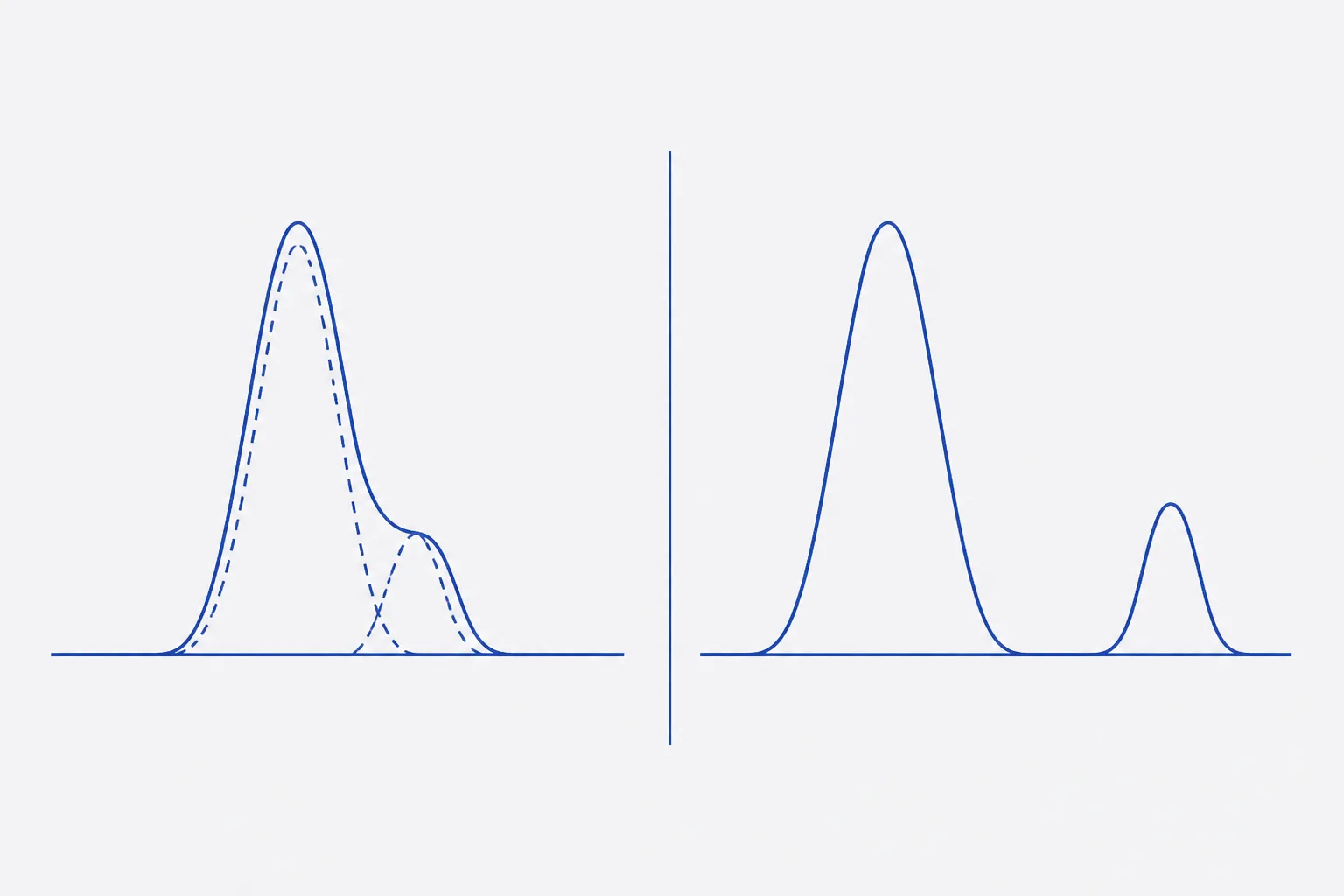
A method is stability-indicating when it has been shown to measure the intact analyte accurately in the presence of its degradation products, impurities and matrix, and to detect and measure those degradation products as they form, so that any change with time in the attribute that matters appears in the result 1. The demonstration is the point. A method earns the description from evidence generated with degraded samples, not from the technique it uses or the column it runs on.
An HPLC purity figure on its own does not qualify. It is an area ratio from one chromatographic view: it can stay constant while material is being lost, and it can hide a degradant under the main peak. The HPLC purity entry in this handbook explains what the figure means. This entry covers what has to be added before a result can support a stability claim.
The definition and the claim it makes
Bakshi and Singh's review of stability-indicating assay methods defines one as a validated quantitative procedure that detects changes with time in the relevant properties of the drug substance or product, and measures the active ingredient without interference from degradation products, process impurities, excipients or other potential impurities 1. Two claims are packed into that. The method sees change when change occurs. And the number it reports for the parent is the parent, not the parent plus whatever co-elutes with it.
The ICH stability guidance depends on that property without always spelling it out. Q1A(R2) requires that formal studies use validated stability-indicating analytical procedures 5. The consolidated ICH Q1 draft lists confirming and validating the stability-indicating nature of the analytical procedures among the purposes of development studies under stressed and forced conditions 6. A stability result from a method that has not been shown to be stability-indicating is an observation that the method did not report change, which is a different statement from an observation that nothing changed.
Why a purity figure is not enough
Chromatographic purity is the main-peak area divided by the total integrated area, at one wavelength, under one set of conditions. Every way that calculation can miss a change is a way a stability study can miss one.
| Failure | Mechanism | What purity shows | What catches it |
|---|---|---|---|
| Co-elution | A degradant elutes under the main peak: isomerised, racemised or subtly oxidised forms | No change | Resolution shown with forced-degradation samples; MS across the peak; an orthogonal separation |
| Normalisation | Parent and degradants leave solution together by aggregation, adsorption or precipitation | No change, because the ratio is unchanged | Assay against a reference standard; size-exclusion; recovery |
| Products not seen | Aggregates retained on the column, polar fragments in the void, products that absorb weakly at the wavelength used | Purity rises or holds | Mass balance; a strong wash; a second wavelength; LC-MS |
| Integration | Small peaks on the tail of the main peak are merged or split differently from run to run | Drift unrelated to the material | Fixed integration parameters; a reporting threshold at or above the quantitation limit |
| Matrix | A buffer or excipient peak coincides with a degradant | False degradant, or a masked one | Blank and matrix injections |
An invented illustration shows the scale of the problem. A preparation reads 98.9% purity at time zero and 98.8% after twelve months, and the assay against a reference standard falls by 9% over the same period. The purity result is correct and useless. The material has aggregated and adsorbed, taking its minor peaks with it in proportion, and only the assay registers the loss.
Specificity: the element that defines the method
Specificity is shown with samples that contain the degradants, and for a new material the only reliable source is a forced degradation study that has taken the parent to roughly 5 to 20% loss under each relevant stress 2. ICH Q2(R2) defines a stability-indicating procedure as a validated quantitative procedure able to detect changes in relevant quality attributes during storage, and requires that its specificity be shown with samples containing the relevant degradation products: spiked samples, samples exposed to physical and chemical stress, or aged samples 3. The stressed samples are injected, and the method must resolve every relevant degradant from the parent and, where they are to be quantified individually, from each other.
Resolution is quantified as the resolution between the critical pair, the two adjacent peaks hardest to separate. A resolution of 1.5 corresponds to baseline separation of two symmetrical peaks of similar size; a small degradant on the tail of a large parent needs more. Record the critical pair and its resolution, because it becomes the system suitability criterion that proves on every later run that the separation still holds.
Peak homogeneity is the second part. Diode-array peak purity compares ultraviolet spectra across a peak and flags a co-eluting species with a different spectrum. For peptides it is weak, because most degradants — deamidated, isomerised, many oxidised forms — carry the same chromophores as the parent and give the same spectrum. Mass spectrometry across the main peak of a stressed sample does better for species that differ in mass. Isobaric species, which differ in neither spectrum nor mass, need an orthogonal separation: a different column chemistry or mobile-phase pH, ion-exchange or capillary electrophoresis for the charge change that deamidation introduces, or chiral analysis for racemisation 7.
The validation elements
A stability-indicating method is usually two methods sharing one chromatogram: an assay for the parent and a quantitative test for its degradants. Each needs its own evidence. ICH Q2(R2), adopted in 2023, sets the validation characteristics, and ICH Q14, adopted alongside it, covers development, including how robustness is explored 34. The general parameters are defined in the method validation entry of this handbook; the table shows how they apply here.
| Element | Parent assay | Degradants | Shown by |
|---|---|---|---|
| Specificity | Parent free of interference | Each relevant degradant resolved and detectable | Forced-degradation samples; MS; orthogonal method |
| Accuracy | Recovery against a reference standard | Spiked recovery where standards exist; otherwise relative response | Known additions; comparison with an independent method |
| Precision | Repeatability and intermediate precision near nominal | Repeatability at the specification limit | Replicate independent preparations |
| Range | Around the nominal content, covering expected loss | From the reporting threshold to above the limit | Response across the range, examined as residuals |
| Quantitation limit | Not usually critical | At or below the reporting threshold | Signal-to-noise or response near zero |
| Robustness | Result unchanged by small deliberate variation | Critical-pair resolution maintained | Gradient slope, temperature, mobile-phase pH, column lot |
| Solution stability | Sample unchanged over the analytical run | No degradant formed in the autosampler | Re-injection at the end of a sequence |
The last row matters more for peptides than its position suggests. A sample that deamidates or oxidises in a warm autosampler over a long sequence generates the degradants the method is trying to measure, and the stability study then records the analysis rather than the storage. Keep the autosampler cool, and show that the result does not drift across a full sequence 1.
Assay and purity: both are needed
Purity describes the profile: what fraction of what is detected is the parent. Assay against a reference standard of known content describes the amount: how much parent is present per unit of sample. Only the assay registers loss that leaves no peak behind, and only the profile shows which route is operating. Q1A(R2) asks for evaluation of the assay together with the degradation products and other relevant attributes, and for attention to mass balance 5. A stability method that reports only one of the two answers half the question.
Peptide-specific traps
- Deamidation products and isoaspartate often resolve poorly on a steep generic gradient. A shallow gradient across the parent's elution window is usually needed.
- Methionine sulfoxide is more polar than the parent and normally elutes earlier; it is among the easier degradants to resolve, and its absence from a stressed sample is a warning about the stress, not a reassurance about the material.
- Racemised residues frequently co-elute with the parent under achiral conditions.
- Aggregates may not elute from a reversed-phase column at all. Size-exclusion is the separate measurement.
- The ion-pairing agent changes selectivity. A method developed with trifluoroacetic acid and moved to formic acid for mass spectrometry needs its specificity shown again.
- Column temperature changes selectivity between closely related peptide variants, so it belongs in the robustness study.
Checklist
- Forced-degradation samples exist for each relevant stress, taken at a time point within the target range of loss.
- Every relevant degradant is resolved from the parent, and from its neighbours where quantified individually. The critical pair and its resolution are recorded.
- The main peak of each stressed sample has been checked by mass spectrometry across its width.
- An orthogonal technique run on the most degraded samples has found nothing the method missed.
- Mass balance closes within a stated tolerance for each stress, or the shortfall is explained.
- The parent is assayed against a reference standard alongside the purity profile.
- The quantitation limit for degradants sits at or below the reporting threshold.
- Accuracy, precision and range are established for the assay and for the degradants separately.
- Robustness shows the critical-pair resolution holds under small deliberate changes.
- Sample solution stability covers the longest analytical sequence planned.
- System suitability includes critical-pair resolution, measured with a degraded sample or a resolution mixture.
- The evidence is filed with the method, and the material, formulation and route it was shown for are named.
A method is stability-indicating for a material, not in general. The evidence covers the degradants that material formed under the stresses applied. A new sequence, a new formulation, a new container or a newly observed degradation route is a new question, and the demonstration has to be extended to cover it before the method's silence can be read as stability 12.
References
- Development of validated stability-indicating assay methods—critical review
- Development of forced degradation and stability indicating studies of drugs—A review
- ICH Q2(R2) Validation of Analytical Procedures
- ICH Q14 Analytical Procedure Development
- ICH Q1A(R2) Stability Testing of New Drug Substances and Products
- ICH Q1 Stability Testing of Drug Substances and Drug Products — Step 2 draft guideline
- Stability of protein pharmaceuticals: an update