stability study design
Forced Degradation: Stressing a Peptide on Purpose to Learn How It Fails
The deliberate-degradation experiment: how it differs from stress and formal stability testing, the conditions used on peptides, the extent of degradation to aim for, identifying the products, mass balance, and why it has to come before a stability-indicating method.
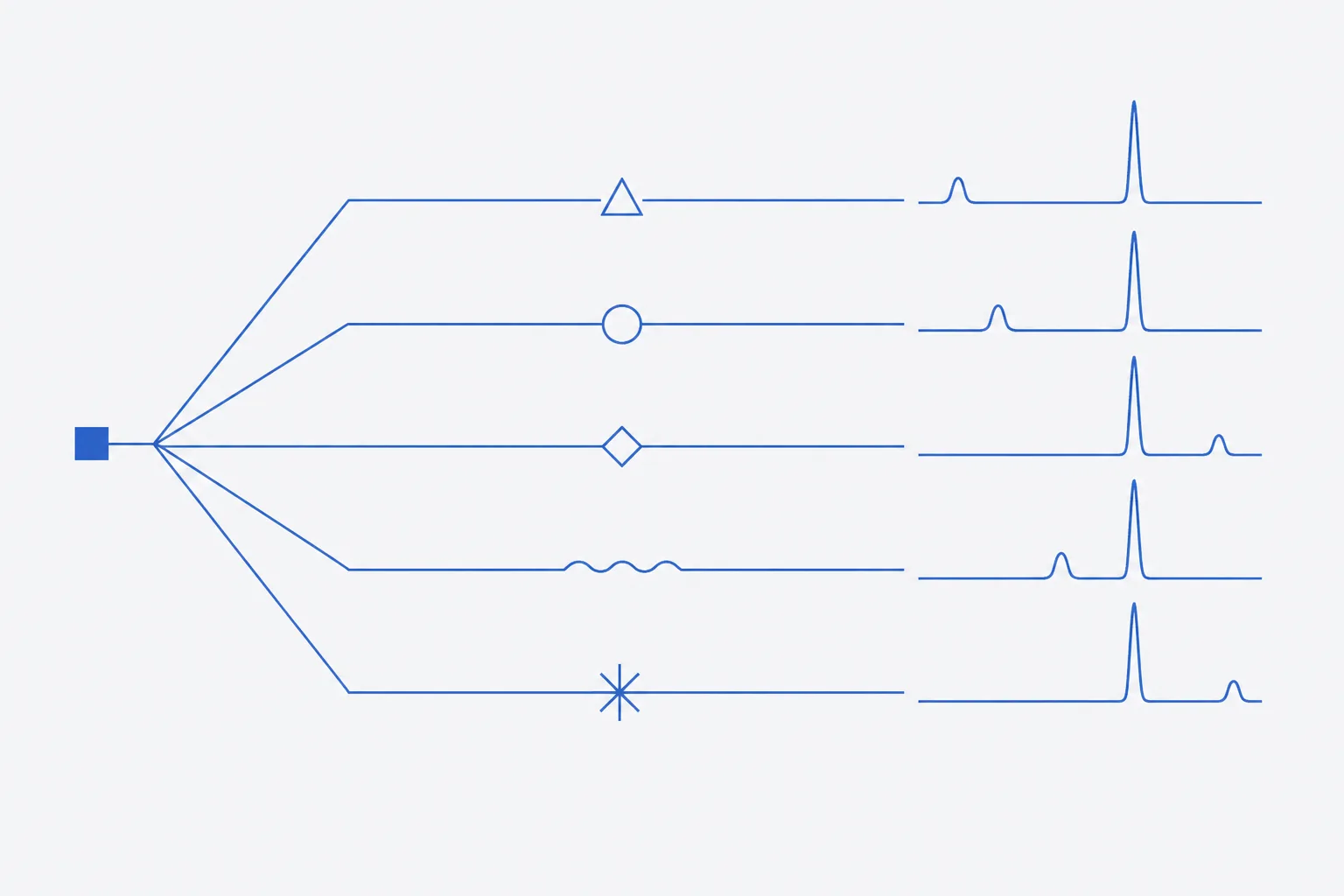
A forced degradation study deliberately degrades a sample under conditions harsher than any storage condition — acid, base, oxidant, heat, humidity, light, agitation — to find out which products the material can form, by which routes, and whether the analytical method can see them. It sets no storage period. ICH places it within stress testing, whose purpose is to identify likely degradation products, establish degradation pathways and intrinsic stability, and validate the stability-indicating power of the analytical procedures 3.
The degradation pathways entry in this handbook catalogues the routes and their mass signatures, and the deamidation entry treats one route in depth. This entry is the experiment that shows which of those routes a particular sequence actually takes, and turns that knowledge into samples a method can be tested against.
Stress, forced and formal: three different studies
The consolidated ICH Q1 draft separates two kinds of development study. Studies under stress conditions use conditions more severe than accelerated but are not necessarily meant to degrade the sample. Studies under forced degradation conditions are meant to degrade it deliberately, through elevated temperature, humidity, pH, oxidation, agitation and light. Neither is part of the formal stability programme, but the draft treats their results as an integral part of the information supporting it 4. Q1A(R2) already required stress testing on a single batch, covering temperature in 10 °C steps above the accelerated condition, humidity of 75% RH or more where appropriate, oxidation, photolysis and hydrolysis across a wide pH range in solution 3.
| Study | Conditions | Question | Output |
|---|---|---|---|
| Forced degradation | Chosen to degrade: strong pH, oxidant, heat, light, agitation | What can form, and can the method see it? | A degradation map and specificity samples |
| Stress testing | Beyond accelerated, not necessarily degrading | How sensitive is the material to each factor? | Intrinsic stability and excursion sensitivity |
| Formal stability | Long-term and accelerated storage conditions | How long does it stay within limits? | A period at a condition |
The target: enough degradation, not the most
The usual target is between 5 and 20% loss of the parent, a range widely accepted as enough to form the relevant products at measurable levels without driving the material into secondary chemistry 1. The limit works in both directions. Under-stressed material forms its products below the level the method can quantify, so the method is never challenged. Over-stressed material forms products of products — fragments of fragments, oxidised aggregates — which storage never produces, and which distort the picture of what the method needs to separate. Q1B makes the same point for light: for method development, limit exposure and end the study when decomposition becomes extensive 5.
| Parent lost | Risk | Response |
|---|---|---|
| Under 5% | Products below quantitation; method untested | Extend time or raise severity one step |
| 5 to 20% | Target range | Keep this time point for method work |
| Over 20% | Secondary products; mass balance harder to close | Use an earlier time point; reduce severity |
| No loss at the harshest reasonable condition | None; the material is stable to that stress | Record the condition and stop; do not escalate without limit |
Sample at several times rather than one endpoint. A time course hits the target without guessing, and it separates primary from secondary products: a product that rises and then falls is an intermediate, as the succinimide on the deamidation route often is, and a product that appears only late is probably secondary.
Conditions for peptides
General reviews of forced degradation describe conditions developed for small-molecule drugs, and those conditions are usually too harsh for a peptide 1. Peptides carry routes that are fast under mild conditions: deamidation and racemisation in weak base, cleavage at aspartyl bonds in weak acid, methionine oxidation in dilute peroxide. Reviews of protein forced degradation recommend starting mild and escalating, and using more than one oxidant system because each gives a different product profile 2. The table gives starting points for a generic study, not settings for any particular sequence.
| Stress | Starting condition | Routes probed | Caution |
|---|---|---|---|
| Acid | Dilute hydrochloric acid or a pH 1 to 3 buffer, 40 to 60 °C, hours to days | Cleavage at Asp-X bonds, pyroglutamate formation, direct deamidation | Asp-Pro cleaves quickly; neutralise to quench |
| Base | A pH 9 to 10 buffer at room temperature before any stronger base | Deamidation, racemisation, disulfide scrambling, β-elimination | Fast; start with minutes and short times |
| Neutral buffer, heat | Near pH 7, 40 to 60 °C | Deamidation, diketopiperazine formation, aggregation | Phosphate catalyses deamidation; record the buffer |
| Peroxide | Dilute hydrogen peroxide, well below small-molecule strengths, room temperature | Methionine first, then cysteine and tryptophan | Quench before analysis |
| Radical or metal systems | An azo radical initiator, or a transition metal with ascorbate | Tryptophan, histidine, site-specific oxidation | Profiles differ from peroxide; use alongside it |
| Heat, solid | 10 °C steps above the accelerated condition, with and without 75% RH or more | Solid-state routes, moisture sensitivity | Note cake collapse; it is a change of state |
| Light | Beyond the Q1B confirmatory exposure, in a transparent container, with a dark control | Photo-oxidation, disulfide cleavage | Filter short-wave ultraviolet unless it is the question |
| Agitation and freeze-thaw | Shaking or stirring; repeated freeze-thaw cycles | Aggregation at interfaces | Physical; look with size-exclusion, not only reversed phase |
Running the study
- Characterise time zero: a reversed-phase trace, an intact deconvoluted mass and a size-exclusion trace of the unstressed material.
- Prepare each stress in a defined matrix, and measure the pH of the final solution rather than inferring it.
- Run controls for every stress: the material in the same matrix at the same temperature without the stressor, and the stressor alone, so reagent and buffer peaks are identified.
- Sample at several time points. Quench each sample at once: neutralise acid and base, remove or scavenge peroxide, cool.
- Analyse with the candidate method using diode-array detection, and by LC-MS.
- Assign each new peak: mass shift to route, then fragmentation or peptide mapping to locate the site.
- Calculate the mass balance at each time point.
- Record the degradation map: stress, product, site, relative retention, and the time point that fell within the target range.
- Retain the target-range samples. They are the specificity samples for method validation.
Identifying the products
Identification runs in two stages. An intact deconvoluted mass for each new peak gives the shift from the parent, which usually names the route: an added oxygen, a lost ammonia, a fragment pair summing to the parent plus water. Fragmentation of the product, or a peptide map of the stressed material, then places the change on a residue. Two cautions carry over from the pathway entries. Several products are isobaric with the parent — isoaspartate, racemised residues, scrambled disulfides — and are seen only as chromatographic peaks with the parent's mass, or not at all by mass. And sample preparation can create the product being measured; an overnight digest at mildly alkaline pH deamidates, so a digest control is needed 26.
Mass balance
Mass balance compares what was lost with what was found: the fall in parent against the sum of the degradants, on a consistent basis. Q1A(R2) asks for attention to the adequacy of the mass balance when stability results are evaluated 3. In a forced study it is the check that the method sees everything the stress produced. A balance that closes supports the method. A shortfall means a product has escaped, and each way of escaping points to a different fix.
| Cause | How to check |
|---|---|
| Product not eluted, or retained on the column | Extend the gradient; run a strong wash and look for late peaks |
| Product not detected at the wavelength used | Compare diode-array spectra; check a second wavelength or MS total ion current |
| Different response factor from the parent | Estimate relative response for major products where standards allow |
| Aggregate or precipitate removed before injection | Size-exclusion on the unfiltered sample; inspect for particles |
| Loss to container surfaces | Recovery in low-binding vessels; rinse and assay the container |
| Small fragments or volatile products | LC-MS at low mass; hydrophilic retention for polar fragments |
Why it comes before the stability-indicating method
A method can only be shown to separate products that exist. Before a forced study, the degradants of a new sequence are predictions; after it, they are peaks in a vial, and the method can be tested against them. That is why the review literature treats stress testing as the starting point of stability-indicating method development 7, and why the consolidated ICH Q1 draft names confirmation and validation of the stability-indicating nature of analytical procedures among the purposes of development studies under forced conditions 4. The same results tell the stability protocol which attributes to monitor: the draft calls these the potential stability-indicating quality attributes 4.
Two limits keep the result honest. A forced study shows what can form, not what will form at the storage condition, so a product seen under forcing may never appear in real time and Q1B allows it to be set aside once confirmatory work shows it does not form 5. And the rates measured under forcing say little about rates in storage, because the conditions change which route dominates 6. The output is a map of failure modes and a set of samples. The rate, and the period, come from the formal study.
References
- Development of forced degradation and stability indicating studies of drugs—A review
- Forced degradation of therapeutic proteins
- ICH Q1A(R2) Stability Testing of New Drug Substances and Products
- ICH Q1 Stability Testing of Drug Substances and Drug Products — Step 2 draft guideline
- ICH Q1B Stability Testing: Photostability Testing of New Drug Substances and Products
- Stability of protein pharmaceuticals: an update
- Development of validated stability-indicating assay methods—critical review