contamination control
Water Grades Type I, II and III: Resistivity, TOC and Bacterial Limits
Laboratory water is specified by measured parameters, not by the process that made it. What each grade guarantees, how distillation, deionisation and reverse osmosis differ, and why water silently moves an analytical result.
Laboratory water is specified by what it measures, not by the machine that produced it. Three parameter families define a grade: ionic content, reported as resistivity or conductivity; organic content, reported as total organic carbon; and biological content, reported as colony count and, where it matters, endotoxin concentration. They are independent. Water can be simultaneously excellent on one and unusable on another, and the commonest error in the whole subject is reading one number and inferring the other two.
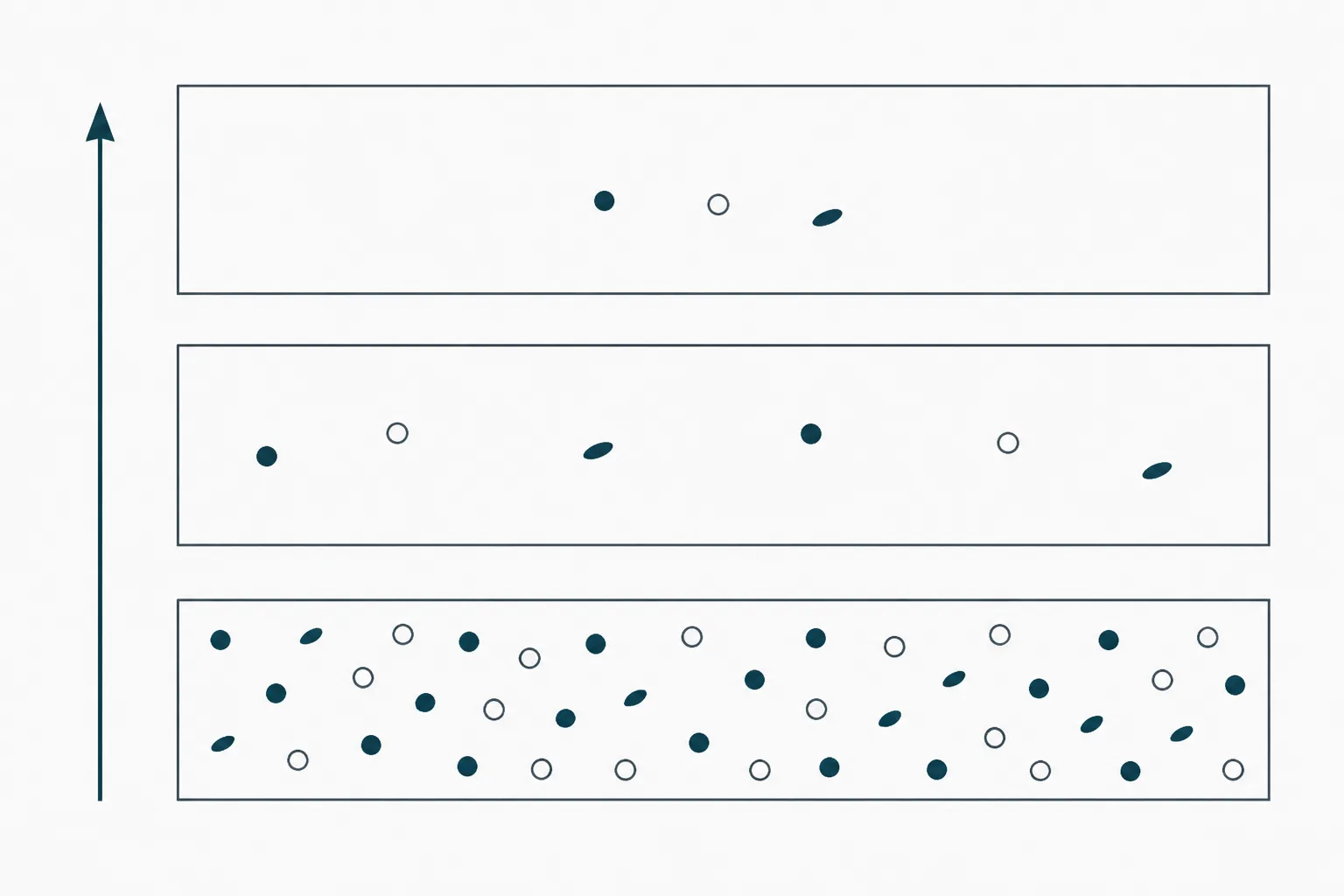
The three defining parameters
Resistivity measures the water's opposition to electrical current and therefore reports dissolved ionic species. It is quoted in megohm-centimetres at 25 degrees Celsius; its reciprocal, conductivity, is quoted in microsiemens per centimetre. Absolutely pure water is not an insulator, because it self-ionises, and that residual self-ionisation sets a ceiling: 18.2 megohm-centimetres, or 0.055 microsiemens per centimetre, at 25 degrees Celsius. No purification can exceed it. The measurement is strongly temperature-dependent, which is why the temperature is part of the specification rather than an aside.
Total organic carbon measures dissolved organic matter as carbon mass per unit volume, typically in micrograms per litre. It is the parameter resistivity cannot see, because most organic contaminants — solvent residues, plasticiser fragments, breakdown products of the purification media themselves, and the metabolic output of any bacteria in the system — are electrically neutral and pass a conductivity cell without registering. Older specifications, written before routine total organic carbon instrumentation, used surrogate measures such as permanganate-oxidisable matter and ultraviolet absorbance instead 1.
Microbial content is the third family and is handled separately from the chemical grades. It is expressed as colony-forming units per unit volume, and, where the downstream use is biological, as endotoxin in endotoxin units per millilitre. Endotoxin deserves separate treatment because it survives the death of the organism that produced it: water can be sterile and still carry a biologically active load 4. Some specification systems bolt microbial grades onto the chemical types as a separate axis 2; others do not address biology at all 1.
The grades and what each is specified for
Two specification systems are in everyday circulation, and their numbering does not align. One defines Grades 1 to 3 by conductivity, oxidisable matter, ultraviolet absorbance, evaporation residue and silica 1. The other defines Types I to IV by resistivity, total organic carbon, sodium, chloride and silica, and adds a separate lettered microbiological axis for bacterial count and endotoxin 2. Their limits are not interchangeable, and in one of them the resistivity minima do not fall in the order the type numbers suggest — read the whole row rather than one cell. In laboratory speech, "Type I" and "ultrapure" have become loose synonyms; when it matters, quote the standard alongside the number.
| Grade in common usage | Ionic content | Organic content | Biology | Specified for |
|---|---|---|---|---|
| Type I, ultrapure | At or near 18.2 megohm-centimetres | Low, single-digit to tens of micrograms per litre | Controlled by a final filter at the point of dispense | Chromatography, mass spectrometry, trace analysis, buffers and standards |
| Type II, purified | Roughly 1 to 15 megohm-centimetres | Moderate | Not inherently controlled | General reagent preparation, media, feed to a polishing unit |
| Type III, primary treated | Below 1 megohm-centimetre in ordinary use | Higher, and variable with the feed | Not controlled | Rinsing, glassware washing, water baths, autoclaves |
| Microbiological grades | Not addressed | Not addressed | Colony count and, at the strictest level, an endotoxin limit | Applied as a separate requirement on top of a chemical type |
The practical decision is not "which is best" but "what does this step actually see". Rinsing glassware that will hold a millimolar buffer does not need ultrapure water; the final rinse before a trace-metals determination does. A gradient chromatography run sees every organic contaminant in the mobile phase concentrated onto the column head. A cell-based assay sees endotoxin at picogram concentrations and is indifferent to silica. Specify against the most sensitive downstream step, and use a lower grade everywhere else without apology.
Distillation, deionisation and reverse osmosis
Three production principles underlie every system, and each has a characteristic blind spot. Knowing the blind spot is more useful than knowing the nominal output, because it predicts the contaminant that will appear when the system is working exactly as designed.
| Method | Principle | Removes well | Characteristic blind spot |
|---|---|---|---|
| Distillation | Phase change; non-volatiles left in the boiler | Ions, non-volatile organics, particulate, bacteria, endotoxin | Volatile organics, ammonia and carbon dioxide travel with the vapour |
| Deionisation by ion exchange | Ionic species exchanged onto resin beds | Cations and anions, to very high resistivity | No organic removal. Resin beds are a substrate for bacterial growth and shed carbon as they age |
| Reverse osmosis | Pressure-driven transport across a semipermeable membrane | Most ions, larger organics, particulate, bacteria, endotoxin | Cannot reach ultrapure ionic levels alone; small neutral molecules and dissolved gases pass |
| Activated carbon | Adsorption onto a high-surface-area solid | Chlorine, chloramine, many dissolved organics | Saturates silently, then releases. A spent bed is a source |
| Ultraviolet oxidation | Short-wavelength photolysis of organic molecules | Organic carbon, converted to ionic fragments; also germicidal | Produces ions that must then be removed by a downstream resin bed |
| Final microfiltration or ultrafiltration | Size exclusion at the point of dispense | Bacteria, particulate; ultrafiltration also removes endotoxin | Removes nothing dissolved and small |
Deionisation carries the most misleading blind spot, and it is worth stating plainly. A mixed-bed system can deliver 18 megohm-centimetres while the water contains substantial organic carbon and a live bacterial population growing on the resin, because neither registers on a conductivity cell. A resistivity meter reading at the top of its scale is not evidence of clean water; it is evidence of low ionic content, and nothing else 3. That is why modern ultrapure systems are hybrids — reverse osmosis or distillation as the primary stage, then a polishing loop combining ion exchange, activated carbon, ultraviolet oxidation and a final filter at the tap — and why an ionic reading alone should never be quoted as a water specification.
How water quality moves an analytical result
The effects are silent, which is what makes them expensive. In gradient reversed-phase chromatography, trace organics in the aqueous mobile phase adsorb onto the column head during the low-organic equilibration and then elute as a band when the gradient runs. The result is ghost peaks that shift with equilibration time and a baseline that rises with the gradient. Both scale with the volume of water pumped, so the problem worsens exactly when a long or sensitive method is being run.
In mass spectrometry, ionic contamination produces sodium and potassium adducts that split the analyte signal across several species and complicate a mass assignment, while dissolved organics suppress ionisation and raise the background. In spectrophotometry, organic contamination absorbs in the low ultraviolet, exactly where peptide bond and aromatic residue measurements are made, so a concentration determined against a poor blank is biased. In trace element work, water-borne metals at part-per-billion level sit above the analyte concentration entirely.
Two effects are specific to peptide handling. Transition metal traces — iron and copper in particular — catalyse oxidation of methionine, cysteine, tryptophan and histidine, so a preparation made in metal-bearing water degrades along a chemical pathway the operator never introduced deliberately. And microbial contamination of a water system delivers two things at once: living organisms whose peptidases digest the solute, and endotoxin, which is heat-stable, survives sterilisation, passes ordinary sterilising filters, and is biologically active at picogram concentrations in cell-based assays 45. A buffer made with contaminated water is compromised in both chemical and biological terms before anything is added to it.
Storage, recontamination and the pharmacopoeial grades
Ultrapure water is chemically aggressive and begins degrading the instant it leaves the dispense point. It absorbs atmospheric carbon dioxide, which forms carbonic acid and drops resistivity from the top of the scale to a few megohm-centimetres within minutes to hours in an open vessel. It leaches from whatever contains it: borosilicate gives up sodium, boron and silica; most polymers give up organics and additives; fluoropolymers give up the least and cost the most. And it picks up airborne organics and microorganisms. The operational conclusion is unambiguous — ultrapure water is produced at the point of use and used immediately. It is not a stored commodity, and a bottle of it filled last week is not ultrapure water any more.
- Dispense at the point of use and use immediately. Do not decant ultrapure water into a storage bottle for later.
- Where lower grades must be stored, keep them in a recirculating loop rather than a static tank. Stagnation is what allows biofilm to establish.
- Eliminate dead legs and unused branches. An unused tap is an incubator connected to the system.
- Sanitise on a schedule and replace consumables on a schedule. A saturated carbon bed or an exhausted resin becomes a source rather than a sink.
- Match the container to the analysis: fluoropolymer or high-purity polymer for trace metals, glass only where leached sodium and boron do not matter.
- Record the grade, the dispense date and the system status against every solution prepared. Water is a reagent, and an unrecorded reagent is an uncontrolled variable.
- Monitor the parameters the use depends on, not only the one displayed on the wall. A resistivity meter does not report organic carbon or bacteria.
Pharmacopoeial water sits on a different axis and is often confused with laboratory grades. Purified water and water for injections are defined for pharmaceutical manufacture, with limits on conductivity, total organic carbon and microbial count; water for injections adds a bacterial endotoxin limit and is produced by distillation or an equivalently effective process. The distinguishing feature is not the numbers but the system behind them: pharmacopoeial water requires a qualified, continuously monitored, sanitised installation with documented trending, because the grade is a property of the system rather than of an individual sample 3. A good laboratory ultrapure unit can match or beat the chemical limits and still not make the claim, because the claim is about validation, monitoring and record, not about a reading on a meter.