stability study design
Photostability Testing: ICH Q1B, Light Sources and Amber Glass
How light sensitivity is established rather than assumed: the Q1B exposure units, the Option 1 and Option 2 sources, dark controls and actinometry, the stepwise container sequence, which residues absorb, and what amber glass does and does not stop.
Photostability is tested by exposing the material, and then the material in its container, to a defined quantity of visible and near-ultraviolet light, alongside a protected dark control, and measuring what changed. For confirmatory studies ICH Q1B sets the minimum exposure at an overall illumination of 1.2 million lux hours and an integrated near-ultraviolet energy of 200 watt hours per square metre 1. The test answers two questions: does light cause unacceptable change, and which level of packaging prevents it.
This entry covers the test. The chemistry of what light and the reactive species it generates do to methionine, tryptophan and the other susceptible residues is covered in the oxidation entry of this handbook.
Status of the guidance
Q1B reached Step 4 on 6 November 1996 as an annex to the parent stability guideline, and it remains the adopted text 1. The consolidated ICH Q1 draft endorsed in April 2025 absorbs photostability into a single section and keeps the same confirmatory exposure of 1.2 million lux hours and 200 watt hours per square metre, while allowing justified alternatives that reflect the photosensitivity of the product, the light source, manufacturing conditions and packaging 2. The draft is not yet adopted; its Step 4 is scheduled for November 2026. Everything below applies under either text.
The exposure units
Two quantities are specified because no single one covers the range. Illuminance, in lux, is a photometric quantity: light weighted by the sensitivity of the human eye, which peaks in the green and falls to nothing in the ultraviolet. Multiply illuminance by time and the result is lux hours. Ultraviolet energy has to be measured radiometrically, as energy per unit area within a stated band, in watt hours per square metre. A lamp can deliver the visible target while delivering almost no ultraviolet, and the reverse.
| Quantity | Unit | Band | Measured with | Confirmatory minimum |
|---|---|---|---|---|
| Overall illumination | Lux hours | Visible, eye-weighted | Calibrated lux meter, logged over time | 1.2 million lux hours |
| Integrated near-ultraviolet energy | Watt hours per square metre | 320 to 400 nm | Calibrated UV radiometer, or a validated chemical actinometer | 200 W·h/m² |
The arithmetic is simple division. At an illustrative illuminance of 10,000 lux inside a light cabinet, 1.2 million lux hours takes 120 hours. At 500 lux, a level typical of ordinary indoor lighting, it takes 2,400 hours, about 100 days of continuous exposure. The ultraviolet target is reached on its own timetable, set by the lamp's ultraviolet output, and the exposure ends only when both targets have been met.
Option 1 and Option 2
Q1B allows two kinds of source. Either may be used, and the applicant may rely on the lamp manufacturer's spectral specification 1.
| Option 1 | Option 2 | |
|---|---|---|
| Source | Any lamp designed to match the D65 outdoor or ID65 indoor daylight standard: artificial daylight fluorescent, xenon or metal halide | A cool white fluorescent lamp and a near-ultraviolet fluorescent lamp, with the same sample exposed to both |
| Ultraviolet specification | Filter out significant radiation below 320 nm | Near-UV lamp from 320 to 400 nm, peak between 350 and 370 nm, significant output in both the 320 to 360 and 360 to 400 nm bands |
| Exposure | Visible and ultraviolet together from one source | Visible and ultraviolet from separate lamps, tracked separately |
| Practical issue | Xenon and metal halide lamps run hot; temperature control or a dark control is essential | Cheaper and cooler; two targets reached at different times |
The 320 nm cut-off matters. Shorter wavelengths do not reach the inside of a building through window glass and would drive photochemistry that ordinary storage never sees. An unfiltered source rich in short-wave ultraviolet overstates light sensitivity, which is acceptable in a forced study and misleading in a confirmatory one.
Controls, monitoring and presentation
Lamps heat what they illuminate, so part of any change seen after exposure may be thermal. Q1B requires either control of temperature or a dark control: a sample wrapped completely in aluminium foil, placed alongside the exposed sample in the same environment and analysed with it 1. The difference between exposed and dark samples is the photochemical effect; the difference between the dark control and time zero is the thermal one.
Exposure is confirmed either with calibrated radiometers and lux meters logged over the run, or with a validated chemical actinometer exposed side by side with the samples. Q1B's annex gives a quinine actinometer for near-ultraviolet lamps: a 2 per cent aqueous solution of quinine monohydrochloride dihydrate, whose absorbance at 400 nm rises with exposure, read against a foil-wrapped control 1. Presentation is specified too. Solids are spread in a layer typically no more than 3 millimetres thick, liquids sit in chemically inert transparent containers, material that cannot be exposed directly goes into a protective transparent container such as quartz, and containers lie in whichever orientation gives the most uniform exposure 1.
Forced first, then confirmatory
Q1B divides testing of a substance into two parts. Forced degradation testing evaluates overall photosensitivity for method development and pathway elucidation; the conditions are at the tester's discretion, exposure may exceed the confirmatory level, and the study can stop once decomposition is extensive. Products that appear only under forcing and are shown not to form under confirmatory conditions need no further examination 1. Light is one of the standard stresses in forced degradation generally, alongside heat, pH and oxidants 56.
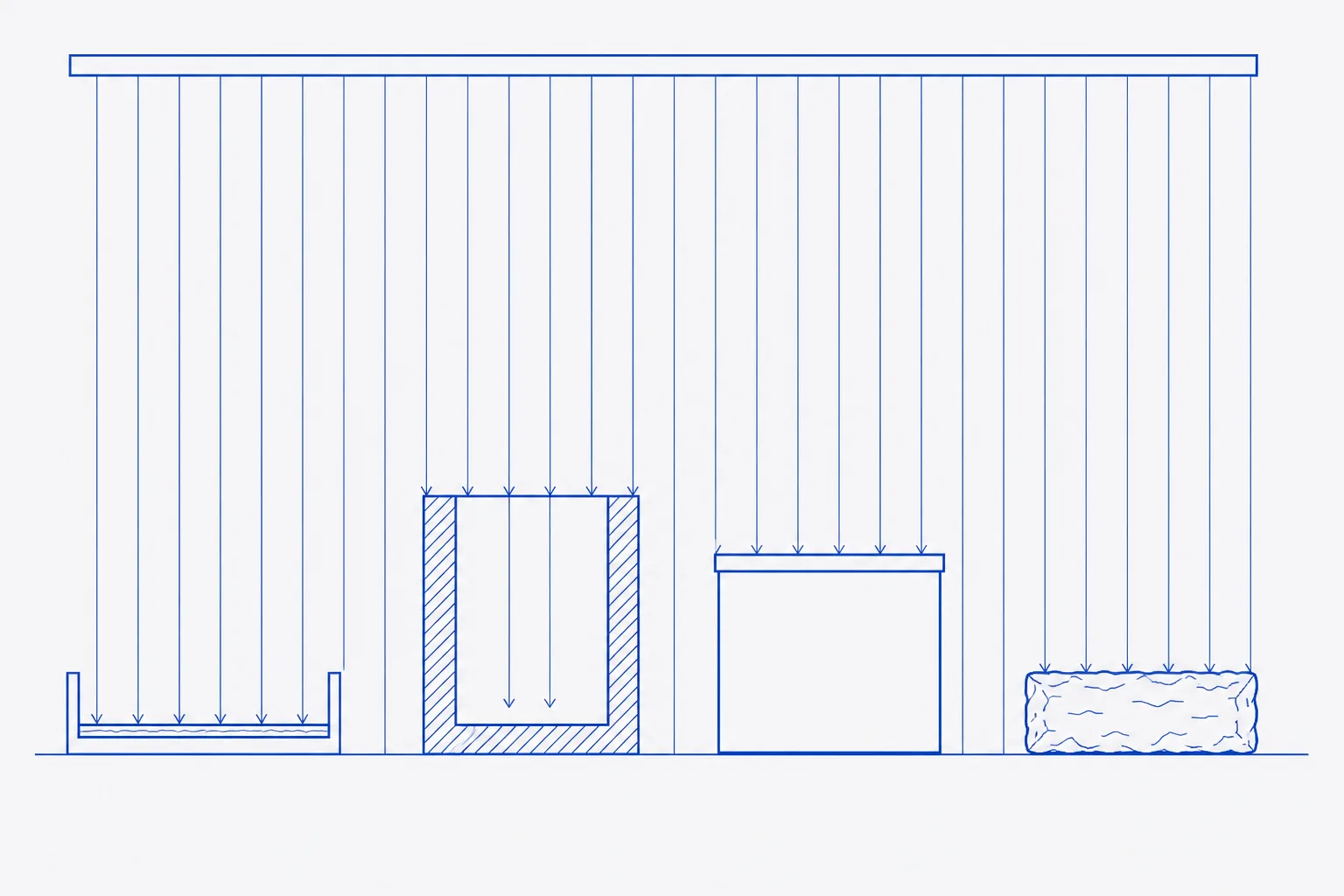
Confirmatory testing then provides the information needed for handling and packaging. It is normally run on one batch, extended to up to two more if the result is equivocal 1. The test proceeds in steps and stops at the first level of protection that gives acceptable change.
| Step | Exposed | Decides | If change is unacceptable |
|---|---|---|---|
| 1 | Material outside any container | Whether the material is photolabile at all | Go to step 2 |
| 2 | Material in its immediate container | Whether the vial or bottle protects it | Go to step 3 |
| 3 | Material in its outer pack, such as a carton | Whether the secondary pack protects it | Redesign the pack or reformulate |
Which residues absorb, and which are attacked indirectly
A peptide is damaged by light in two ways. Direct photolysis needs a chromophore that absorbs the light: in peptides, the aromatic side chains of tryptophan and tyrosine, more weakly phenylalanine, and the disulfide bond of cystine. Tryptophan is the dominant absorber in the ultraviolet reaching the sample, and its excited state can transfer energy or electrons to neighbours, cleave a nearby disulfide or generate singlet oxygen 3. Indirect photodegradation needs no chromophore on the peptide at all. A sensitiser — an excipient impurity, a trace flavin, a metal complex, or another tryptophan — absorbs the light and generates the reactive species, which then attack methionine, histidine, tryptophan and cysteine 34.
| Residue | Absorbs near-UV directly | Main involvement |
|---|---|---|
| Tryptophan | Yes, most strongly | Primary absorber and sensitiser; ring oxidation and ring-opening products |
| Tyrosine | Yes | Radical formation; crosslinking between two tyrosines |
| Phenylalanine | Weakly | Minor contributor |
| Cystine disulfide | Weakly | Bond cleavage, often driven by energy from nearby tryptophan |
| Methionine, histidine | No | Oxidised by singlet oxygen and radicals from a sensitiser |
The practical consequence is that a sequence with no aromatic residue is not automatically safe from light. If the preparation contains a sensitiser, methionine and histidine can still be attacked, and visible light can do it, since the sensitiser rather than the peptide is doing the absorbing 3. That is why the test exposes the preparation as it will actually be held, not the pure peptide alone.
What amber glass actually blocks
Amber glass absorbs strongly through the ultraviolet and the short-wavelength end of the visible spectrum and transmits progressively more light towards the red. That matches the main risk well, because the direct absorbers in a peptide absorb in the ultraviolet. It matches the indirect risk less well: a sensitiser that absorbs visible light can still be excited through amber glass. Pharmacopoeias set maximum transmission limits for light-resistant containers; the confirmatory test is what shows whether a given container meets the need of a given material.
| Protection | Stops | Leaves | Note |
|---|---|---|---|
| Clear glass | Short-wave ultraviolet below roughly 300 nm | Most near-UV and all visible | Equivalent to direct exposure for most purposes |
| Amber glass | Most ultraviolet and blue light | Longer visible wavelengths | Hinders visual inspection for colour and particles |
| Clear glass in an opaque carton | Everything while boxed | Exposure whenever the carton is open | Inspection is easy; protection depends on handling |
| Foil overwrap | Everything | Nothing while wrapped | The laboratory equivalent of a dark control |
A proportionate photostability check
- Run a forced exposure on the material in solution in a transparent container, with a foil-wrapped dark control, to learn whether it is photolabile and to generate photoproducts.
- Confirm that the analytical method separates and detects those photoproducts before relying on it for the confirmatory run.
- Set out the confirmatory presentations side by side: solid spread thinly and exposed directly, material in its clear container, and material in amber glass or its carton. Give each a foil-wrapped dark control.
- Monitor exposure with a calibrated lux meter and ultraviolet radiometer, or with an actinometer, and log temperature throughout.
- Continue until both 1.2 million lux hours and 200 watt hours per square metre are reached.
- Analyse exposed samples and dark controls together: appearance, colour of any solution, assay and individual degradants.
- Attribute the change: exposed minus dark control is photochemical; dark control minus time zero is thermal.
- Record the lowest level of protection that gave acceptable change, and write it into the handling instruction.
The confirmatory exposure is a benchmark, chosen so that different materials and products can be compared directly, not a model of any particular room 1. A vial on an open bench under ordinary lighting accumulates the visible component over a few months, and a sample repeatedly handled under bright task lighting does so faster. The result of the test is a statement of the protection the material needs, and it applies to the material as it was tested 34.
References
- ICH Q1B Stability Testing: Photostability Testing of New Drug Substances and Products
- ICH Q1 Stability Testing of Drug Substances and Drug Products — Step 2 draft guideline
- Protect from light: photodegradation and protein biologics
- Stability of protein pharmaceuticals: an update
- Forced degradation of therapeutic proteins
- ICH Q1A(R2) Stability Testing of New Drug Substances and Products