instrumentation
Pipette Calibration and Gravimetric Verification: Accuracy, Precision and the Z-Factor
A pipette is a balance problem in disguise. The gravimetric check step by step, the density and buoyancy correction that converts mass to volume, acceptance criteria by volume, and the technique faults no calibration can repair.
A pipette delivers a volume that nobody measures. What is measured is a mass on a balance, and the volume is inferred from it through the density of water at the working temperature and a correction for the air the water displaces 2. That inference is the whole of gravimetric verification, and it is why a pipette check is really a balance problem with a plunger attached. Two specifications come out of it, and they fail independently: accuracy, the deviation of the mean delivered volume from nominal, and precision, the scatter of repeated deliveries about that mean 1.
Accuracy and precision are separate specifications
Accuracy — systematic error in the language of the standard — is the difference between the mean of the delivered volumes and the volume selected. It is a bias: consistent in size and direction, invisible within a single experiment, and fully correctable if it is known. A pipette running two per cent high delivers two per cent high all day, and every concentration prepared with it is two per cent low.
Precision — random error — is the spread of individual deliveries about that mean, reported as a standard deviation or as a coefficient of variation. It is not correctable, because it has no direction. It sets the floor beneath which no result from that instrument can be resolved, and it propagates through a dilution series in quadrature, so a four-step series built on a two per cent instrument carries about four per cent at the far end.
The two failures have different causes and different remedies. Bias usually comes from a shifted plunger stop, a worn seal, a mismatched tip brand, or a persistently wrong technique such as immersing too deeply. Scatter usually comes from an inconsistent operator, a damaged tip cone, a partially blocked shaft, or liquid that is not behaving as water does. A published comparison of manual pipetting across operators found variation between individuals large enough to dominate the instrument's own specification, which places technique alongside hardware rather than beneath it 4.
The gravimetric procedure
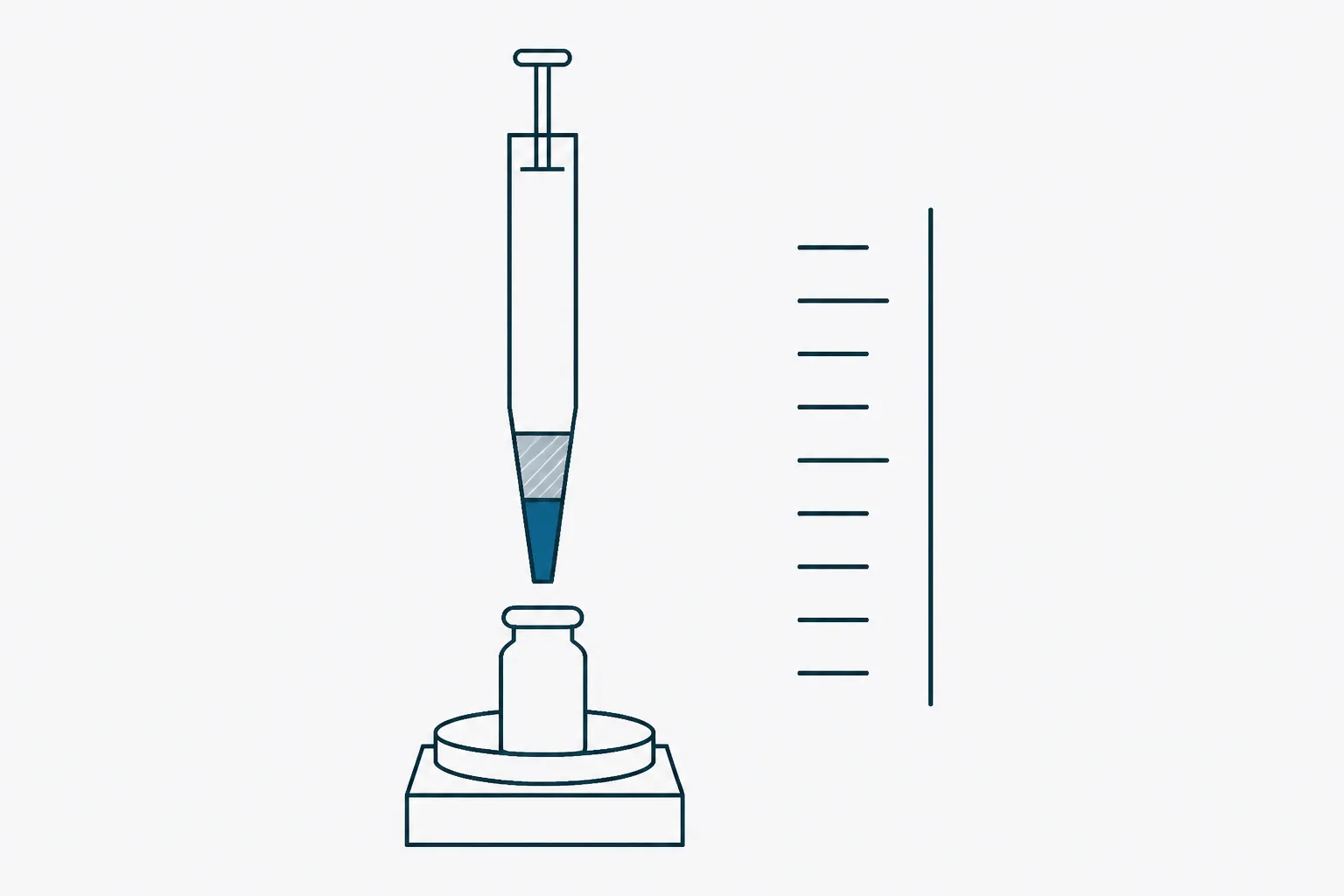
The reference method is gravimetric and is defined in detail in the volumetric-apparatus standard 2. It requires a balance with a resolution appropriate to the volume under test, distilled or deionised water, a receiving vessel with a narrow neck, and a room that is thermally settled. The procedure below is the working form of it.
- Equilibrate pipette, tips, water, receiving vessel and balance in the test room for at least two hours, and record air temperature, water temperature, barometric pressure and relative humidity.
- Select a balance whose readability is at least one order finer than the tolerance of the volume under test.
- Fit a tip and pre-wet it three to five times with the test water, discarding each delivery. The air cushion inside an unwetted tip is drier than the one inside a wetted tip, and the first delivery is measurably short.
- Place the receiving vessel on the pan, add a small volume of water to reduce evaporation from a dry surface, close the draught shield, and tare.
- Aspirate at a constant, controlled plunger speed with the tip immersed two to three millimetres below the surface and the pipette held vertical. Pause one second before withdrawing.
- Touch the tip against the vessel wall to remove the pendant drop, deliver against the wall to the first stop, wait one second, then depress to the second stop to blow out.
- Close the shield, wait for the stability indicator, and record the mass to full resolution.
- Repeat for ten deliveries at the nominal volume, then ten at ten per cent of nominal, and for a variable-volume instrument ten at fifty per cent as well.
- Convert each mass to a volume using the Z-factor for the recorded temperature and pressure, then compute the mean and the standard deviation for each set.
- Compare the mean against the accuracy tolerance and the standard deviation against the precision tolerance, and record both against the tolerance applied.
Evaporation is the dominant systematic threat in the whole procedure and it always biases low. Water leaves the receiving vessel between tare and reading, and at microlitre volumes the loss over a slow weighing is a real fraction of the delivery. A narrow-necked vessel, a small water reservoir already present, a closed shield and a short interval between delivery and reading are the standard controls; an evaporation trap or a lidded vessel is used at the smallest volumes. A published evaluation of gravimetric correction applied within a sample-preparation workflow found the correction improved precision materially, which is the same effect seen from the other direction 3.
The Z-factor and temperature correction
The Z-factor converts a mass in milligrams to a volume in microlitres. It bundles two physical corrections into one number: the density of water at the measured temperature, which falls as the water warms, and the buoyancy of the air the sample displaces, which depends on air density and therefore on barometric pressure and humidity 2. Volume equals mass multiplied by Z. Omitting the correction and treating one milligram as one microlitre introduces a bias of roughly a third of a per cent at ordinary room temperature, rising above half a per cent in a warm laboratory.
| Water temperature | Z-factor | Bias if Z is ignored |
|---|---|---|
| 15 °C | 1.0020 | 0.20 per cent low |
| 18 °C | 1.0025 | 0.25 per cent low |
| 20 °C | 1.0028 | 0.28 per cent low |
| 22 °C | 1.0033 | 0.33 per cent low |
| 25 °C | 1.0040 | 0.40 per cent low |
| 28 °C | 1.0048 | 0.48 per cent low |
| 30 °C | 1.0054 | 0.54 per cent low |
Two temperatures matter and they are not the same temperature. The water temperature sets its density; the air temperature and pressure set the buoyancy term. In a settled room they converge, which is why the standard asks for a two-hour equilibration rather than for two thermometers. A pipette taken from a cold store, or water drawn from a chilled reservoir, breaks the assumption and produces a temperature gradient inside the tip that changes the air cushion volume during the delivery itself.
The correction is also a reminder about what an air-displacement pipette actually does. It moves a column of air, and the liquid follows. The relationship between plunger travel and delivered volume depends on the density, viscosity, vapour pressure and surface tension of the liquid. Calibration with water certifies the instrument against water and against nothing else. A volatile solvent raises the vapour pressure inside the tip and delivers high; a viscous or dense liquid delivers low unless the technique is adjusted or a positive-displacement instrument is used 3.
Acceptance criteria by volume
Tolerances are set by the manufacturer for the specific instrument and by the standard for the class, and both are expressed as a maximum permissible systematic error and a maximum permissible random error at stated test volumes 1. The figures below are representative of single-channel air-displacement instruments and are given to show the shape of the relationship rather than to replace the specification supplied with the pipette. Note what happens in the second and third columns: the percentage tolerance widens sharply as the selected volume falls away from nominal, because the underlying mechanical error is roughly constant in microlitres.
| Nominal volume | Accuracy at nominal | Precision at nominal | Accuracy at 10 per cent of nominal |
|---|---|---|---|
| 2 µL | ±2.5 per cent | ≤1.5 per cent | ±12 per cent |
| 10 µL | ±1.0 per cent | ≤0.5 per cent | ±5 per cent |
| 20 µL | ±1.0 per cent | ≤0.4 per cent | ±4 per cent |
| 200 µL | ±0.6 per cent | ≤0.2 per cent | ±3 per cent |
| 1000 µL | ±0.6 per cent | ≤0.2 per cent | ±2 per cent |
| 5000 µL | ±0.5 per cent | ≤0.2 per cent | ±1.5 per cent |
The operational consequence is a selection rule. Choose the smallest pipette whose nominal volume covers the delivery, and avoid working below about a fifth of nominal wherever a smaller instrument exists. Delivering 15 microlitres from a 1000 microlitre pipette is inside the mechanical range and outside anything worth calling a measurement.
Frequency, and what calibration cannot fix
The common schedule sends every pipette away annually for service and adjustment. It is expensive, it removes instruments from the bench, and it produces no information about the eleven months in between. The alternative is to check often and service on evidence: a quick two-volume gravimetric check quarterly, or monthly on instruments in daily use, with a full ten-replicate check and external service triggered by a failure or by any drop, spill or seal replacement. Checking is cheap, needs only a balance already present, and generates a trend, which is what actually identifies a failing instrument before the results do.
| Trigger | Test performed | Response to a failure |
|---|---|---|
| Monthly, instruments in daily use | Four deliveries at nominal | Escalate to a full ten-replicate check |
| Quarterly, all instruments | Ten replicates at nominal and at 10 per cent | Quarantine, then service and adjust |
| After a drop, spill or autoclave cycle | Ten replicates at nominal | Quarantine until a passing check exists |
| After seal or piston replacement | Full check at three volumes | Do not return to service without it |
| Change of tip brand | Ten replicates at nominal | Requalify or revert to the original tip |
What no calibration reaches is technique, and technique is where most of the real error lives 4. A calibration certificate records the behaviour of the instrument in the hands of the person who tested it, under conditions that were controlled for the purpose. It does not transfer.
- Immersion depth. Too deep and liquid clings to the outside of the tip; too shallow and air is drawn in. Two to three millimetres is the working range.
- Plunger speed. A fast aspiration overshoots and leaves the meniscus unsettled; the effect scales with viscosity.
- Angle. Aspirating with the pipette tilted changes the hydrostatic head on the air cushion. Aspirate vertical, deliver at a shallow angle against the wall.
- Pre-wetting. An unwetted tip delivers short on its first use, by a margin that matters most at small volumes.
- Hand warmth. Gripping the barrel warms the air cushion and expands it, which pushes the delivery high over a long session.
- Blow-out timing. Releasing the plunger before the delivery has drained leaves liquid in the tip; blowing out into a submerged tip draws it back.
- Tip fit. A tip from another manufacturer changes the seal, the internal geometry and the air cushion, and voids the calibration outright.
The practical closing point is that a pipette check produces two numbers and both belong in the record with the conditions that produced them: temperature, pressure, tip brand, operator, and the tolerance applied. A bias recorded with its date can be applied retrospectively to work already done. A bias discovered a year later, with no intervening data, can only be used to decide which results to discard.
References
- ISO 8655-2:2022 Piston-operated volumetric apparatus — Part 2: Pipettes
- ISO 8655-6:2022 Piston-operated volumetric apparatus — Part 6: Gravimetric reference measurement procedure for the determination of volume
- Effect of gravimetric correction and type of pipettes used in sample preparation on the precision of LC-MS/MS-based analyses
- Assessing variations in manual pipetting: An under-investigated requirement of good laboratory practice