UV-Vis Spectrophotometer Qualification: USP <857> Tests
The instrument side behind every A280 and A214 result: wavelength accuracy with holmium oxide, photometric accuracy with potassium dichromate, stray light, resolution and spectral bandwidth, with reference materials, limits and the record for each test.
USP <857> qualifies a UV-Vis spectrophotometer by testing wavelength accuracy, photometric accuracy and linearity, stray light and resolution, each against a traceable reference material with a stated acceptance limit 12. The chapter prefers certified reference materials to laboratory-prepared solutions, and requires the tests to cover the operating ranges in use rather than the full range the instrument offers 3. The instrument is Group C under the general framework, so these tests are its operational qualification and, repeated on schedule, part of its performance qualification.
Every A280 and A214 concentration in a peptide laboratory rests on these tests. A wavelength error moves the reading along the absorption band; a photometric error scales every result; stray light flattens high absorbances. The limits below are those of the 2015 text (USP 38), which can be read in full; the chapter was revised in 2019 and again by proposal in 2021, and the current official text is paywalled 234. Where the revision changed a requirement, the change is noted. Check every limit against the current official chapter before writing it into a protocol.
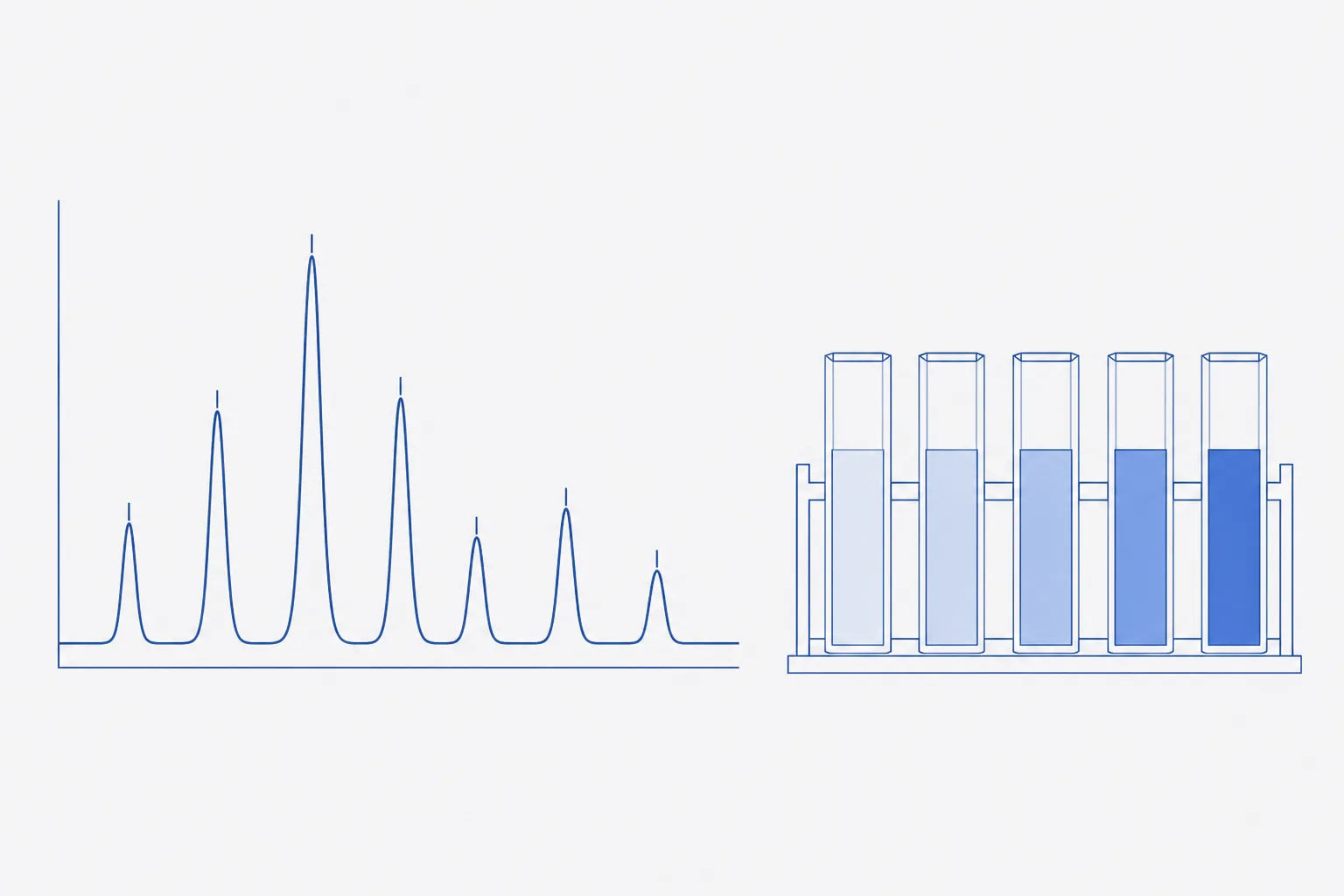
What USP <857> covers: wavelength, photometric, stray light, resolution
The chapter defines a UV-Vis spectrometer as an optical system producing monochromatic radiation in the range 200 to 780 nm and detecting transmittance, usually expressed as absorbance 1. Its job is to measure absorbance at defined wavelengths, so what is qualified is how well it places the wavelength, how correctly it reads the absorbance, how much unwanted light reaches the detector, and how finely it resolves a narrow band.
| Parameter | Reference material | Wavelengths | Acceptance limit | Replicates |
|---|---|---|---|---|
| Wavelength accuracy | Holmium oxide solution (4% m/v in perchloric acid), holmium glass, or lamp emission lines | Bands across 241 to 640 nm; Hg and D2 lines | Within ±1 nm of certified value in the UV (200 to 400 nm); ±2 nm in the visible (400 to 700 nm) | At least 6 on non-diode-array instruments; 1 on diode-array |
| Wavelength precision | As above | As above | Standard deviation not more than 0.5 nm | At least 6 |
| Absorbance accuracy | Potassium dichromate in 0.001 M perchloric acid; neutral-density glass filters | 235, 257, 313, 350 nm; 440 to 635 nm for filters | Dichromate: larger of ±1% of A above 1.0 A or ±0.010 A below 1.0 A. Filters: larger of ±0.8% or ±0.008 A | At least 6, at two or more absorbance levels |
| Absorbance precision | As above | As above | Standard deviation not more than the larger of 0.5% of A above 1.0 A or 0.005 A below | At least 6 |
| Stray light | Potassium chloride, sodium iodide, acetone, sodium nitrite | 190 to 385 nm, by region | Stray-light fraction S not more than 0.01 by the filter-ratio method | Per region |
| Resolution | Toluene 0.020% v/v in hexane, against hexane | 269 nm and 266 nm | Absorbance ratio not less than 1.3 at 2 nm bandwidth | As required |
The 2015 chapter sets no criterion for photometric noise and none for a qualification interval; it describes performance qualification as ongoing and says reference materials should be recertified periodically 2. The 2019 revision, as reported by a reference-material supplier, made absorbance linearity a requirement at the analytical wavelengths, with at least three absorbance levels spanning the range, and extended dichromate use to 430 nm 3. The 2021 proposal removed the separate photometric-response section and relabelled cells as cuvettes 4.
Wavelength accuracy and precision with holmium oxide
Holmium oxide in acidic solution gives a set of narrow absorption bands whose minima of transmittance are fixed properties of the solution. A NIST study certified the band positions of a solution of holmium oxide in dilute perchloric acid as intrinsic wavelength standards, so the band locations do not depend on the instrument that measured them 5. The corresponding NIST reference material is certified for 14 bands between 240 and 650 nm and for several spectral bandwidths, and retained samples from thirty years of production showed band positions unchanged within their uncertainties 6.
| Region | Band positions, nm |
|---|---|
| Ultraviolet | 241.1, 249.9, 278.1, 287.2, 333.5, 345.4, 361.3, 385.6 |
| Visible | 416.3, 451.4, 467.8, 485.2, 536.6, 640.5 |
Two practical limits. First, holmium has no bands below about 240 nm, so it does not test the wavelength scale at 214 nm; the 2020 review names cerium oxide down to 201 nm and certified materials down to 191 nm as options for the far UV, and says qualification should bracket the analytical wavelength 3. Second, the certified positions apply at the bandwidth stated on the certificate; the measured minimum moves with bandwidth, and a test run at 2 nm against a value certified at 1 nm will not agree for the right reasons.
- Warm up the instrument as the manual specifies and set the bandwidth to the certificate's bandwidth.
- Scan the holmium cuvette over the band region against air or the matching blank.
- Read the wavelength of each transmittance minimum (absorbance maximum).
- Repeat for six scans on a scanning single-beam or double-beam instrument; one scan on a diode-array instrument.
- Calculate the mean and the difference from the certified value for each band; calculate the standard deviation.
- Compare with the limits: ±1 nm in the UV, ±2 nm in the visible, standard deviation not more than 0.5 nm.
Photometric accuracy and linearity with potassium dichromate
Acidic potassium dichromate is the classical absorbance standard for the UV: its absorptivity at 235, 257, 313 and 350 nm is certified, and solutions covering 0 to 200 mg·L⁻¹ in 0.001 M perchloric acid give absorbances up to about 3 A 2. The test compares measured with certified absorbance at two or more levels, with six replicates at each. The tolerance is the larger of a relative and an absolute figure: below 1.0 A the absolute figure of ±0.010 A governs; above, ±1% of the absorbance 2. A reference-material supplier's summary of the 2019 text adds that the total tolerance for a certified-material check is the certificate uncertainty plus the manufacturer's stated accuracy, and that the result must also lie inside any limit set by the monograph or method 3.
| Level | Certified A | Tolerance | Acceptable range | Mean of 6 | Result |
|---|---|---|---|---|---|
| Low | 0.745 | ±0.010 A (absolute figure governs below 1.0 A) | 0.735 to 0.755 | 0.748 | Pass |
| High | 1.502 | ±1% of A = ±0.015 A | 1.487 to 1.517 | 1.526 | Fail |
The failing high level means the photometric scale reads high at high absorbance: investigate stray light, bandwidth, cuvette matching and solution preparation before touching the instrument. Prepare dichromate solutions with a balance and volumetric glassware that are themselves in calibration; the standard is traceable only if the preparation is. Linearity follows from the same data: a series of at least three levels at each analytical wavelength should reproduce certified values within the tolerance, and a loss of proportionality at the top of the range is the usual signature of stray light.
Stray light: potassium chloride, iodide and the filter-ratio method
Stray light is radiation reaching the detector at wavelengths outside the selected band. It matters most where the lamp is weakest and the sample absorbs most, which is the far UV. The test uses a solution that absorbs completely below its cut-off wavelength, so that any signal measured there is stray light. The chapter matches the solution to the region 2.
| Region, nm | Solution |
|---|---|
| 190 to 205 | Potassium chloride, 12 g·L⁻¹ in water |
| 210 to 259 | Sodium iodide or potassium iodide, 10 g·L⁻¹ in water |
| 250 to 320 | Acetone |
| 300 to 385 | Sodium nitrite, 50 g·L⁻¹ in water |
The filter-ratio method measures a 10 mm cuvette of the solution against a 5 mm cuvette of the same solution over the required range. The stray-light fraction is S = 0.25 × 10^(−2A), where A is the maximum observed absorbance, and the limit is S not more than 0.01, which corresponds to a maximum of at least 0.7 A 2. The 2019 text describes the same measurement as Procedure A, with 0.7 A differential corresponding to a 2.0 A limit in the alternative Procedure B, which measures the cut-off solution against its reference and takes the wavelength at which absorbance exceeds 2 A as the cut-off 3. Stray light is now recommended as part of performance qualification and is tested between 190 and 400 nm 3.
Resolution with toluene in hexane
A solution of 0.020% v/v toluene in UV-grade hexane, measured against hexane, has an absorbance maximum near 269 nm and a minimum near 266 nm. The ratio of the maximum to the minimum falls as the bandwidth widens and the two features merge. At a spectral bandwidth of 2 nm the ratio must be not less than 1.3; the chapter tabulates expected ratios against bandwidth and temperature, for example 1.3 to 1.4 at 2.0 ± 0.2 nm and 20 ± 1 °C 2. Two nanometres is described as sufficient for most compendial quantitative work.
Spectral bandwidth and why certified values depend on it
The bandwidth is a method parameter, and it must be small enough for the band being measured. For compounds with narrow natural bands the chapter requires a spectral bandwidth of not more than one eighth of the natural half-bandwidth 2. A peptide measured at 280 nm has a broad band and tolerates a wide slit; a sharp feature does not. Certified holmium positions and dichromate absorbances are tabulated at stated bandwidths, so qualify at the bandwidth the method uses. Where the bandwidth cannot be selected, an atomic emission line scanned in single-beam mode gives the bandwidth directly as the peak width at half height 2.
Frequency, reference-material recertification and trending
The chapter gives no fixed interval 2. Set one in the PQ plan from the instrument's history and the risk: annual full OQ with more frequent checks of wavelength and absorbance is common practice, and a repair, lamp change or move triggers a repeat of the affected tests. Reference materials have their own clock. Holmium solutions sealed in fused silica are stable for years; the NIST thirty-year study supports a long life for the sealed solution, but the certificate and the supplier's recertification interval govern use 6. Dichromate solutions made in the laboratory are fresh preparations, and glass filters are recertified periodically.
Trend the results. A wavelength offset that rises by 0.1 nm each quarter, still inside ±1 nm, is information about a failing lamp or a mechanical wear, and a control chart on the offset shows it before a limit does.
Recording a qualification run
| Test | Record |
|---|---|
| All tests | Instrument identifier and serial number; software version; date; operator; bandwidth; cuvette type, path length and identifier; temperature if the test depends on it |
| Wavelength | Reference material, certificate number and expiry; certified and measured positions for each band; replicate values; mean, difference, standard deviation; limit; pass or fail |
| Absorbance | Reference material, lot, certified absorbance; preparation record (mass, volume, balance and glassware identifiers); readings for each level and replicate; difference and tolerance; pass or fail |
| Stray light | Solution, concentration, cuvette lengths; maximum absorbance and wavelength; calculated S; limit; pass or fail |
| Resolution | Toluene solution preparation; absorbances at about 269 nm and 266 nm; ratio; bandwidth; limit; pass or fail |
| Summary | Overall outcome; deviations and actions; next due date; reviewer |
Test sequence
- Confirm the URS: wavelength range, bandwidth and absorbance range the methods use.
- Check that reference materials are in date and their certificates cover those wavelengths and the bandwidth in use.
- Warm up the instrument, record the identity, software version and lamp hours.
- Test wavelength accuracy and precision at bands bracketing the analytical wavelengths.
- Test absorbance accuracy and precision at two or more levels, including one near the highest absorbance used.
- Test stray light in the region of the analytical wavelengths.
- Test resolution at the bandwidth used.
- Evaluate each result against its limit; investigate any failure before releasing the instrument.
- Label the instrument with the date and the next due date, and file the report in the qualification file.
References
- <857> Ultraviolet-Visible Spectroscopy
- General Chapter <857> Ultraviolet-Visible Spectroscopy (USP 38-NF 33 S2 text, mirror)
- Is Your Spectrophotometer Still 'Pharma Compliant'? A Review of the Latest USP Chapter
- Revision of USP <857> Ultraviolet-Visible Spectroscopy and <1857> Ultraviolet-Visible Spectroscopy - Theory and Practice
- Intrinsic Wavelength Standard Absorption Bands in Holmium Oxide Solution for UV/Visible Molecular Absorption Spectrophotometry
- Thirty-year Stability of Standard Reference Material 2034 Holmium Oxide Solution Wavelength Standard for Spectrophotometry (NIST Special Publication 260-192)